
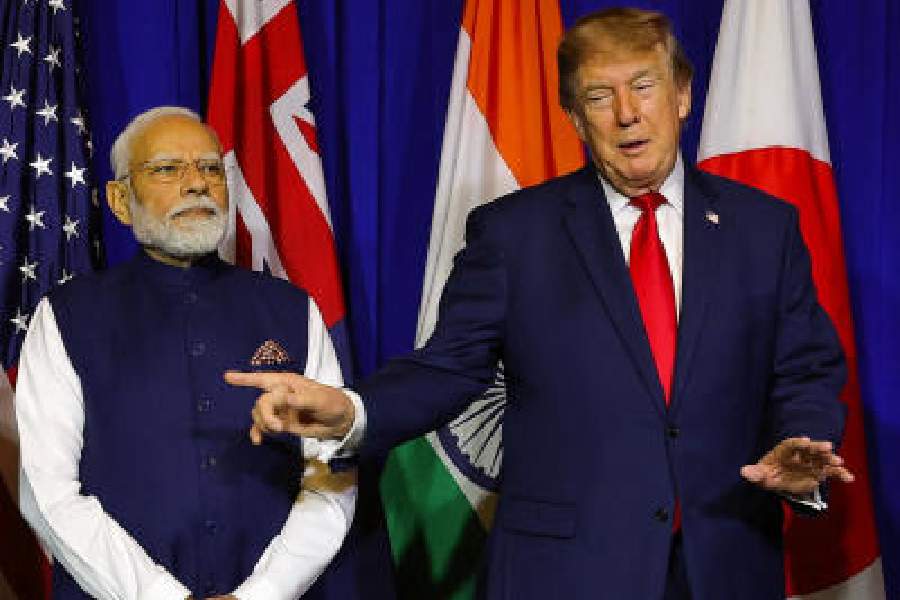
Narendra Modi met leaders of the Association of Southeast Asian Nations in Manila on Tuesday to discuss peace and stability. During the Quad meeting at the Solaire Hotel, Donald Trump said the group wants to develop critical minerals supply chains. India must now strengthen regional ties to ensure its autonomy.
Narendra Modi and Donald Trump at the Quad meeting at the Solaire Hotel in Paranaque, Philippines, on Tuesday. Reuters
Narendra Modi's call for peace, stability and predictability in the world during his meeting on Tuesday with leaders of the Association of Southeast Asian Nations (ASEAN) in Manila echoes a sentiment shared widely across the globe. Yet translating that desire into reality represents a mounting challenge at a time when violating international law and ignoring traditional partnerships are increasingly becoming the norm. Apart from the summit with ASEAN leaders, the prime minister juggled multiple bilateral meetings with other nations and also attended a meeting with the president of the United States of America, Donald Trump, the Japanese prime minister, Sanae Takaichi, and the Australian prime minister, Anthony Albanese, in the Philippines. Mr Trump announced progress in the attempts of the Quad countries -- India, the US, Japan and Australia -- to develop their own critical minerals supply chains, which could insulate them from dependence on China that controls the bulk of these precious minerals vital to modern technology. However, India cannot take for granted the US's support in balancing China's aggressive claims in the Indo-Pacific region. After all, Mr Trump's fleeting visit to Manila -- he reached almost at the end of the ASEAN meetings -- was effectively a pit stop on his way to a much more important conclave in China. Mr Trump's planned meeting with the Chinese president, Xi Jinping, and a trilateral scheduled in Shenzhen that will include the Russian president, Vladimir Putin, are the main course of the US president's visit to Asia.
That the US prioritises big-power summits over the collective concerns of Southeast Asia and its extended neighbourhood, including India, should no longer come as a surprise. This goes to underscore why India's Act East Policy needs to step up a gear. In Manila, Mr Modi proposed e-visas to visitors from ASEAN nations. That positive step must be built upon. New Delhi has rightly increased military collaboration with Southeast Asian nations, including the planned export of BrahMos missiles to Vietnam, the Philippines and Indonesia. This, however, does not mean that India should give up on the Quad or on the role the US can play in the Indo-Pacific. But the past few months have shown that ultimately India must count on its own bilateral and multilateral ties with other regional nations to accomplish the goals of securing peace, stability and predictability laid out by Mr Modi.