
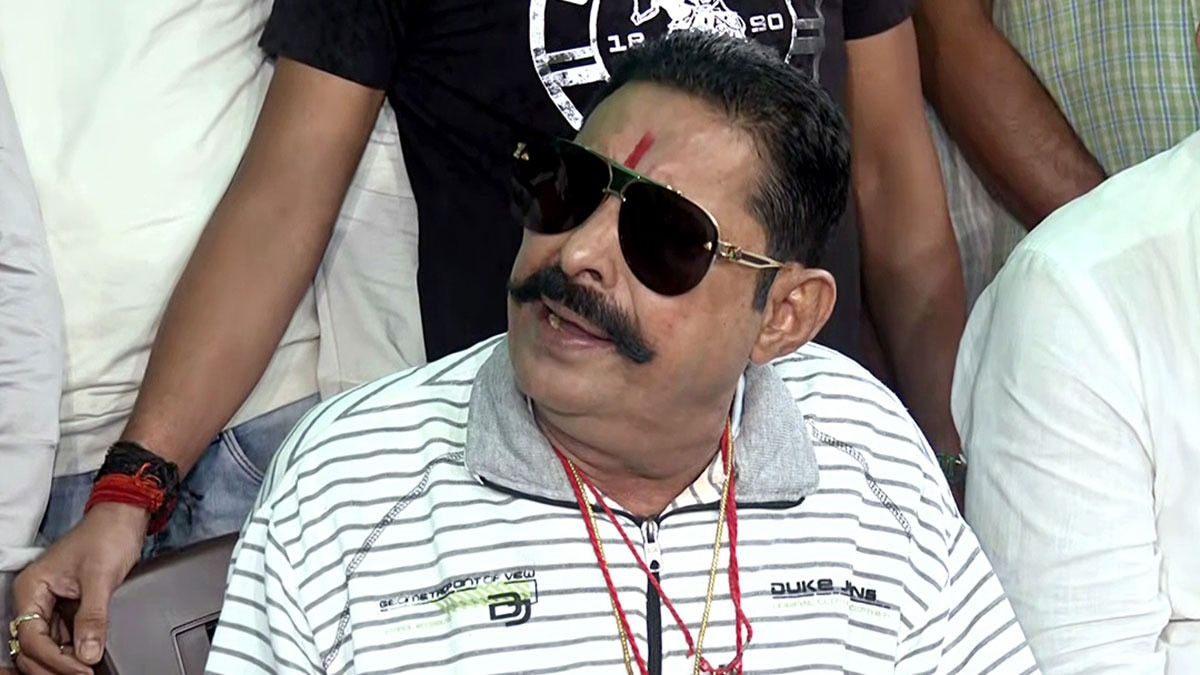
Mokama MLA Anant Kumar Singh has seven days to explain why he should not face disqualification. On November 2, the assembly secretariat issued a notice after the JD(U) accused him of campaigning for a rival. Singh, who won in 2025, now faces both this legal challenge and a surrender order.
Anant Kumar Singh has seven days to defend his Bihar legislative assembly membership. On November 2, the assembly secretariat issued the Mokama MLA a notice, asking him to explain why he should not be disqualified under the anti-defection law.
The notice follows a petition by the Janata Dal (United), which has accused Singh of voluntarily giving up his membership of the party by campaigning for a rival candidate in the recent Patna Graduates’ constituency election to the Bihar legislative council.
The proceedings have opened a constitutional battle over a politician who has repeatedly demonstrated that his electoral fortunes in Mokama are not necessarily tied to any party symbol.
The JD(U), which expelled Singh and his wife Neelam Devi for six years on October 24, is seeking to end his tenure as an MLA through the 10th Schedule of the Constitution. Singh’s response to the notice could determine whether he retains the seat he won in 2025 by a margin of 28,206 votes.
The legal challenge comes amidst another setback. On October 30, the Supreme Court set aside the bail granted to Singh in the Dularchand Yadav murder case and directed him to surrender by December 1. Singh is an accused in the case arising from the death of Yadav during the 2025 Bihar assembly election campaign. He has denied the allegations.
The criminal proceedings and the assembly’s anti-defection inquiry are separate, but together they have placed the Mokama MLA under considerable legal pressure.
The anti-defection case stems from Singh’s decision to campaign for Jan Suraaj candidate Anuj Kumar Singh against the JD(U)’s official nominee and sitting MLC Neeraj Kumar. The JD(U) says Singh repeatedly defied instructions, campaigned for another party’s candidate and made derogatory remarks against senior leaders. Its state president, Umesh Singh Kushwaha, submitted a complaint to legislative assembly speaker Prem Kumar, accompanied by documentary and video ‘evidence’.
The constitutional question is whether Singh’s conduct amounts to voluntarily giving up membership of the party under Paragraph 2(1)(a) of the 10th Schedule. The distinction is crucial: expulsion does not automatically disqualify an MLA, and campaigning against a party nominee does not, by itself, settle the question of defection.
For two decades, Mokama has remained in the grip of Singh and his family. Singh first won the seat in the February 2005 assembly election on a JD(U) ticket. He retained it in the October 2005 poll and won again in 2010, still with the JD(U). In 2015, after falling out with Nitish Kumar over the party’s alliance with the Rashtriya Janata Dal (RJD), he contested as an Independent and defeated the official JD(U) candidate, Neeraj Kumar.
In 2020, Singh switched to the RJD and won once more. When his conviction in an arms case led to his disqualification in 2022, wife Neelam Devi contested the by-election on the RJD ticket and retained the seat for the family. In 2025, back with the JD(U), Singh won again, despite contesting from jail.
That makes seven successive electoral victories for the family: six for Singh and one for his wife. No other candidate has won Mokama since February 2005. The man popularly known as “Chhote Sarkar” has demonstrated that, in this constituency, the political identity of the candidate has often mattered more than the party symbol.
THE LEGAL POSITION
Expulsion from a political party does not, by itself, cost an MLA his seat. Disqualification under the anti-defection law is governed by Article 191(2) of the Constitution, read with Paragraph 2 of the 10th Schedule, introduced through the 52nd Constitutional Amendment in 1985.
The Schedule provides two principal grounds on which a member elected on a political party’s ticket may be disqualified:
If the member voluntarily gives up membership of the political party on whose ticket he was elected; or
If the member votes or abstains from voting in the House contrary to a direction issued by the party, without prior permission, and the party does not condone the act within 15 days.
The JD(U)’s case rests on the first ground: that Singh’s conduct amounts to voluntarily giving up membership of the party.
The Supreme Court has held that the expression “voluntarily giving up membership” is wider than a formal resignation. In Ravi S. Naik v. Union of India (1994), the court ruled that a member’s conduct can demonstrate that he has abandoned his political party. Publicly supporting a rival candidate, campaigning against the party’s official nominee and making sustained attacks on the leadership may therefore be considered as evidence. But none of these acts, taken in isolation, automatically establishes defection. The assembly speaker must examine the totality of the conduct and the evidence before reaching a reasoned conclusion.
Another important judgment is G. Viswanathan v. Speaker, Tamil Nadu Legislative Assembly (1996). The Supreme Court held that an expelled member continues to be treated as belonging to the political party that set him up for election for the purposes of the 10th Schedule. In other words, expulsion by the party does not provide an escape from the anti-defection provisions.
The speaker must give Singh a fair opportunity to respond before deciding the petition. The seven-day notice is part of that process. The speaker will have to examine the JD(U)’s evidence, Singh’s explanation and the circumstances surrounding his support for the Jan Suraaj candidate.
The decision will not be beyond judicial scrutiny. In Kihoto Hollohan v. Zachillhu (1992), the Supreme Court upheld the speaker’s role as the adjudicating authority under the 10th Schedule while making clear that the decision is subject to judicial review on grounds including constitutional violation, jurisdictional error, breach of natural justice, mala fides and perversity. If the speaker disqualifies Singh, he will cease to be an MLA and the Mokama seat will fall vacant. The decision could, however, be challenged before a constitutional court.
THE IRONY
A day after his expulsion, Singh told reporters he had “no regrets”. He declared that the JD(U) belonged to Nitish and that with the latter no longer in an active role, the party was “finished”. He predicted that it would struggle to win even 10-12 seats in the next assembly election and said he would form his own party rather than join another. He maintained his personal relationship with Nitish remained intact.
Earlier, Singh had spoken of stepping back from electoral politics and allowing his son to contest from Mokama. Following his expulsion, he has indicated that he may reconsider and contest again if the pressure continues.
The irony is difficult to miss. The same party that gave him a ticket in 2005, watched him defeat its candidate as an Independent in 2015, took him back and fielded him again in 2025 while he was in jail is now seeking his disqualification for supporting another party’s nominee in a council election.
Mokama’s voters have repeatedly returned Singh or a member of his family to the assembly. The present proceedings raise a different question: can the anti-defection law bring to an end a political hold that rival candidates and changes of party affiliation have failed to break?
For the JD(U), the episode tests its willingness to act against a powerful local leader who has repeatedly demonstrated political independence. The party waited until the Patna Graduates’ constituency election was over before initiating action. Now the matter rests with the speaker.
If the speaker concludes that Singh’s campaign for the Jan Suraaj candidate and his public attacks on the party leadership establish that he voluntarily gave up JD(U) membership, the Mokama seat will fall vacant. If the Speaker takes a narrower view, Singh may retain his assembly membership despite having been expelled from the party. Either way, the proceedings have placed a remarkable political career at the intersection of personal loyalty, party discipline and constitutional law.