
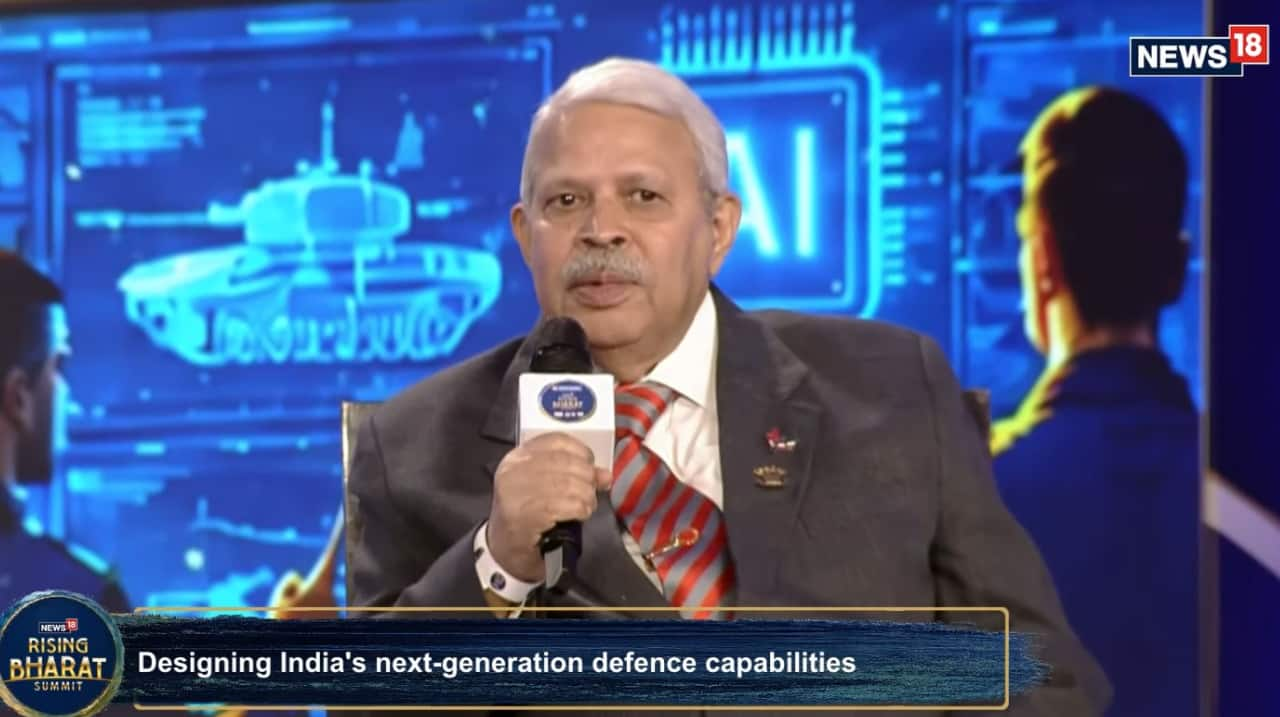
Demand for drones has risen after Operation Sindoor, Major General R C Padhi (Retd) said at the Rising Bharat Summit in Lucknow. He noted that the company now makes thousands of units. “The future battlefield is going to be dominated by autonomous weapons systems,” he said, highlighting India’s growing manufacturing capacity.
Demand for drones has increased following Operation Sindoor, with future battlefields expected to be increasingly dominated by autonomous weapons systems, Major General R C Padhi (Retd), Senior Vice President (R&D) at IG Defence and IG Drones, said at the Network18 Rising Bharat Summit – North Edition in Lucknow.
Speaking during a session titled Design, Develop, Defend: India’s Next Manufacturing Frontier, Major General Padhi said the company had expanded its drone manufacturing capacity and was currently producing thousands of units, with ambitions to scale up production significantly.
“Post Operation Sindoor, the demand for drones has increased. The future battlefield is going to be dominated by autonomous weapons systems. We have increased our capacity of manufacturing drones. Now we are manufacturing in thousands, but our ambition is for millions,” he said.
Major General Padhi stated that 95% of the components used by the company were manufactured and developed in India. He added that demand from overseas markets was also picking up, with Gulf countries that earlier sourced drones from the US now approaching Indian manufacturers.
“These drones are indigenously designed and manufactured,” he said, referring to the company's products.
He also stressed the need for greater collaboration between industry, the Defence Research and Development Organisation (DRDO), defence public sector undertakings (PSUs) and academia to strengthen India's defence manufacturing ecosystem. “A lot of progress has been made in the last few years. We have been signing MoUs with the PSUs. If we put all our human intellectual resources together, money is never a problem,” he said, highlighting the importance of pooling expertise and resources to accelerate indigenous defence development.
The discussion also highlighted developments in India's defence manufacturing ecosystem, including indigenous platforms and technologies.
Satish Bharathan, vice-president, Land Platforms, Equipment and Systems Business Unit at Larsen & Toubro's Precision Engineering & Systems IC, said the company had submitted its competitive bid for the Advanced Medium Combat Aircraft (AMCA) programme and was awaiting the announcement of the winners.
On the Zorawar light tank, Bharathan said user trials would continue for 9-12 months, during which the requirements specified by the customer would need to be met. He said the Defence Research and Development Organisation (DRDO), the user and L&T were discussing certain technical trade-offs.
“I am hopeful, all going well, by 2029, the Zorawar could be in production,” he said.
Jyoti Vashishtha Sinha, co-founder and chief technology officer of Omnipresent Robot Technologies, stressed the need for India to build capabilities in surveillance, imagery and space technologies. She also highlighted the importance of domestic semiconductor manufacturing, saying chips could be used against the country during a conflict.
Sinha said the company's software to reduce bird strikes was in beta testing at one of the air bases and could eventually be deployed across all air bases.