
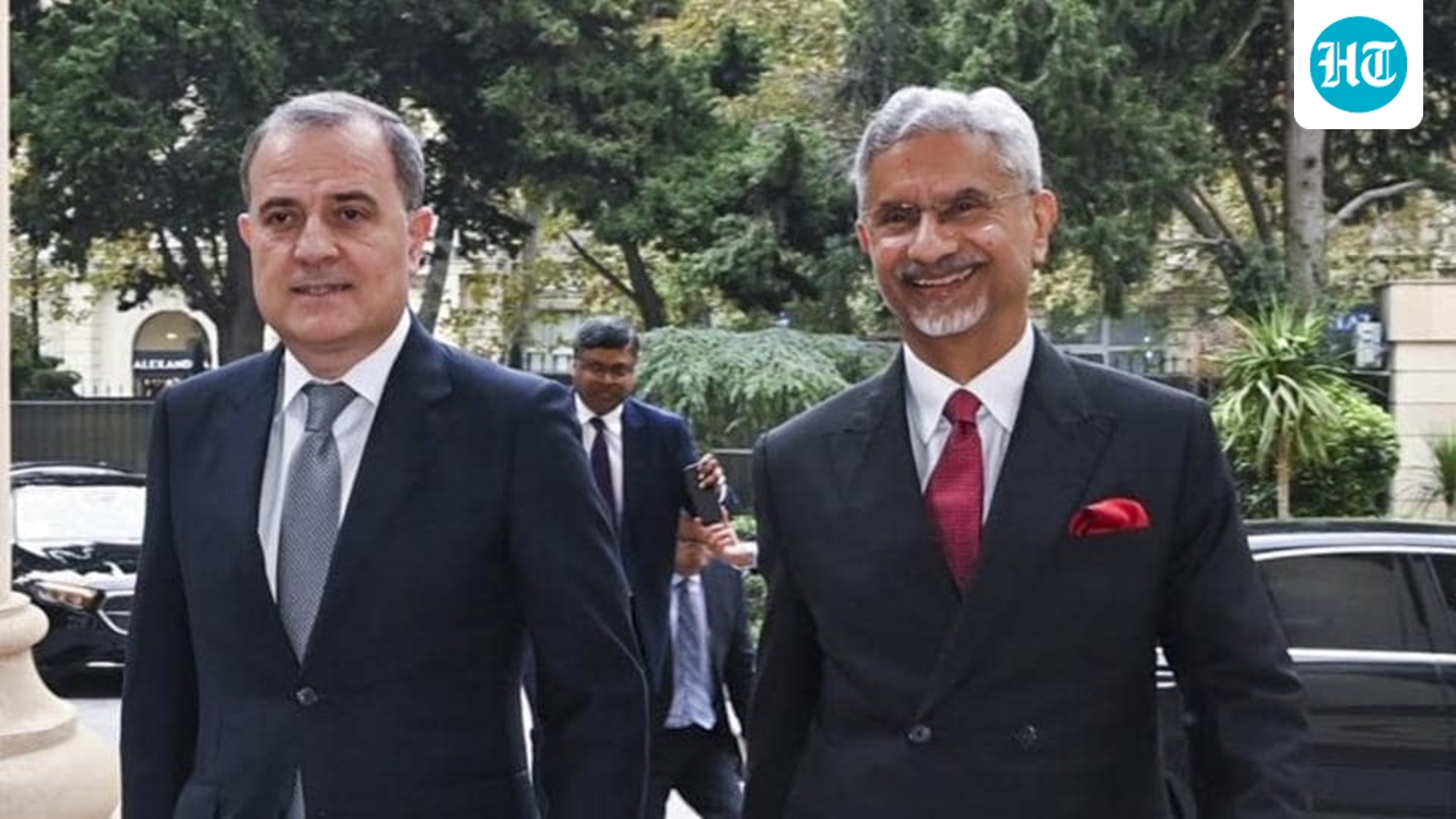
External affairs minister S. Jaishankar visited Baku on October 23, 2026, to reset ties with Azerbaijan. The visit aimed to move past recent friction and build stronger economic links. Azerbaijani foreign minister Jeyhun Bayramov said the two countries had "different viewpoints on different issues" while both sides sought deeper future cooperation.
External affairs minister S. Jaishankar's visit to Baku on October 23, 2026 is more than a routine diplomatic engagement. It represents a carefully calibrated attempt by New Delhi to reset a relationship that had drifted into quiet awkwardness. Without public recrimination, without dramatic gestures, and without abandoning core strategic interests, this seems a well-articulated attempt to get over that awkwardness in bilateral relations. In the often theatrical world of international diplomacy, the visit stands out for its restraint and deliberate pragmatism.
For more than a year, India-Azerbaijan relations had carried an undercurrent of friction. Baku's sharp criticism of India's Operation Sindoor in May 2025, its open expressions of solidarity with Pakistan, and the steady institutionalisation of the Türkiye-Azerbaijan-Pakistan trilateral format sat uneasily with New Delhi. India's growing defence partnership with Armenia, including the supply of military equipment, added another layer of discomfort in Baku. High-level political contact had thinned noticeably. Against this backdrop, a standalone bilateral visit by India's foreign minister, the first in eight years since the late Sushma Swaraj travelled to Azerbaijan in 2018, carried unmistakable signalling value. It indicated that both sides had decided the costs of continued drift outweighed the difficulties of managed engagement.
What stood out most was the tone of pragmatic restraint. Both sides acknowledged past differences without allowing them to dominate the conversation. Azerbaijani foreign minister Jeyhun Bayramov's public admission that the two countries had held "different viewpoints on different issues" was unusually candid for a joint appearance. Jaishankar, for his part, consistently used a forward-looking language highlighting pathway, deeper consultations, expanded economic activity, connectivity, and people-to-people ties. By framing terrorism, conflict, and instability as common threats, he registered India's core security concerns without turning the meeting into a lecture. The discussion of the August 2025 Armenia-Azerbaijan peace agreement further allowed India to reiterate its longstanding preference for dialogue and diplomacy while remaining neutral on the substance of the dispute.
The substance of the talks reveals India's evolving strategic priorities in the South Caucasus and the broader Eurasian space. Energy remains the foundational pillar of the relationship. ONGC Videsh's existing investments in Azerbaijan's oil fields and the Baku-Tbilisi-Ceyhan pipeline give India a tangible economic stake. Both sides spoke of deepening this partnership and exploring new areas of collaboration. For energy-importing India, Azerbaijan offers diversification. For Azerbaijan, Indian investment and technology provide options beyond traditional partners.
Connectivity featured equally prominently. Closer coordination on the International North-South Transport Corridor (INSTC) offers India a multimodal route that links it more effectively to Central Asia, Russia, and Europe via the Caspian, partially reducing dependence on traditional maritime chokepoints. Azerbaijan's own East-West corridors, the Baku-Tbilisi-Kars railway, the Port of Baku, and the Alat Free Economic Zone were also discussed as potential points of synergy. Stronger air connectivity and tourism was also discussed. India was already among Azerbaijan's top sources of visitors. It received attention as ways to broaden the relationship beyond government-to-government channels. Trade, though still modest at around $400 million in 2025 (with higher figures reported for parts of 2026), was identified as an area with clear upside potential, particularly in pharmaceuticals, agriculture, information technology, and manufacturing. The presence of more than 1,000 Indian companies in Azerbaijan provides a ready base for expansion.
Yet the reset has clear and important limits. Azerbaijan's strategic closeness to Pakistan and Türkiye is structural rather than tactical. It is rooted in shared Turkic identity, defence cooperation, and geopolitical alignment that will not disappear because of one productive visit. India's defence relationship with Armenia is equally unlikely to be rolled back; it serves New Delhi's interest in maintaining balanced engagement across the South Caucasus. The Armenia-Azerbaijan peace process remains fragile, and residual sensitivities over Nagorno-Karabakh and related issues will continue to shape regional dynamics. Political trust, once eroded, takes time and consistent delivery to rebuild. A single set of meetings, however positive, does not dissolve accumulated suspicion or divergent threat perceptions.
The larger significance of the visit lies in what it reveals about India's approach to the Eurasian heartland. New Delhi is no longer content with a binary choice between partners who align closely with its positions and those who do not. Instead, it is practising selective, interest-driven engagement -- protecting core concerns such as terrorism and connectivity while keeping channels open with countries that sit at the intersection of multiple geopolitical currents. Azerbaijan, as a Caspian energy producer, a transport node linking East and West as well as North and South, and a participant in several overlapping regional formats, fits this logic well. For Baku, deeper engagement with India offers economic diversification and a degree of strategic autonomy from over-reliance on any single partnership.
Jaishankar's visit, therefore, represents a quiet but deliberate recalibration. It signals that India is prepared to manage differences rather than allow them to freeze relationships indefinitely. It demonstrates that economic and connectivity interests can coexist with unresolved political irritants. And it affirms that New Delhi intends to remain an active player in the South Caucasus rather than a distant observer. Whether this newly charted pathway leads to a more substantive and resilient partnership will depend on sustained follow-through -- on concrete energy and infrastructure projects, trade facilitation measures, increased air links, and regular political dialogue at multiple levels.
In the complex and often zero-sum geometry of Eurasian diplomacy, the ability to keep difficult relationships functional is itself a form of strategic success. Jaishankar's Baku visit has arrested the drift, restored a measure of normalcy, and created space for practical cooperation. That is not dramatic, but it is meaningful. In contemporary international relations, quiet, pragmatic progress of this kind is often more durable than high-profile declarations that later prove difficult to implement.