
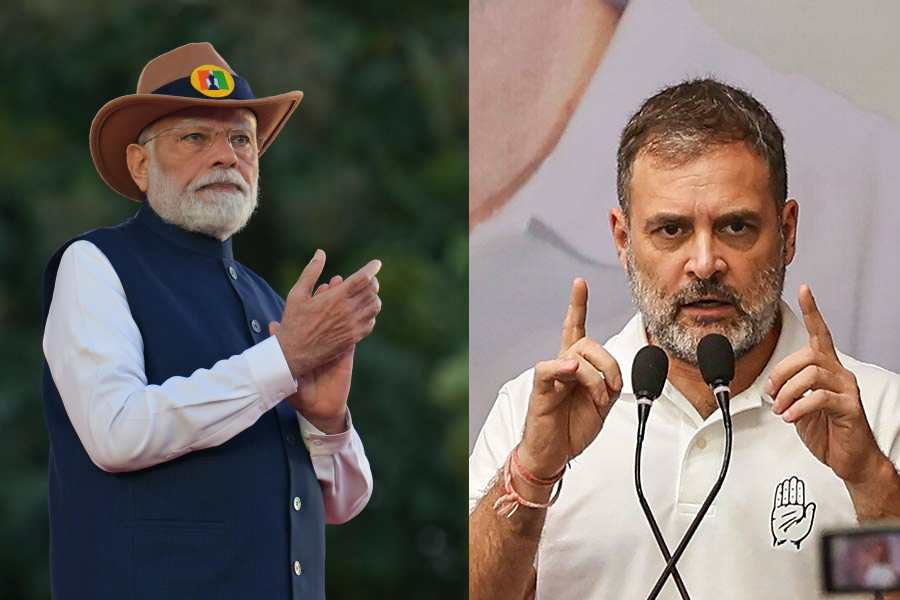
Rahul Gandhi on Friday called Prime Minister Narendra Modi’s FICCI address his own confession of policy failure. Gandhi said, "Monopoly doesn't create jobs." He blamed demonetization and GST for hurting small traders. He also argued that handing over key sectors to big companies destroyed fair competition and left many unemployed.
Referring to Modi's 'they're so hungry they can't even fill their stomachs' remark, Gandhi said in a post on X, 'The whole country knows whose hunger this is. Airports, ports, mines, forests, electricity, coal, roads -- all handed over to them. How many jobs did they create?'
Congress leader Rahul Gandhi on Friday turned Prime Minister Narendra Modi's questions to industry leaders about pay and hiring back on the government, calling the remarks Modi's "own confession" of policy failure.
Referring to Modi's remark about industry's appetite for concessions at the FICCI annual general meeting on Thursday, Gandhi said in a post on X, "The whole country knows whose hunger this is. Airports, ports, mines, forests, electricity, coal, roads -- all handed over to them. How many jobs did they create?"
The leader of the Opposition in the Lok Sabha also blamed "demonetization and a flawed GST" for what he described as the destruction of small traders and job-creating micro, small and medium enterprises.
"And for the big companies that competed honestly, you wiped out the playing field altogether," Gandhi said, arguing that the government's policies had fostered monopolies and undermined fair competition. "Monopoly doesn't create jobs. It drives up prices and eliminates competition."
"'You do it, we'll see?' Modi ji, you and your friends carried out the looting - the country saw it, and is still seeing it," he said.
Gandhi also took aim at Modi's remark that he did not expect the audience to applaud.
"Your policies left no one worth applauding - not industrialists, not small traders, not the poor and middle class struggling with inflation, not unemployed young people. Get your applause and your thali-banging from whatever 'bhakts' you have left," he said.
Modi had said his government had taken several steps to improve the business environment, including introducing a 22 per cent corporate tax rate for eligible domestic companies that opt for it, simplifying tax return and refund processes and lowering GST rates on several products.
He cited personal income tax relief on earnings up to Rs 12 lakh under the new tax regime and told industry leaders their appetite for concessions seemed insatiable.
"Did you increase the salaries of your employees? Did you increase the number of employees? No," Modi said, according to the Prime Minister's Office's English rendering of the speech.
CPI(M) general secretary M A Baby also criticised the speech, calling it a "remarkable admission of the abject failure of the government's economic policies over the past 12 years", PTI reported.
"He has conceded that wages have not risen and unemployment remains unaddressed despite slashing corporate taxes to a record low and showering concessions on big business," he said.
The Left leader argued that the prime minister's words exposed the hollowness of "Aatmanirbhar Bharat" and that he had "confessed that India has made no progress in becoming self-reliant".
"In fact, the share of manufacturing in India's GDP is now lower than when he launched 'Make in India' with much fanfare in 2014," Baby said.
Baby said Modi's remarks about companies' appetite for concessions were the "most revealing part" of the speech. He also argued that income and wealth had become more concentrated.
"What Modi forgot to mention is that income and wealth concentration have now surpassed the levels of 100 years ago under British rule. No amount of patriotic rhetoric can hide this class reality," Baby said.
The JD(U) on Friday hit back at the Congress over its criticism of Modi's remarks. The party said industry had an important role in generating employment and accused the Congress of turning the issue into a political controversy.
JD(U) national general secretary and spokesperson Rajeev Ranjan Prasad told PTI the prime minister's remarks were meant to motivate industry leaders and encourage them to reflect on their contribution to job creation.
"Now that the prime minister himself has raised the issue, we can look at it this way: the industrial sector has an important role to play in generating employment. It should create employment opportunities on a large scale, particularly when the decisions taken by the government of India have created an investment-friendly environment."