
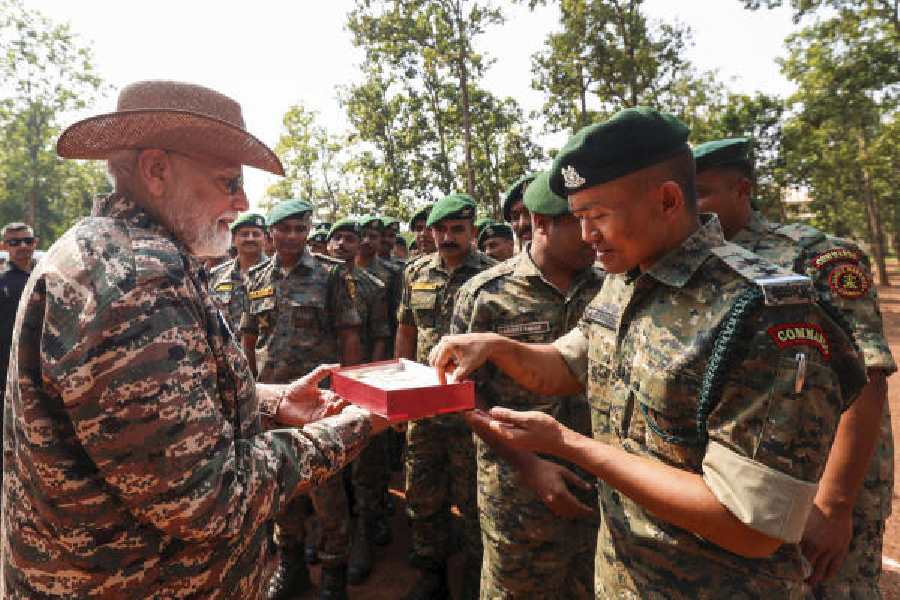
Prime Minister Narendra Modi celebrated Diwali with security forces in Bastar on Sunday. He said, "Diwali 2026 is truly special." Modi claimed Maoists are gone but warned of "dimaagi Naxals" infiltrating political parties to incite people. Congress leader Jairam Ramesh hit back, accusing the Prime Minister of using a solemn occasion.
Prime Minister Narendra Modi offers sweets to security personnel in Bastar on Diwali. (PMO via PTI)
Prime Minister Narendra Modi on Sunday fell back on his "dimaagi Naxals" rhetoric to counter the INDIA bloc's escalating "vote chori" campaign, accusing these purported Maoist fellow travellers of infiltrating political parties and organisations and inciting people against the "Constitution and democracy".
Modi's comments came in an address to security personnel in Bastar, with whom he celebrated what he described as a "special" Diwali.
Congress communications chief Jairam Ramesh was quick to hit back, accusing the Prime Minister of a "brazen assault on all institutional norms" by using a "solemn, non-political occasion" like Diwali to spout invective against his political opponents.
Modi told the troops this was the first Diwali since his government had wiped out Maoists from the country's forests. The Bastar region of Chhattisgarh had for decades been a hotbed of Maoist violence.
"Diwali 2026 is truly special. After 40-50 years, you are witnessing a Diwali like this. This is the first Diwali after the country won its decades-long battle against Naxalism and Maoist terrorism," Modi said.
"This is the first Diwali when every district in the country is free from Naxalism. This is the first Diwali when crores of Indians have overcome the fear of Naxalism. This is an extraordinary achievement...."
Modi said he had chosen to celebrate this Diwali with the security personnel in Bastar to convey the nation's gratitude for their contribution to the fight against Maoism.
The Prime Minister accused previous governments, particularly the Congress-led UPA, of compromising with Maoist terror and credited his government with decisively tackling the threat. He then turned his attention to what he described as the emerging threat of "dimaagi Naxals".
"Friends, amid the success, there is one more thing we must keep in mind. While the armed Naxalites have been eliminated, dimaagi Naxals have taken control of various organisations," he said.
"Even today, they continue to incite people against the Constitution and democracy. These ideological Naxalites have infiltrated several political parties and diverse organisations. We must identify them, defeat them and ensure the nation's security."
Ramesh, in a post on X, said: "The Prime Minister has not spared the nation even on Diwali day his trademark abuse. He has once again spoken of what he calls dimagi naxals.
"He has used a very solemn non-political occasion, donned the uniform of the security forces, and hurled invectives at his political rivals. This is a brazen assault on all institutional norms but when has that ever stopped this man?"
Modi had first invoked "dimaagi Naxals" in his Independence Day speech this year, saying that while armed Maoists had been driven out of the forests, their ideological backers were waiting for opportunities to promote violence and anarchy.
Sunday's speech, however, had a sharper edge. Modi, for the first time, explicitly alleged that "dimaagi Naxals" had infiltrated political parties.
The remarks come at a time when the Opposition and the youth have taken to the streets to allege voter list manipulation and demanded the resignation of chief election commissioner Gyanesh Kumar.
Union ministers and BJP leaders have repeatedly accused Congress leader Rahul Gandhi of using the "vote chori" agitation to undermine India's constitutional institutions and foment anarchy. Modi's latest comments seemed consistent with that stand.
Ramesh cited earlier instances of Modi linking Opposition protests to the Maoist ideology, only to later reverse his stand.
He highlighted how Modi had on April 28, 2024, described those demanding a caste census as "urban Naxals" before announcing on April 30, 2025, that a caste census would be conducted as part of Census 2027.
Ramesh also recalled that Modi had in September 2020 accused the protesters against three new farm laws of supporting the Maoist ideology -- only to announce these laws' withdrawal on November 19, 2021.
"The PM is clearly distraught, disturbed and desperate. Jhola-picking-up time is fast approaching," Ramesh posted.
Modi, in his address to the security forces, obliquely accused the previous UPA government of inaction in the face of the Maoist threat.
"Our government worked to stop the support that Left-wing extremism received from people within the government and the system," he said.
Modi alleged that previous governments had forced the security forces to fight Maoism with their hands tied to their back, denying them the freedom to retaliate effectively against rebel attacks.
"We gave freedom to the forces to take their own decisions," Modi said.
In a broadside against the Nehru-Gandhis, Modi accused the "mehlon mein rahne wale naamdar" (bigwigs living in palaces) of remaining unmoved by the deaths of thousands of security personnel in Maoist attacks.
"This land had been cursed with the blood of our brave soldiers, but not a single sigh was heard from any of the bigwigs living in palaces, nor did a single tear fall from any of their eyes," he alleged.
"This went on for decades. During this time, more than 1,000 soldiers made the ultimate sacrifice in Chhattisgarh alone."
Modi claimed a huge turnaround since those days, saying that for the first time in 47 years, not a single CRPF jawan had lost his life in the line of duty over the past year.
"This is a victory of right policies and strong political will," the Prime Minister said.
He cited a recent World Bank report on poverty reduction to showcase his government's achievements, claiming that 50 crore people had moved out of extreme poverty in India over the past 12 years.
"What decades of slogans about eradicating poverty could not achieve, the country has accomplished in just 12 years. Imagine what a remarkable achievement this is!" he said.