
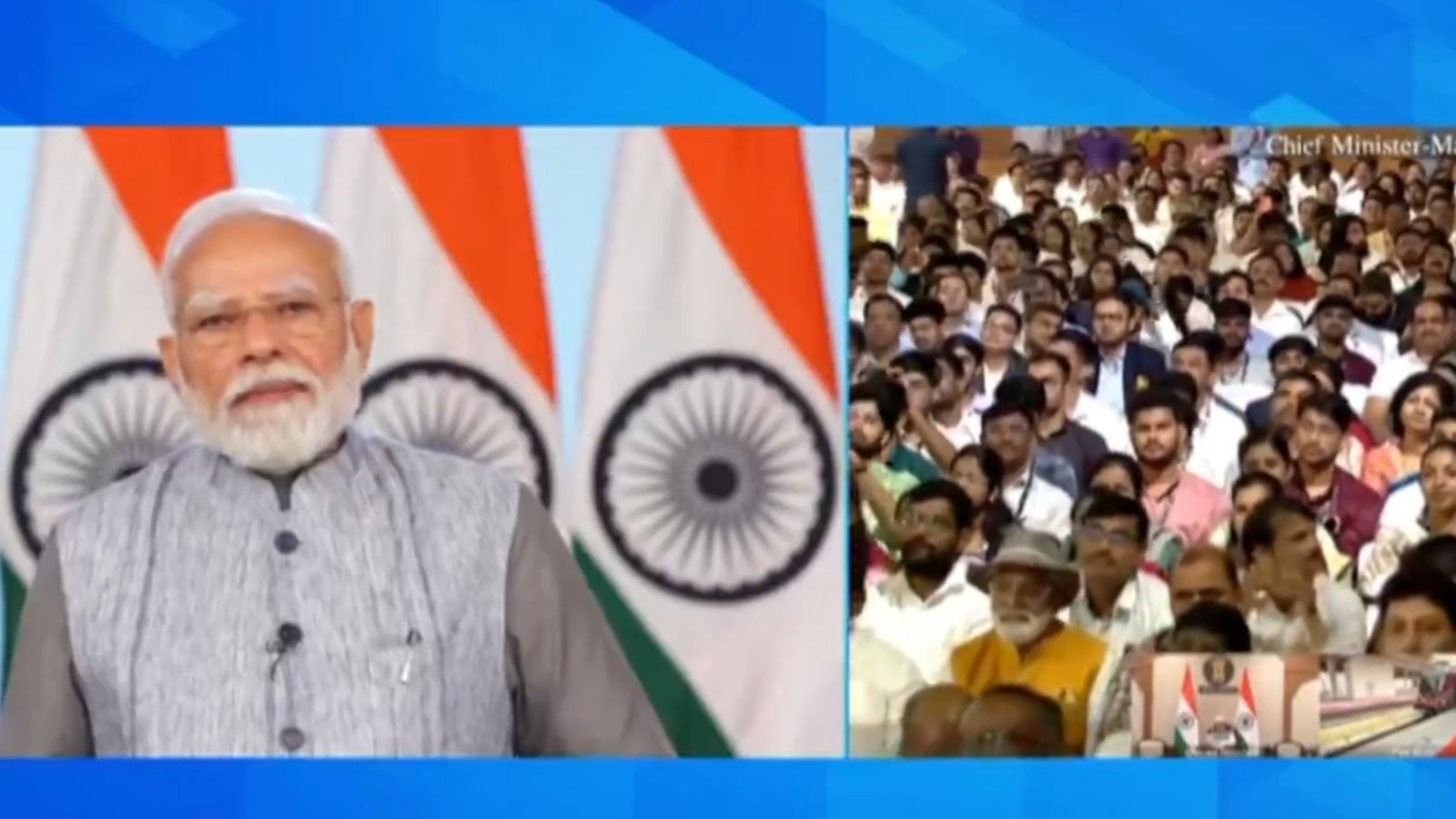
Prime Minister Narendra Modi on Tuesday virtually inaugurated Pune Metro Line 3, connecting Maan-Hinjawadi and Shivajinagar. Built for Rs 8,300 crore, the line aims to help IT professionals. "The new Metro line will directly connect the city to Pune's IT hub," Modi said. Passenger services will start at 6 am Wednesday.
Says India witnessed fall in extreme poverty, transformation in urban transport infra in last 12 years
Prime Minister Narendra Modi on Tuesday virtually inaugurated Pune Metro Line 3 connecting Maan-Hinjawadi and Shivajinagar, aimed at easing the commute of lakhs of Information Technology (IT) professionals who for years have been complaining about hours-long snarls on roads during their daily commute to their offices in Hinjawadi and back home.
Built at a cost of over Rs 8,300 crore, the 23-km-long Pink Line will connect IT hub Hinjawadi and the District Court Metro station at Shivajinagar. An all-women team of around 100 drivers will operate the trains, a first in the country. Commercial passenger services will begin at 6 am on Wednesday.
"The new Metro line will directly connect the city to Pune's IT hub. This will save commuters time, which in turn would mean an increase in the productivity of professionals. This will help in the economic growth of the country," Modi said after virtually inaugurating the line and laying the foundation stones for four more routes, including Metro Line 4.
Modi said the expansion of Metro networks would improve connectivity and accelerate economic growth. He cited the expansion of the country's Metro network as an example of the Centre's efforts towards building 'Viksit Bharat'.
"The first Metro rail in the country was started in 1984 and was operational in only five cities till 2014. The previous government would have delayed the development of the Metro in Pune. In the last 12 years, the Metro network across the country has grown from a mere 248 km to 1,200 km, and Metro services now operate in 26 cities, compared to five in 2014," he said.
Around one crore people travel by Metro across the country every day, Modi said, adding that India ranks among the world's top three countries in terms of Metro network and ridership.
Taking a dig at the Congress for merely giving slogans of poverty alleviation, Modi said around 50 crore people had overcome extreme poverty in India in the last 10-12 years, stressing that India is defeating poverty on the ground under BJP-rule.
"Around 50 crore people have overcome extreme poverty in India in the last 10-12 years. Earlier, the fight against poverty was limited to slogans. Today, India is defeating poverty on the ground," he said.
Citing the World Bank (WB)'s report on India's success in poverty alleviation, Modi said his government has consistently focused on empowering the poor, enabling them to overcome poverty through confidence and opportunities.
"When the country gave the NDA the opportunity to serve in 2014, we set out with a resolve to ensure the ease of living and ease of transportation for the middle-class living in cities," Modi said.
Reaching out to farmers amid the drought in Maharashtra, the PM said they should not worry and assured full support from the Centre. He also appealed to people across the country to remember farmers during the ongoing festive season and ensure that drought-affected families also experience the happiness of Diwali. "I'm aware of the drought situation in Maharashtra. The state government has also provided advance assistance. I want to assure every farmer in Maharashtra that during this difficult time, the NDA government stands with them with full sensitivity. Do not worry, we are all standing with our farmers. We will collectively face this crisis," Modi added.
Chief Minister Devendra Fadnavis said Pune Metro Line 3 was the first Metro project in the country to use the PPP model. He added that the Metro rail network was expanding in the state, with 12 municipal corporations set to have Metro operations soon.
"Metro rail is important not only for mobility but is an economic multiplier. Pune and Pune Metropolitan region will be a mobility centre by 2030 for easy travel. The foundation stone of phase two Metro rail will help in expanding the Metro rail network in Pune, which will be later extended to the new airport proposed in Purandar," Fadnavis said, recalling the contribution of late deputy chief minister Ajit Pawar to the development of Pune.
"The Metro Line 3 will be identified as the Pink Line, as all-women drivers will operate the Metro rail on the route," the chief minister added.
The 23.203-km route will run at six-minute intervals during peak hours and 12-minute intervals during non-peak hours. The first train will depart from Maan-Hinjawadi at 6 am, while the last will leave at 10.30 pm. From Shivajinagar, the first train will depart at 6 am and the last at 11.40 pm.
At the District Court Shivajinagar Metro station, Line 3 connects with Mahametro's Line 1, which runs between Pimpri-Chinchwad and Swargate, and Line 2, which connects Vanaz and Ramwadi. Fadnavis said a common ticketing app would allow passengers to travel on Mahametro and Line 3 using the same platform.
The fully elevated Metro Line 3 connects Maan with Shivajinagar, a major administrative and commercial hub, passing through the Rajiv Gandhi Infotech Park in Hinjawadi. The project cost, including land acquisition and the relocation of utilities and other facilities, stands at Rs 8,313 crore.
Of the 23 stations on the route, 17 will open to passengers from November 4. At seven stations, passengers will initially have access to only one staircase. These are Maan, Maan-MIDC Circle Phase 2, Maan Bus Depot, Hinjawadi Phase 2 Circle 1, Padmabhushan Chowk, Agricultural College and District and Sessions Court.
The remaining 10 stations will have both escalators operational when they open on Wednesday. These include Hinjawadi Phase 2 Circle 2, Shri Shiv Chhatrapati Shivaji Maharaj Chowk at Hinjawadi, Hinjawadi Phase 1, Wakad Chowk, Shri Shiv Chhatrapati Krida Sankul at Mhalunge, Mitcon at Balewadi, R K Laxman Museum at Balewadi, Aundh, Sakalnagar and Savitribai Phule Pune University.
Of the six stations that will remain closed initially, the authorities expect to complete work at two by the end of November 2026. They plan to complete the remaining four stations and their escalators in phases by January 2027.
The PMRDA estimates that two to 2.5 lakh people will use the Metro service every day. The project is expected to ease traffic congestion in Hinjawadi IT Park, Aundh, Baner, Balewadi, Mhalunge, Ganeshkhind Road and Shivajinagar.
The project uses the public-private partnership (PPP) model. The Pune Metropolitan Region Development Authority (PMRDA) developed it, while Pune IT City Metro Rail Limited (PITCMRL), a joint venture between Tata and Siemens, implemented it.