
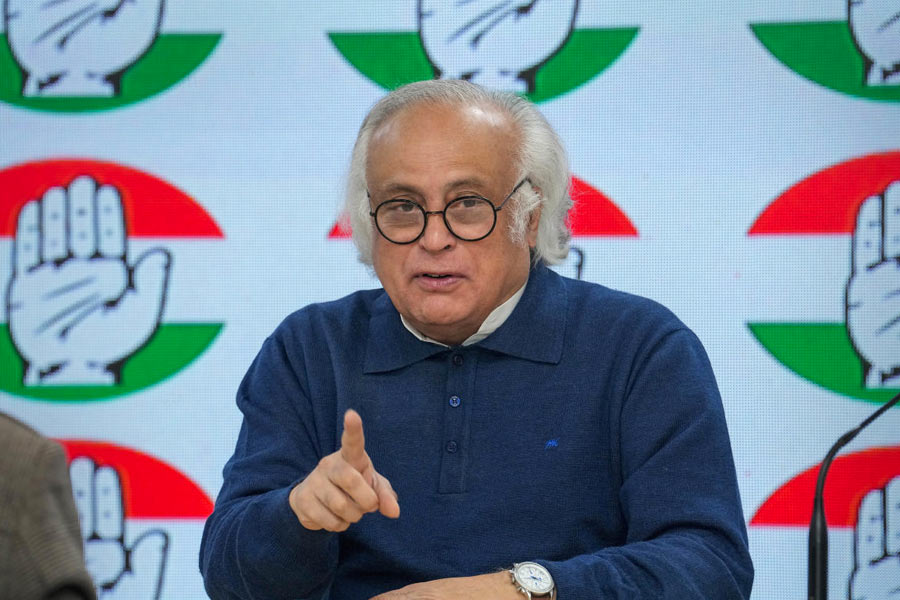
Parliament’s Monsoon session remained unprorogued for 100 days on Saturday as the Centre weighed a special sitting for a delimitation bill. Jairam Ramesh said, "The PM-HM jodi is still in search of a supertainted two-thirds majority in the Lok Sabha to get the Constitutional Amendment Bill on Delimitation passed."
'PM-HM jodi is still in search of a supertainted two-thirds majority in the Lok Sabha to get the Constitutional Amendment Bill passed' says Jairam Ramesh
Parliament's Monsoon session remained unprorogued for a record 100 days on Saturday as the Centre weighed a special sitting to push through a constitutional amendment linking delimitation to the rollout of women's reservation. Congress general secretary Jairam Ramesh said Prime Minister Narendra Modi and Union home minister Amit Shah were still seeking the two-thirds majority needed to pass the bill in the Lok Sabha.
Both Houses were adjourned sine die, or indefinitely, on August 13. Neither had been prorogued, the step that formally ends a session, as of Saturday morning. The previous record of 87 days was set in 2008.
"Today is the 100th day since the 2026 Monsoon Session of Parliament was adjourned sine die and has not been prorogued.
"The PM-HM jodi is still in search of a supertainted two-thirds majority in the Lok Sabha to get the Constitutional Amendment Bill on Delimitation passed," Ramesh wrote on X.
The government had been exploring a special or extended sitting, with government sources earlier expressing confidence that the bill would clear the Lok Sabha by 15 to 18 votes. The Centre had yet to announce dates or say how long the sitting might last. The uncertainty also fuelled speculation over the timing of the Winter session, which was expected to begin in the first week of December.
An extended sitting of the existing session requires at least two days' notice, while a fresh session requires at least 14 days' notice. The Constitution sets no deadline for prorogation after a House adjourns sine die. An extended gap between adjournment and prorogation is permissible in itself.
The amendment under discussion would raise the Lok Sabha's strength from 543 seats to a maximum of 850 through delimitation, paving the way for 33 per cent reservation for women in Parliament and state assemblies ahead of the 2029 Lok Sabha elections.
The Centre was understood to be considering a 50 per cent increase in Lok Sabha seats for every state to address concerns raised by southern states. One option under consideration would retain the existing inter-state share of seats based on the 1971 Census. A final decision was pending.
"Nobody knows what the new Bill will contain since the old Bill was defeated resoundingly on April 17, 2026," Ramesh said.
He said no specific new proposals had been discussed with any political party "in a serious and structured manner". The Opposition had sought an all-party meeting on delimitation, and Ramesh said the Centre had yet to call one despite four letters from Congress president Mallikarjun Kharge to Modi.
Ramesh had earlier outlined a four-point formula that would keep the Lok Sabha at 543 seats, retain the existing representation of states and Union territories, reserve a third of the current seats for women and freeze the arrangement for 25 years. In Saturday's post, he said the freeze should last until the Viksit Bharat objective was achieved.
"There are far more serious and pressing economic, political, social, military and foreign policy challenges that await and demand attention. Far-reaching and comprehensive Delimitation can wait. Indira Gandhi put it off for 25 years in 1976. In 2001, Atal Bihari Vajpayee put it off for a further twenty-five years, that is, till the results of the first census after 2026 are published. They were wise and nationalist PMs," Ramesh wrote.
Ramesh said Modi had expressed grave concerns about the economy at the FICCI conclave on November 19.
"He seems to be in a very disturbed state of mind, as indeed he should be. Debate and discussions on delimitation require cool heads unburdened by tensions of the type that are preoccupying the PM. Extensive consultations with various stakeholders are also needed.
"Under the circumstances, it is in the nation's interest to let the current Lok Sabha strength and state-wise configuration continue with one-third reservation for women implemented. This arrangement should then remain frozen till the much-trumpeted Viksit Bharat objective is achieved. It will be a fitting tribute to it since the consequences of a fundamentally new delimitation can best be managed in an environment when Viksit Bharat has become a reality," he said.