
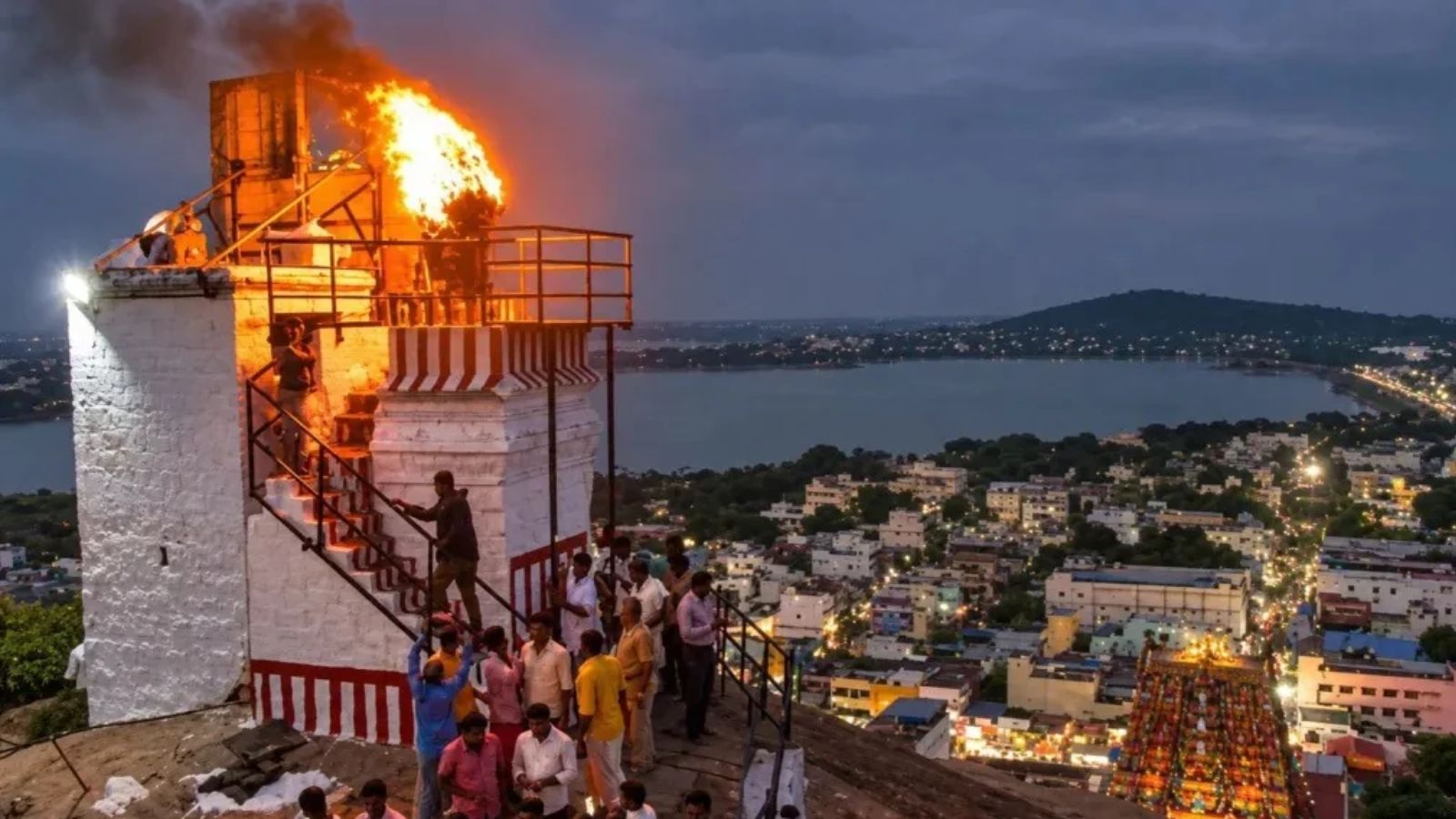
The Supreme Court permitted lighting the lamp on the Thiruparankundram hill on November 24 for Karthigai Deepam. The bench said this one-time arrangement would "appropriately balance the interests involved pending further consideration." Officials must ensure safety and protect the monument, while the order grants no permanent rights to any group.
The Supreme Court permitted lighting of the lamp on the 'deepathoon' atop the Thiruparankundram hill on the occasion of 'Karthigai Deepam' on November 24.
The Supreme Court, in an interim order on Friday, permitted lighting of the lamp on the 'deepathoon' (lamp pillar) atop the Thiruparankundram hill, the seat of the Arulmigu Subramaniaswamy Temple, on November 24 on the occasion of 'Karthigai Deepam' as a one-time measure, while staying the directions in a Madras High Court judgment on the issue.
A bench of Justices Aravind Kumar and Vipul M Pancholi said that a limited, one-time arrangement, subject to stringent safeguards, would "appropriately balance the interests involved pending further consideration".
The court stayed the directions in paragraphs 1 to 140 of the Madras High Court's January 6, 2026, judgment "insofar as they concern the challenge in the present proceedings".
One-time permission
The court permitted the lighting of the ceremonial lamp on the stone pillar identified as 'deepathoon' on November 24, but clarified that the permission was only a temporary arrangement and "not in recognition or enforcement of any asserted customary, religious or proprietary right".
"Access shall remain confined to the authorised persons and such officials as may be necessary for supervision and scrutiny and security. The district administration in consultation with the concerned authorities shall schedule the timing, route of access, duration and other incidental arrangements keeping in view the requirement of public safety, fire prevention, archaeological protection and maintenance of peace. The authorised team shall leave the site immediately upon the completion of the ceremony, without leaving behind any temporary article or installation," the court added.
ASI to ensure monument protection
The bench said the Archaeological Survey of India (ASI) should prescribe conditions necessary for the protection and preservation of the monument and its surroundings.
"The ceremony shall be undertaken strictly in accordance with the applicable statutory requirements. No excavation, construction, structural alteration, permanent installation or damage to any monument, religious structure or property shall be permitted" and "the existing religious observance at the customary locations shall continue undisturbed," the court added.
The Supreme Court added that the affairs of the dargah and the mosque shall not be interfered with in any manner during this period.
Arrangement limited to this year
The bench said the present arrangement will "not confer upon any person any additional right of entry, occupation or control of any portion of the hill."
The bench also clarified that the present arrangement does not proceed upon any finding that the stone pillar is or has historically been a place of customary religious observance nor does it determine whether lighting of the lamp at the location constitutes an essential religious practice or whether any individual, religious denomination or institution possesses any enforceable right in that regard.
"All questions concerning title, possession, usage, religious entitlement, temple administration and access to the site are expressly left open. Neither the permission granted by this court, nor the performance of the ceremony pursuant thereto shall be relied upon by any party as evidence of any established custom, precedence of religious usage...or alteration of existing legal position till adjudication of these appeals," the Supreme Court said.
Clarifying that the present arrangement "shall not furnish an independent basis for claiming similar permission in any subsequent year", the bench said it "is confined to the forthcoming festival and shall not be treated as governing the rights of the parties or the manner of observance in subsequent year".
Authorities asked to coordinate
The Supreme Court asked the police commissioner, the district collector, the ASI and the concerned central and state authorities to ensure close coordination in implementing its directions. "In the event of any specific statutory, physical or security impediment, which cannot be reasonably be addressed through the prescribe safeguards, the district collector shall immediately bring the same to the notice of this court for appropriate directions," the bench added.
"The observance of religious festivals in a society governed by the Constitution must remain consistent with mutual respect, public order and the rule of law. The limited arrangement made today is not a determination of the dispute; it is an arrangement made precisely because the dispute remains to be determined," the bench said.
It asked the Madurai district collector to submit a brief report regarding compliance with directions within three days after the festival.
The bench will now hear the matter in the second week of January 2027.