
OBC groups are pushing to change the 2027 census caste query after the Supreme Court declined their plea. The court said the issue is a policy decision. These groups now want the government to use a pre-loaded drop-down menu for castes instead of the current open-ended format for data collection.
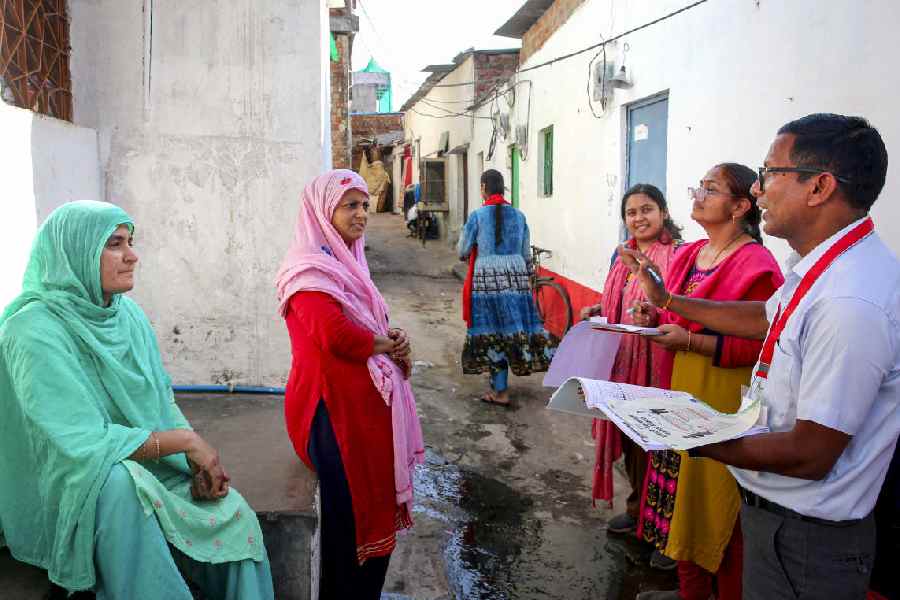
Enumerators collect information from residents in Bhopal in May. File picture
Several OBC organisations are planning to make a renewed effort to convince the government to modify the open-ended format for enumeration in the 2027 census after the Supreme Court refused to entertain a plea seeking a direction to introduce a pre-loaded drop-down menu for OBC castes in the digital enumeration tools.
The organisations are also reaching out to Opposition MPs to pressure the government into tweaking the questionnaire to accurately capture the caste-wise breakdown of the population. The census commissioner has announced the census in all states except Uttar Pradesh, Uttarakhand, Punjab, Manipur, Goa, Ladakh and snow-bound areas of Himachal Pradesh and Jammu and Kashmir from January 25 to 28.
In August, the Registrar General of India had notified a 40-item questionnaire for the census, including 13 new fields compared with the 2011 census. The additional information the government seeks includes parental details, number of bank accounts, permanent residential address, and mobile, Aadhaar, voter ID and passport numbers.
The census always had questions to collect SC/ST data. The questionnaire released in August introduced, for the first time since 1931, an open-ended question on caste.
In 2011-12, the rural development ministry, the housing ministry and the RGI had carried out a special Socio-Economic Caste Census (SECC) to gather data on economic status and caste. However, the caste question was left open-ended, leaving it to the enumerators to manually record the respondent's caste details.
The government in 2015 released the economic data but not the caste statistics, citing inaccuracies such as mix-ups in surnames, gotras and castes. The ongoing census format follows the same SECC model. The OBC Federation of India filed a petition in the Supreme Court seeking a direction to the Centre to include a pre-loaded drop-down menu for castes in the digital enumeration tools.
A three-judge bench headed by Chief Justice Surya Kant on Wednesday disposed of the petition, ruling that the issue pertained to a policy decision.
"The issue highlighted, in our considered opinion, essentially pertains to a policy decision, which can be effectively addressed by the policy makers. We, therefore, without expressing any opinion on merits, dispose of this writ petition with liberty to the petitioner to approach the Registrar General and Census Commissioner of India, to whom a copy of this writ petition may be forwarded as a representation, to enable that authority to look into the issue highlighted on behalf of the petitioner," the top court order stated.
Shashank Ratnoo, the counsel for the petitioner, said the ball was now in the government's court. "The Supreme Court has asked it (government) to consider. The government has to consider it in a time-bound manner. Otherwise, appropriate remedy under law will be taken," Ratnoo said.
G. Karunanidhi, general secretary of All India OBC Employees' Federation, said OBC groups would make a renewed effort to convince the government. "We will approach the government before the enumeration starts. We will convince them that without the drop-down menu the purpose of collecting caste data will be defeated," he said, adding he had written to home minister Amit Shah on adopting standardised caste codes and official caste lists during enumeration.