
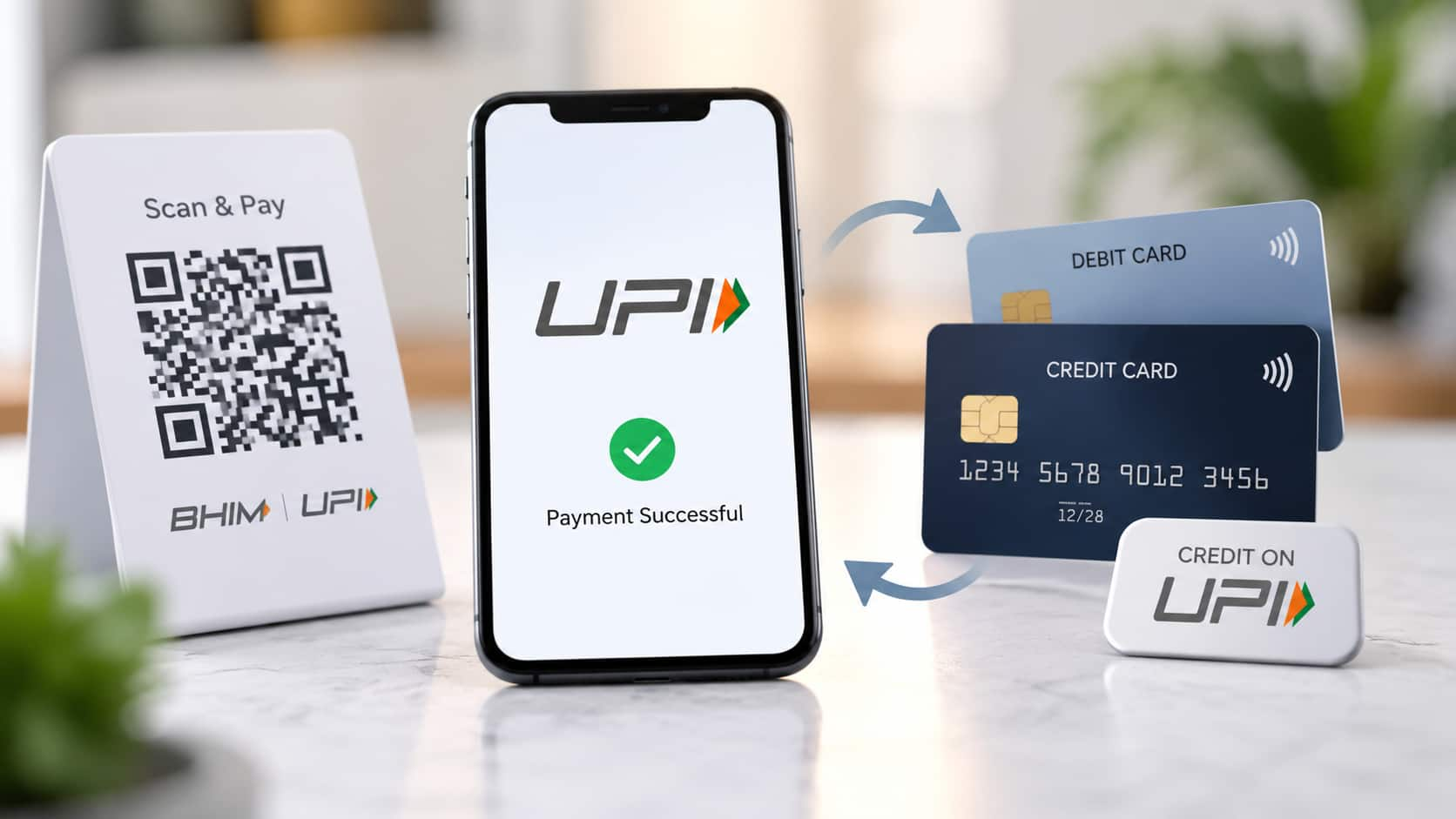
The NPCI told the Supreme Court that merchants cannot pass MDR charges to customers under the revised UPI framework. The corporation said, “The charge under the MDR is attracted only to a small fraction of P2M transactions that exceed Rs 2,000.” Violations could lead to strict action against payment providers.
Market Mastery
Webinar by Vishal Malkan
Find the weak links
in your portfolio by Vishal Malkan
The National Payments Corporation of India (NPCI) has told the Supreme Court that merchants cannot pass on Merchant Discount Rate (MDR) charges to customers under the revised UPI pricing framework.
The top court on September 28 had sought responses from the Centre and others, including the NPCI, on a petition challenging the decision to impose an MDR on specified UPI person-to-merchant transactions above Rs 2,000.
The court, however, had declined to grant an interim stay on the revised framework after the petitioner's counsel sought suspension of the decision pending consideration of the matter.
In a response affidavit filed on November 3, the NPCI told a bench headed by Chief Justice of India Surya Kant that UPI application providers cannot impose platform fees or other charges on users for making payments through the Unified Payments Interface (UPI).
The petition had challenged the amendment to Section 10A of the Payment and Settlement Systems Act, 2007, introduced through the Taxation and Other Laws (Amendment) Act, 2026, the subsequent Finance Ministry notification and NPCI's revised MDR framework announced in September.
“The charge under the MDR is attracted only to a small fraction i.e. approximately 0.4 per cent, of P2M (person to merchant) transactions that exceed Rs 2,000 and thus, a measure confined so narrowly in its incidence affords less scope for merchants to recalibrate their pricing across their entire customer base merely on account of a charge that arises only occasionally and only above a defined value. Accordingly, the apprehension that the MDR Framework will result in quiet revision of prices is also misconceived”, the NPCI said.
Defending the revised framework, the corporation said the prohibition on passing MDR charges to customers was not merely a policy assurance but a mandatory direction backed by contractual enforcement mechanisms.
Any violation, it said, could invite compliance action against banks, Payment System Providers (PSPs) and Third Party Application Providers (TPAPs), including possible termination of their UPI membership and facilities.
The corporation rejected concerns that the revised charges could indirectly increase the financial burden on consumers through higher merchant prices. Under the revised framework, MDR of up to 0.4 per cent would apply to merchant transactions exceeding Rs 2,000, it said.
The NPCI said that transactions below the threshold would continue to remain free, while small merchants covered under the zero-MDR framework would also remain exempt.
The affidavit said that the limited applicability of the charge would leave little scope for merchants to revise prices across their entire customer base. NPCI further said that P2P transfers and transactions involving small merchants under the P2PM category would continue to attract no MDR.
The P2PM category covers merchants receiving monthly inward UPI credits of up to Rs 1 lakh.
“MDR not exceeding 0.4 per cent will apply to P2M transactions above Rs 2,000 which means effectively, the said MDR will apply to only about 4 per cent of merchant transactions, and approximately 96 per cent of all P2M will remain unaffected, being either below the Rs 2,000 threshold or covered by the zero-MDR framework for small merchants.
“This narrow incidence of the charge, confined to a small fraction of high-value merchant transactions, demonstrates that the MDR Framework is calibrated to raise revenue for the sustainability of the ecosystem precisely from the class of transactions best placed to bear it without disturbing the free character of the vast majority of UPI usage. Pertinently, the 0.4 per cent ceiling for MDR is far lower than the charges imposed by other system providers for credit cards and debit cards”, the NPCI affidavit said.
According to NPCI, approximately 70 per cent of UPI transactions are person-to-person transfers, while around 96 per cent of person-to-merchant transactions are valued at Rs 2,000 or below.
To address concerns over the possible impact on small businesses, the NPCI said the revised framework proposes a dedicated fund to promote UPI adoption among merchants with annual turnover of up to Rs 20 lakh.
Explaining the rationale behind the revised pricing structure, the corporation said the zero-MDR regime had created a structural gap between the operational costs of running the UPI ecosystem and the revenue available to sustain it.
It submitted that UPI processes billions of transactions every month, requiring sustained investments in payment infrastructure, technological innovation, cybersecurity, fraud prevention and customer services.
The PIL was filed by advocate Anjan Datta.
Ending nearly six years of fully free UPI payments, the government had introduced a 0.4 per cent fee on transfers worth over Rs 2,000 made to merchants through the UPI platform from October 15 while explicitly ring-fencing everyday person-to-person transactions and small payments from any charge.
The MDR will be capped at Rs 300 for payments of Rs 75,000 and above.
Essential and thin-margin sectors -- railways, telecom, insurance, fuel and agricultural inputs -- will pay a flat MDR of Rs 5 per transaction above Rs 2,000.
Payments into mutual funds, securities and through stockbrokers and dealers will attract 0.02 per cent MDR, also capped at Rs 300.
P2P transfers -- which make up 37 per cent of UPI's transaction volume and 70 per cent of its transaction value -- will continue to attract zero charges, irrespective of size.