
Congress leader Jairam Ramesh on Friday said the National Clean Air Programme needs an urgent revamp. He noted that many cities exceed air safety limits, which are four times the WHO level. "The National Clean Air Programme launched almost eight years back needs an urgent revamp and move beyond road dust."
Ramesh said CREA's analysis very rightly suggests that the programme should now control emissions from industry, power generation and residential sources; control directly emitted particulate matter; and address gaseous precursors responsible for secondary PM2.5 formation
Congress leader Jairam Ramesh on Friday flagged the issue of rising pollution levels and said the National Clean Air Programme, launched almost eight years back, needs an urgent revamp and move beyond road dust mitigation.
The former environment minister said this is the time when pollution in the nation's capital generates global headlines but there are places where, according to a detailed analysis just published by the Centre for Research on Energy and Clean Air (CREA), the public health crisis is even worse.
"For the month of October 2026, the top three most polluted cities in India going by the monthly average PM2.5 concentration were in Uttar Pradesh -- Baraut in Baghpat district, Khora in Ghaziabad district and Gajraula in Amroha district," Ramesh pointed out.
He said 13 cities in UP, 11 cities in Haryana, 3 in Gujarat and 2 each in MP, Punjab and Rajasthan exceeded the national ambient air quality standard for PM2.5 (24-hour mean) which itself is four times the WHO safety level.
"The National Clean Air Programme launched almost eight years back needs an urgent revamp and move beyond road dust mitigation," the Congress leader asserted.
Ramesh said CREA's analysis very rightly suggests that it should now control emissions from industry, power generation and residential sources; control directly emitted particulate matter; and address gaseous precursors responsible for secondary PM2.5 formation.
An airshed-based approach needs to be followed, he added.
"The National Ambient Air Quality Standards (NAAQS) were last promulgated in November 2009. They were acknowledged to be very progressive then, but now they need to be updated, especially the safe limits for PM2.5 concentrations," Ramesh said.
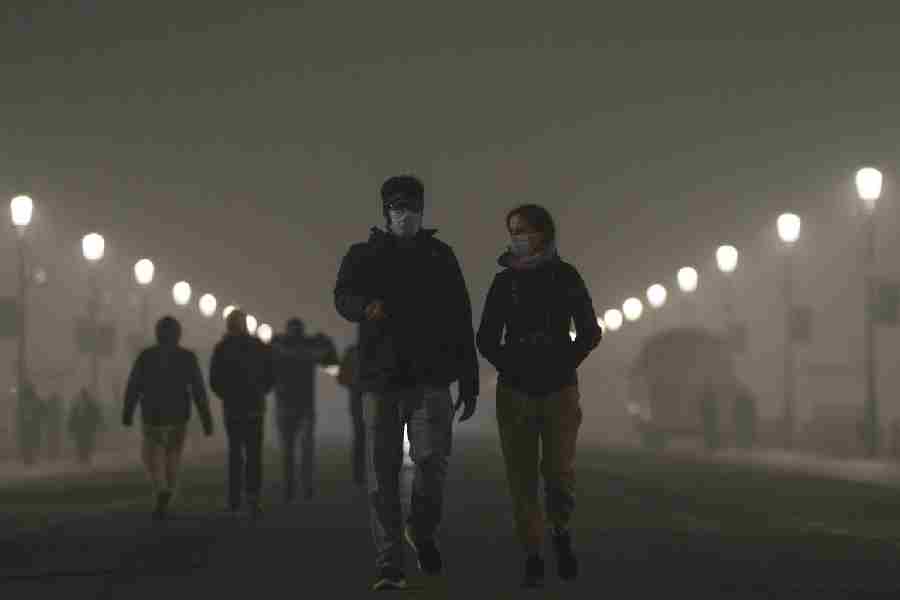
His remarks came on a day a thick layer of smog hung over the national capital as the air quality deteriorated sharply and edged closer to the 'severe' category, with the overall Air Quality Index (AQI) settling at 391.
Of the 59 monitoring stations across the city, 30 recorded severe air quality at 9 am, while the remaining stations were in the very poor category.
As per the Central Pollution Control Board (CPCB), an AQI between zero and 50 is classified as 'good', 51 and 100 as 'satisfactory', 101 and 200 as 'moderate', 201 and 300 as 'poor', 301 and 400 as 'very poor', and 401 and 500 as 'severe'.