
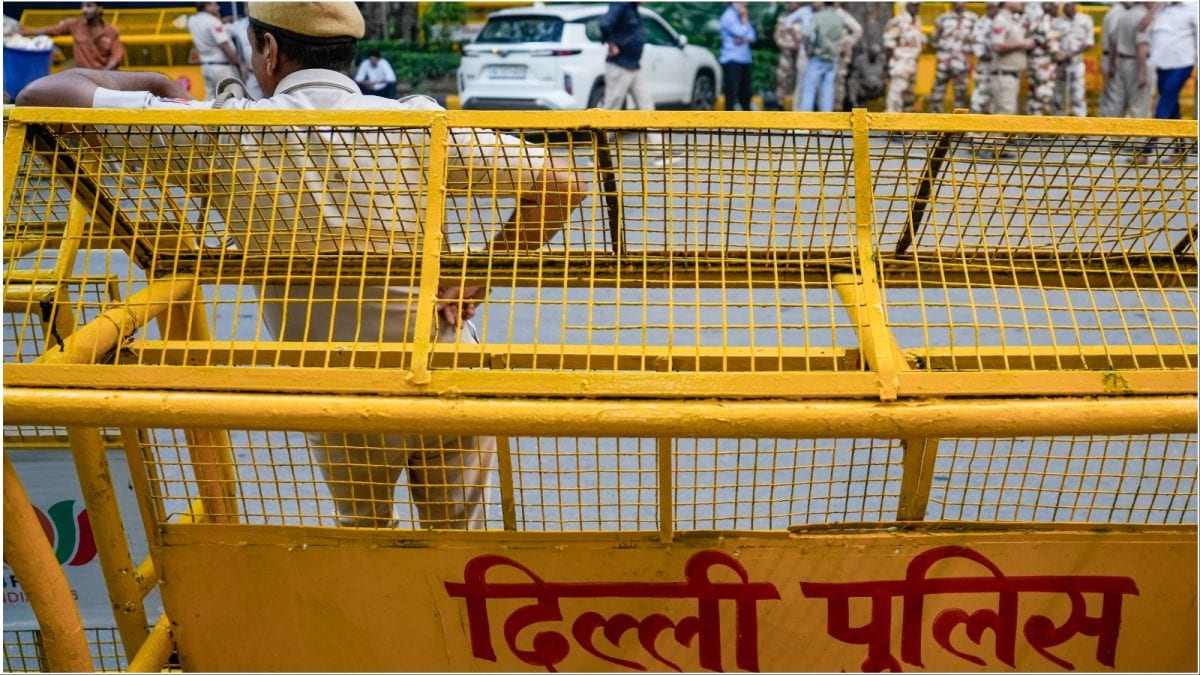
The Supreme Court on Tuesday issued notices to the Centre regarding Delhi protests against CEC Gyanesh Kumar. The bench heard concerns about police action and business losses during the festive season. Senior advocate Mukul Rohatgi said, “If you don’t sell during festive season, our sales are down,” urging for solutions.
Supreme Court hears pleas over Delhi protest crackdown, discusses right to protest, CCTV surveillance and traders' concerns over festive-season business losses.
The Supreme Court on Tuesday issued notices to the Centre and other respondents while hearing a batch of petitions challenging the Delhi Police’s crackdown on protests against Chief Election Commissioner (CEC) Gyanesh Kumar.
The bench, comprising Chief Justice of India (CJI) Surya Kant and Justices Joymalya Bagchi and JV Mohana, also took up a plea filed by the Kirana Committee Delhi seeking a halt to protests during the festive season. The proceedings witnessed sharp exchanges over the right to protest, alleged police excesses, restrictions on public spaces and the impact of demonstrations on businesses.
The proceedings also saw the court examine competing claims over the use of designated protest sites in the national capital, with traders’ associations seeking restrictions on demonstrations during the festive season, citing substantial business losses.
On the previous date of hearing, the Supreme Court had directed the Union government to produce the orders issued under Section 163 of the Bharatiya Nagarik Suraksha Sanhita (BNSS) in Delhi during the protests.
Solicitor General Tushar Mehta informed the bench that the government’s response covered five categories, including habeas corpus petitions, journalists, advocates and the denotification of Jantar Mantar.
Senior advocate Menaka Guruswamy, appearing for the petitioners, pointed out that the Section 163 orders were required to be placed before the court separately. She said the Delhi Police’s justification for its action had been filed, but the relevant order had not yet been placed on record.
Mehta responded that the fifth affidavit contained the information. Guruswamy insisted that the petitioners should be served a copy of the affidavit.
Traders Seek Restrictions On Protests During Festive Season
Senior advocate Mukul Rohatgi, representing traders’ associations in Delhi, raised concerns over the disruption caused by protests in the national capital, arguing that the impact on commercial activity needed to be considered.
“Fifty lakh people live there. We have to now think of a scheme. It’s no longer Jantar Mantar here or there," Rohatgi told the court.
He said shops in Connaught Place and surrounding areas remained closed and claimed that traders were suffering losses during the festive season.
“If you don’t sell during festive season, our sales are down," he said, urging the court to consider an “out-of-the-box solution".
Rohatgi argued that the issue could no longer be viewed merely as a dispute over the availability of a designated protest location, given the number of people living and conducting business in the surrounding areas.
Solicitor General Mehta responded that those calling for a bandh should take responsibility for its consequences.
Justice Bagchi asked whether the organisers of the protests had been made parties to the proceedings. Rohatgi said he would implead them.
The CJI subsequently directed the petitioners to implead all organisations that had conducted the protests, observing that the court could not determine the issues without hearing their responses.
“No court can determine the issue unless the organisers are made parties," the bench indicated.
Senior advocate Arundhati Katju questioned whether the decline in sales could be attributed solely to the protests.
Supreme Court On Right To Protest: No One Can Occupy A Site Indefinitely
The hearing also witnessed an exchange over the use of Jantar Mantar as a designated protest location.
Senior advocate Menaka Guruswamy argued that Jantar Mantar was a notified protest site and questioned the objections being raised against demonstrations there.
Senior advocate Hariharan also referred to an incident involving Delhi Police personnel at Jantar Mantar, alleging that the police had staged a protest there the previous day without facing the restrictions imposed on others.
Guruswamy alleged that the violence during the protests was committed by the Delhi Police.
The Solicitor General maintained that Jantar Mantar was a public road and not a designated site for indefinite demonstrations.
The CJI, however, emphasised that the right to protest had to be accommodated while ensuring that public spaces remained accessible to others.
“Everyone has the right to protest. Designated time must be given for a designated period," the CJI observed.
He further said that no group could occupy a particular site indefinitely, asking where farmers, journalists and other groups would go if one organisation were allowed to retain a location permanently.
The bench also stressed that orders granting permission for demonstrations must clearly specify the conditions and reasons for allowing or refusing permission.
The Solicitor General submitted that permission had been granted for only one day, but the protesters continued occupying the site for 17 days. He also alleged that the protesters had marched towards Parliament and argued that they could not have been permitted to proceed to Parliament or the Supreme Court without authorisation.
Rohatgi sought a complete restriction on protests and dharnas for the next two months, saying traders were suffering.
Responding to the argument, Guruswamy referred to the alleged 7,000 detentions and asked whether the impact on democracy was not equally concerning.
Mehta disputed the characterisation of the action as detention, saying it was a case of “removal".
CCTV Surveillance And Right To Privacy Also Discussed
The bench also heard arguments concerning surveillance of protesters and the use of CCTV cameras at designated protest locations.
The Solicitor General questioned the argument that CCTV surveillance at a public protest site violated privacy rights, asking whether a person participating in a public demonstration could claim privacy in that setting.
He argued that CCTV cameras were installed at designated locations to ensure safety and prevent untoward incidents, drawing a comparison with surveillance cameras installed for women’s safety.
Justice Bagchi described the argument as simplistic and examined the issue from the perspective of reasonable expectations of privacy and the subsequent use of collected data.
The judge distinguished between the mere recording of a person’s presence in a public place and the use of that information for identification or further investigation.
Referring to changes under the Identification of Prisoners Act, Justice Bagchi discussed the State’s ability to use identification techniques, including iris-based identification.
He questioned whether the availability of footage from a particular date and its subsequent use necessarily established a legitimate state interest.
The Solicitor General argued that legitimate state interest was an exception to the right to privacy. He also said that identification through facial data could merely serve as a trigger for further investigation, including examination of a person’s location and other surrounding circumstances.
Justice Bagchi also referred to techniques through which CCTV surveillance could be camouflaged.
Traders Cite Rs 10,000-Crore To Rs 12,000-Crore Business Impact
According to the Chamber of Trade and Industry (CTI), Delhi’s traders feared business losses of Rs 10,000 crore to Rs 12,000 crore as the INDIA bloc’s rally and associated traffic restrictions affected wholesale markets, transport operations and festive-season shopping.
CTI Chairman Brijesh Goyal told news agency ANI that around 80 per cent of shops in major markets surrounding Ramlila Maidan remained closed amid traffic restrictions and concerns over large crowds.
He clarified that the actual losses would be assessed after receiving detailed information from individual markets.
According to the CTI, around 20 to 22 major markets, including Chandni Chowk, Sadar Bazaar, Khari Baoli, Chawri Bazaar, Karol Bagh, Connaught Place and Janpath, account for approximately three lakh shops.