
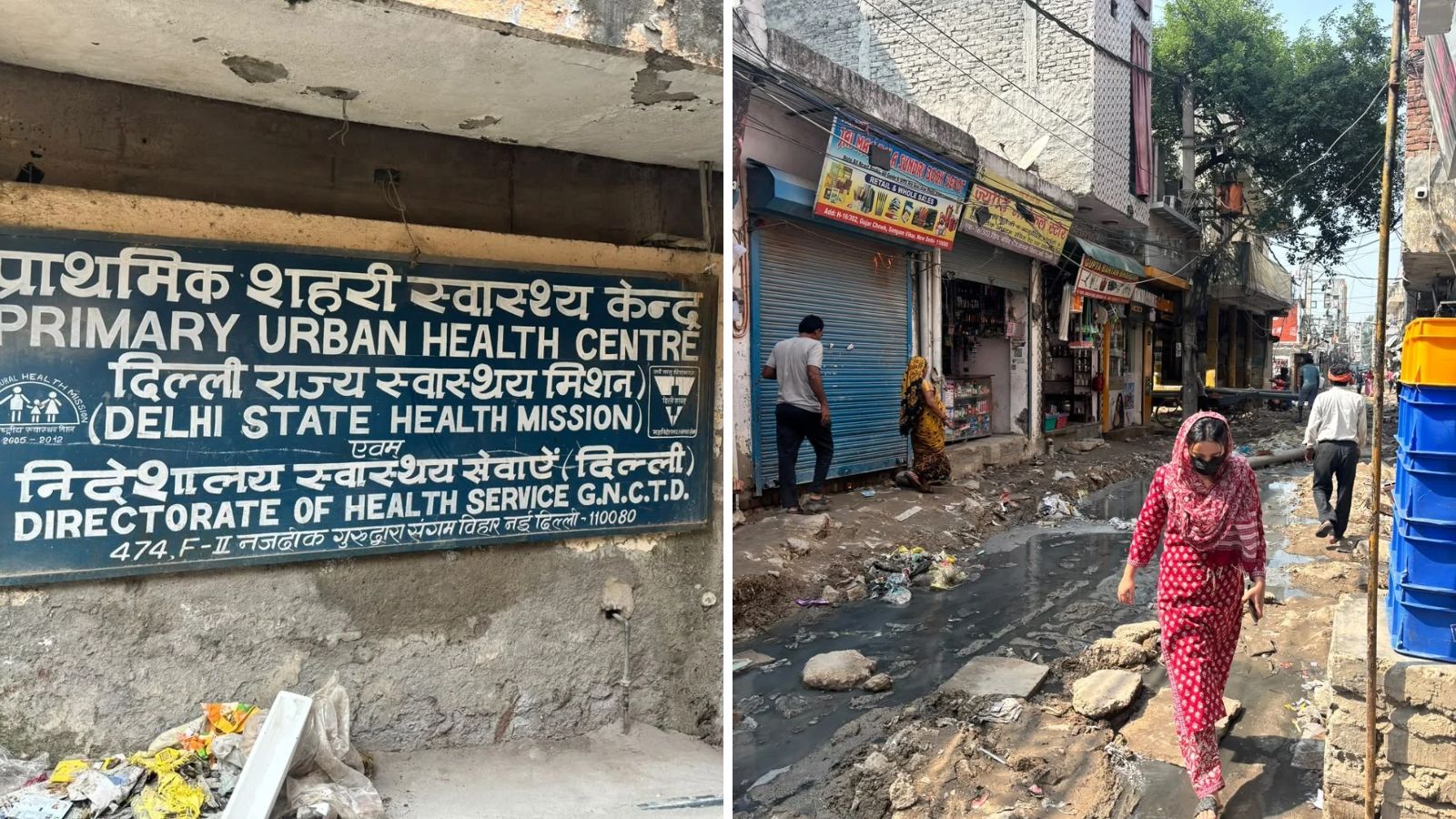
Sangam Vihar, home to over 10 lakh people, has no operational Ayushman Arogya Mandir. Residents rely on one dispensary and three centres in cramped basements. A health worker said, "I was hired as a sweeper but I work as a nurse and a receptionist too." Facilities remain limited for patients.
In Sangam Vihar's narrow lanes, where open drains run alongside houses and sewage spills onto broken roads, finding a government health centre can be a challenge amid the maze of multicoloured buildings. Getting treatment there is not easy either.
Home to over 10 lakh people spread across roughly 5 sq km, Sangam Vihar - among Asia's largest unauthorised colonies - does not have a single operational Ayushman Arogya Mandir (AyAM).
Instead, residents depend on one Delhi Government Dispensary (DGD) and three Primary Urban Health Centres (PUHCs), all operating from rented buildings, some in cramped basements with limited staff and facilities.
The nearest AyAMs are around 7 km away, in Saket and Govindpuri.
Following the phasing out of 553 Mohalla Clinics established under the previous AAP regime, the BJP government has been expanding AyAMs or Primary Health Centres. According to the latest 2026 Directorate General of Health Services (DGHS) report, over 203 centres are operating across Delhi.
But none are in Sangam Vihar. Officials cited the absence of government-owned land.
Care in a basement
At the PUHC in Gali 10, stairs lead down to a basement. A banner lists seven rooms, but only four are functional.
At 11 am, Santosh (46), stood at the entrance, looking bewildered. The construction worker had just been referred to the Nehru Nagar Chest and TB Hospital, around 11 km away, for suspected tuberculosis (TB).
The PUHC has no TB testing facility or medicines for the disease.
Santosh has been staying with his brother-in-law since he arrived from Siwan in Bihar last month in search of work. For two weeks, he has had fever, chills, breathlessness and blood in his cough. "I get exhausted. I haven't earned a single penny. What will I send home?" he asked.
Inside the PUHC, a contractual health worker who did not wish to be named was juggling several responsibilities. "I was hired as a sweeper but I work as a nurse and a receptionist too," the woman said.
Her day begins at 5 am. She cooks for her family before travelling from Burari by bus and local tempo. She reaches the PUHC by 8 am to sweep the floors before patients arrive.
Three other contractual health workers also work at the PUHC. A doctor visits the centre three days a week. The centre, which sees around 100 patients daily, offers immunisation, hypertension, diabetes and thyroid care, as well as basic blood tests thrice a week.
Through sewage and sludge
Reaching the PUHC in Gali 15 is an ordeal.
The road is dug up, sewage pipes lie exposed and black sludge mixes with garbage. Bricks and stones have been placed haphazardly to help pedestrians cross.
Raja Ram (90) had walked nearly a kilometre from Gali 17 to the PUHC, leaning on a wooden stick. "I felt feverish around 2 am and couldn't sleep all night," he said. Smiling, he added: "Otherwise, I have no problem. Waiting for death can be tiresome."
Nutan (57), a domestic worker earning Rs 12,000 a month, complained of fever, itching and diarrhoea.
"It is the water here. I have loose motions too," she said. Her husband is bedridden, leaving her as the sole earner.
She underwent a Widal test - a blood test undertaken to support the diagnosis of typhoid and paratyphoid fever - and was prescribed antiprotozoals, ORS and paracetamol.
A health official blamed poor sanitation and contaminated water in the area. "Sangam Vihar is a high-risk area due to open drains and sludge. Cholera, loose motions, enteric fever, hepatitis and typhoid are endemic. TB is widespread. Immunity is low, and nearly every house will have a TB case. It is because of poor hygiene and contaminated water."
"Hypertension and diabetes are rising rapidly. We are seeing diabetes even among people aged 21, 23 and 27," the official added.
Clinics under strain
At the DGD in Gali 1, another basement houses four rooms separated by makeshift partitions - the doctor's cabin, a pharmacy, an immunisation room, and a space to conduct TB tests.
A cobwebbed, foul-smelling bathroom lies unused. In the dim waiting area, women sit on steel benches, many holding children, facing a blue wall with peeling paint.
Anita (85) arrived leaning on a stick. Randhir, a nurse who also doubles as receptionist, helped her downstairs. Minutes later, she emerged carrying medicines for fever, cough and skin disease.
Randhir said that most women who come to the DGD get urine pregnancy and haemoglobin kits as well as clinical breast examination. "There was a Mohalla Clinic in Sangam Vihar. It is abandoned now. Our load has increased since it closed," he added.
At Gali F2, the fourth facility shares a building with a charity school. Dust and the smell of paint hung in the air as repairs continued.
The centre was mostly empty. "Most of our patients come for immunisation," the nurse said.
Land a hurdle
A DGHS official said government-owned land was mandatory for sanctioning an AyAM. "There is no government land in Sangam Vihar. The plots we do have, one near the baraat ghar and a small patch of police land, are too small. We have written to DDA and MCD, and are awaiting their response," the official added.
AyAMs are the first point of contact for 12 comprehensive health service packages under the National Health Mission. Across Sangam Vihar, there are 22 ASHA workers, according to health officials, each looking after 2,000 to 3,000 people. Also, staffing at the four facilities falls short of Indian Public Health Standards.