
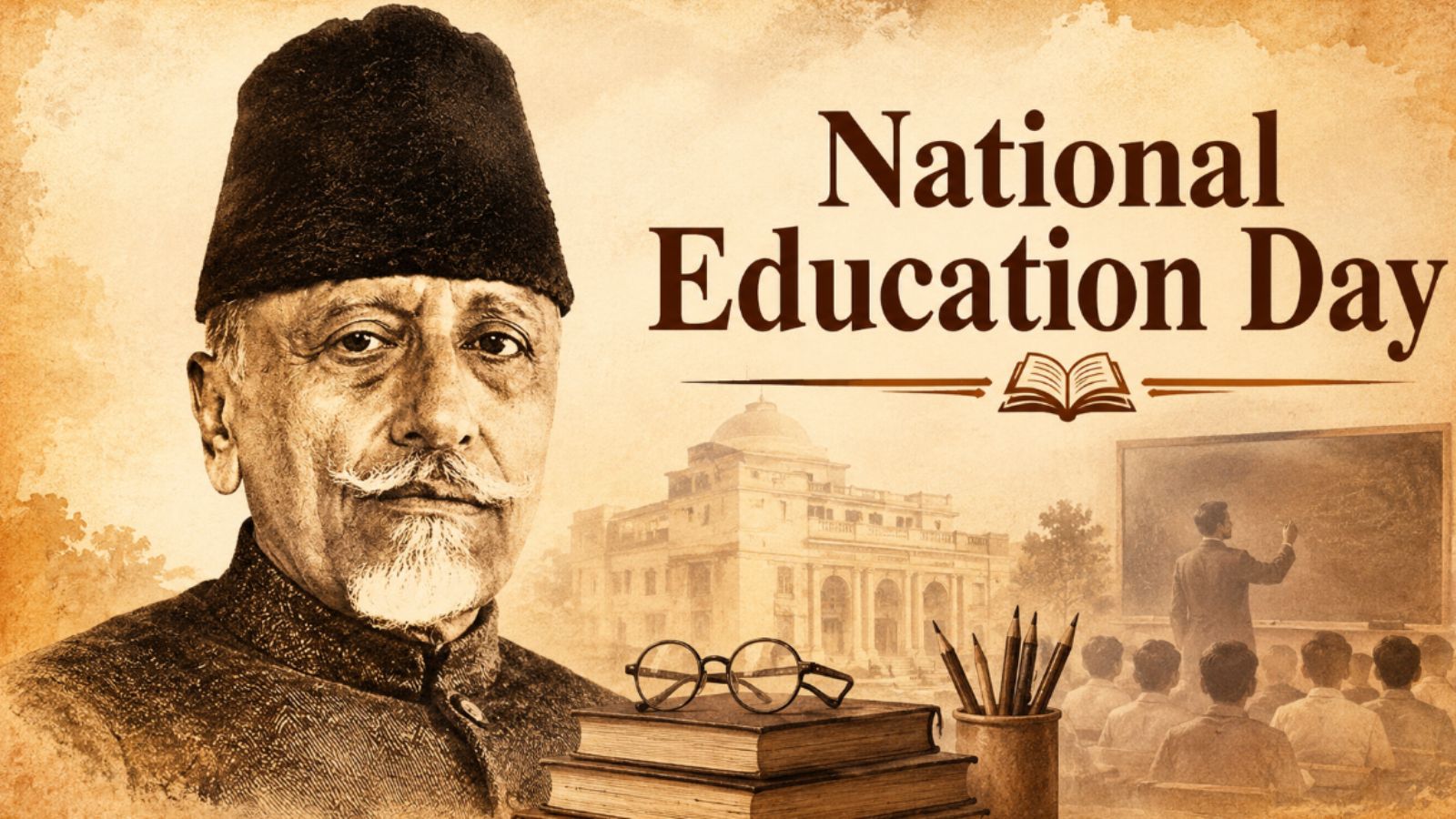
India celebrates National Education Day on November 11 to mark the birth anniversary of Maulana Abul Kalam Azad. As the first Education Minister, he set up many institutions like IITs and the UGC. He said, "giving highest priority to education in the country's national budget" should be placed immediately.
From spending years in Ranchi jail to setting up institutions of national importance, including IITs, UGC, and AICTE among others, Maulana Azad as the first Education Minister helped the education system in India to find its identity after shadowy years of colonialism.
National Education Day 2026: Every year, on November 11, India celebrates National Education Day to commemorate the birth anniversary of the country's first-ever post-Independence Education Minister, Maulana Abul Kalam Azad.
From spending years in Ranchi jail to setting up institutions of national importance, including the Indian Institutes of Technology (IITs) and the University Grants Commission (UGC), among many others, Maulana Azad's tenure as the Education Minister helped the country's education system to find its identity after shadowy years of colonialism.
The first National Education Day dates back to 2008, when the Ministry of Human Resource Development (now the Ministry of Education) declared Maulana Azad's birth anniversary as a day to pay tribute to his efforts towards the education system of India.
Mecca to Khilafat Movement
Maulana Abul Kalam Azad was born in Mecca on November 11, 1888, to scholar Maulana Khairuddin and Alia. Initially named Feroze Bakht, he became popular as Abul Kalam. A gifted scholar, he mastered the Quran at 10 and became a trained theologian by 17.
His studies at Al Azhar University in Cairo further enriched his knowledge. In Calcutta, he started the magazine 'Lisan-ul-Sidq' and was influenced by Urdu critics Shibli Nomani and Altaf Hussain Haali.
Azad entered politics during the Partition of Bengal in 1905, opposing it on religious grounds and advocating a united India. He participated in revolutionary activities and came in contact with leaders such as Sri Aurobindo Ghosh. A strong advocate of Hindu-Muslim unity, he remained firmly opposed to the partition of India in 1947.
His famous Urdu journal Al-Hilal, launched in 1912, reflected his liberal, rationalist views and his opposition to colonial exploitation. His travels across Iraq, Syria and Egypt shaped his political ideas and fortified his commitment to India's freedom.
From the office of Education Minister
Soon after India gained independence in 1947, Maulana Azad became the country's first Education Minister with a cabinet rank. He played a critical role in improving the country's education system and establishing institutions to promote education, science and culture.
In one of his speeches, Azad emphasized on giving highest priority to education in the country's national budget and should be placed 'immediately' after food and clothing.
Azad established the Indian Council for Cultural Relations (ICCR) in 1950 and helped set up three national academies, namely Sangeet Natak Akademi (1953), Sahitya Akademi (1954) and Lalit Kala Akademi (1954). He strongly believed that education should include Indian culture, which he felt had been neglected during British rule.
As Chairman of the Central Advisory Board of Education which was an apex body to recommend to the government educational reform both at the center and the states, he advocated free and compulsory education for all children up to the age of 14, along with girls' education, vocational training, agricultural education and technical education.
He also played a major role in establishing the UGC in 1956 to provide financial support to universities and maintain educational standards.
Azad was a pioneer in higher education and believed that universities had both academic and social responsibilities. He supported English for higher education and international communication, while advocating that primary education should be taught in the mother tongue.
He also gave important technical education in India. During his tenure, IIT Kharagpur was established in 1951, followed by IITs in Bombay, Madras, Kanpur and Delhi. The School of Planning and Architecture, Delhi, was established in 1955.
Education through the lens of secularism
Maulana Azad firmly believed that the solution to the problems created by religious extremists lay not in dismissing religious instruction in elementary stages but in propagating sound and healthy religious education so that the youth in their development stages would not get misguided to the intolerance of other religions.
Delivering a speech on the country's first National Education Day in 2008, former President Pratibha Patil said that the objective of celebrating this day should be to strengthen the country's educational institutions and to raise the quality of education to greater heights.
Patil said the day should be an occasion to evaluate the current performance of the country in the education field and urged all stakeholders involved in this field to come together to seek methods to advance the Indian education system in the world as a knowledge society and to focus on how to educate citizens.