
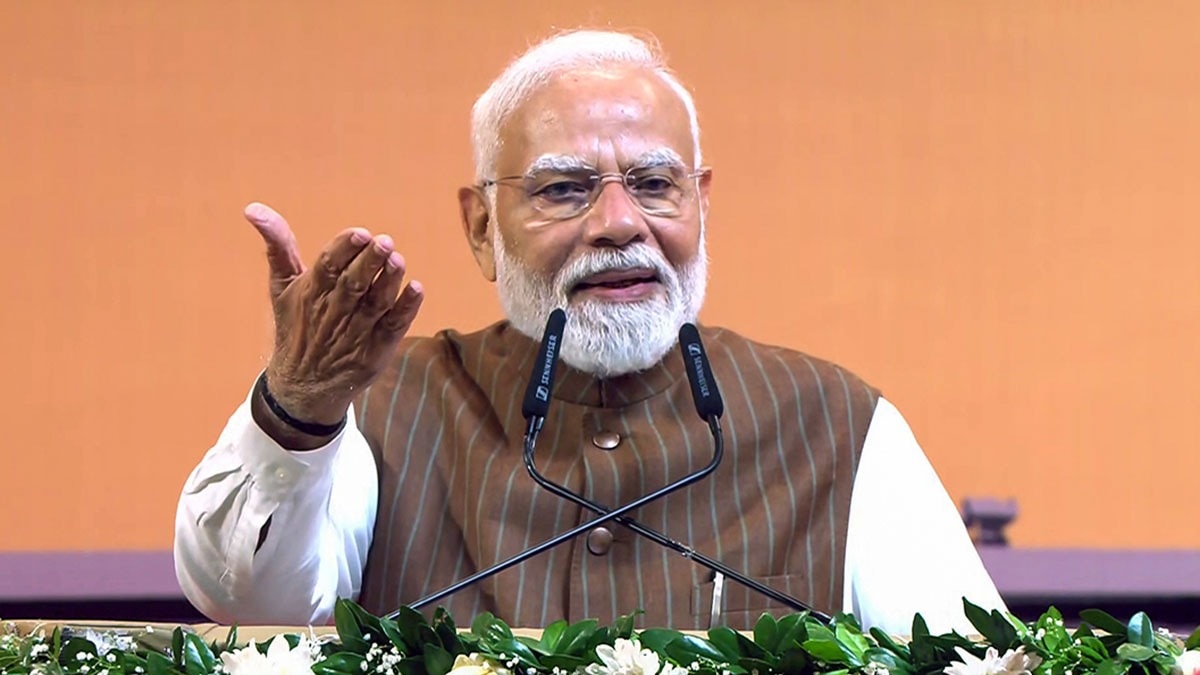
The Lowy Institute’s 2026 Asia Power Index ranked India third among 27 nations. Prime Minister Narendra Modi got a boost as experts named him the second-most-effective leader in the region. India gained points in cultural influence and defence networks, showing that the country is turning more potential into real global influence.
India's rise as Asia's third-most-powerful nation strengthens Modi's global standing amidst hard domestic criticism while exposing the limits of his 'Vishwaguru' ambitions
At a time when Prime Minister Narendra Modi faces one of the most sustained waves of domestic criticism in his 12 years in office, an assessment from Australia has handed his international credentials an unexpected boost. The Lowy Institute's 2026 Asia Power Index, released this week, places India third among 27 countries and territories, behind only the United States and China.
India gained 0.5 points to reach 40.5 while China stagnated at 73.6 and the US suffered the steepest fall by any country, losing 1.5 points to 78.9. India is the only country rated as a major power below the two superpowers, in an index that measures influence in Asia rather than global rank.
For a Modi government under siege at home, the timing is a gift. The Sydney think-tank found the power gap between India and China at its narrowest since the index began in 2018. Experts surveyed for the index now rate Modi as the second-most-effective leader in the region after Chinese president Xi Jinping -- a judgment that lifted India three places on that indicator. Diplomatic influence, at 70.3 points, remains India's strongest suit and it barely moved in a year when most countries lost ground.
There is evidence, too, that India is turning more of its potential into influence. Cultural influence rose 2.3 points to 43.8. Defence networks gained about 2.2 points to 18.6, moving up two places to ninth on the back of wider military cooperation and BrahMos missile sales to Southeast Asia. Economic relationships climbed two places to seventh, and India's future resources remain the third strongest in the index.
However, measured against its own record, India has only just climbed back to where it started. The first index in 2018 ranked India fourth, behind Japan, with 41.5 points, enough to count as a major power. The score slipped to 41 in 2019 and fell below the 40-point line to 39.7 in 2020, the year the Covid pandemic shrank the economy. It dropped to 37.7 in 2021 and bottomed out at 36.3 in the 2023 edition.
The reversal began after that. India overtook Japan for third place in 2024 with 39.1 points, crossed the major-power threshold in 2025 on the back of the military showing in Operation Sindoor, and has now consolidated that position.
This year's score is still a full point short of 2018, although Lowy's methodological revisions make direct long-range comparisons imperfect. Third place also came as much from Japan's slide as from India's climb. Besides, India's rise does not make the order tripolar. China's power remains about 80 per cent greater than India's, and the US is still nearly twice as powerful as India on the index.
India's own economy did not help. Economic capability fell 0.7 points to 26.4, although India held third place on the measure as a weaker rupee and a change in how the International Monetary Fund (IMF) measures economies shrank its relative GDP. Outbound investment fell by nearly Rs 1.8 lakh crore (about $20 billion).
The much-advertised middle-power moment, in which countries like India were meant to fill the space America vacates, has not arrived either. Lowy finds no coherent bloc forming to replace US leadership and calls the regional balance "markedly bipolar". In a two-power Asia, third place brings standing but little say over outcomes. India's realistic opportunity is to become indispensable to both superpowers rather than to rival either.
VISWAGURU OR NOT?
A country that wants to be a teacher to the world is judged by what it does when the world is at war. Three wars have reshaped the global order since 2022. Russia's invasion of Ukraine fractured the international consensus, the Israel-Palestine conflict exposed divisions over the West's moral authority, and the Middle Eastern wars of 2026 weakened assumptions about American leadership. A world organised around Western primacy is giving way to one in which major powers chase competing interests without reliable ideological alignments.
India has met each war with the same doctrine -- strategic autonomy, now rebranded as multi-alignment, and Modi has turned it into a foreign-policy brand. The old non-alignment kept its distance from rival blocs whereas multi-alignment seeks gains from engaging all of them at once. It offers the West a counterweight to China without a formal alliance, gives Russia an influential partner outside its shrinking circle of friends, and gives the Global South another interlocutor.
On Ukraine, New Delhi refused to condemn Russia and kept buying Russian oil despite Western pressure and US tariffs, even as it deepened strategic engagement with Washington and the Quad. Only at the Shanghai Cooperation Organisation Summit in September 2026 did Modi publicly urge Russian president Vladimir Putin to end the war.
On Gaza, India condemned the Hamas attack of October 2023 on Israel, hedged at the United Nations and kept its support for Palestinian statehood. In February 2026, Modi travelled to Israel to raise ties with Benjamin Netanyahu's government to a special strategic partnership.
These positions are not always easy to reconcile, but they have given India room to manoeuvre while other countries find their choices narrowing. Balancing has kept India's options open. It has not given India a hand in ending either war.
The Iran war exposed the cost. Modi's rating as the region's second-most-effective leader gives some substance to his projection of India as 'Vishwaguru', a country whose stature reflects a larger civilisational role. But regional effectiveness is a different thing from global leadership. Lowy's experts marked down Modi's global leadership and India's strategic ambition in the same survey that marked up his regional standing.
The report ties the slide to India's low profile in the Gulf conflict. It singles out New Delhi's muted response when a US submarine sank an Iranian naval vessel returning home from an exercise India had hosted. India's influence in its own region has clearly grown, but its capacity to shape the outcome of major crises remains limited.
DOMESTIC DISTRACTION
Lowy describes India's 2026 as "a year focused on internal challenges". That is a polite description of the most-visible street protest movement of Modi's third term. The youth-led Cockroach Janta Party has turned anger over examination failures, unemployment and the credibility of elections into a sustained campaign.
None of this enters Lowy's formula directly. Its verdict is that India gained influence in Asia despite an inward-looking year. The global profile is where the distraction shows. Pictures of detained students in Delhi have travelled abroad, and international rights groups and foreign newspapers have criticised the police action. A country that claims to guide the world is also judged by how it handles dissent at home.
Leader of Opposition Rahul Gandhi sought to stretch this message to American campuses. At Columbia University in New York on November 17, he said India was sitting on an "economic disaster", blamed government policy for weakening small businesses and agriculture, questioned the shortage of jobs and repeated his allegations of electoral malpractice. The BJP rejected the assessment and pointed to India's strong economic growth.
At the University of Chicago on November 18, Rahul turned to Modi's foreign policy. Personal friendships with US president Donald Trump and Putin count for little, he argued, because big countries act on national interest, not feelings. He said India had become a "side player" in world affairs and that he was shocked that Pakistan, not India, had a role in the US-Iran negotiations. Rahul wants India to reclaim the leadership it once held in the Non-Aligned Movement.
The Lowy report offers neither side a complete vindication. It supports Modi on regional influence, where expert ratings rose sharply, and undercuts any claim that India is losing international relevance. It supports Rahul on global presence, where the same experts docked India for its silence in the Gulf.
Rahul's economic gloom theory fits less well. Lowy raised India's future resources score to 56.2 on the back of a better economic forecast. Diplomatic influence and domestic welfare are different tests of governance. India can gain influence in Southeast Asia while failing to create enough quality jobs for its graduates. It can become a more valuable partner to the US and Europe while facing legitimate questions about its democratic institutions and the credibility of its elections. International prestige cannot substitute for opportunity at home.
The 2026 index captures the central paradox of Modi's leadership. The world increasingly recognises India's ambitions even as the prime minister's authority at home faces sustained challenge. Modi has made India harder for the world to ignore. His next task is to convince disaffected Indians that their own lives are advancing along with the nation's standing abroad.Subscribe to India Today Magazine