
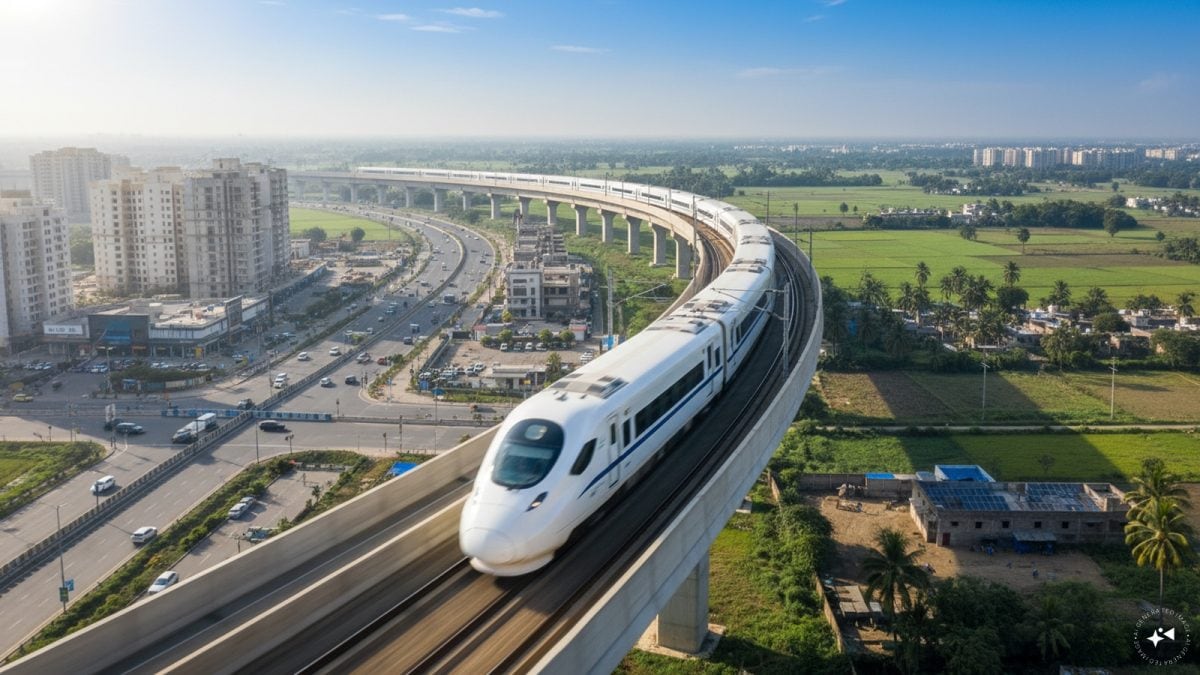
India’s proposed North Bullet Train Corridor could connect Delhi, Agra, Kanpur, Lucknow, Varanasi, Patna, Siliguri and Guwahati. Railway Minister Ashwini Vaishnaw said the project aims to cut travel time, with Delhi to Agra taking just 59 minutes. Many people got excited as this high-speed rail plan showed a faster future.
India's proposed North Bullet Train Corridor could connect Delhi, Agra, Kanpur, Lucknow, Varanasi, Patna, Siliguri and Guwahati.
India’s Vande Bharat trains have soon become a much-loved way of travelling across the country. It is fast, efficient and constantly being upgraded. But now a new train corridor has been suggested. And it is the North Bullet Train Corridor.
And India’s proposed North Bullet Train Corridor could significantly reduce travel time between Delhi and several major cities across northern, eastern and northeastern India. The high-speed rail project is expected to connect the national capital with destinations including Agra, Kanpur, Lucknow, Varanasi, Patna, Siliguri and Guwahati.
Railway Minister Ashwini Vaishnaw, in a recent TOI report, has shared indicative journey durations, including a proposed travel time of just 59 minutes between Delhi and Agra and around three hours and 33 minutes between Delhi and Varanasi.
The same TOI report suggests that the journey from Delhi to Guwahati could take less than eight hours, according to Assam Chief Minister Himanta Biswa Sarma.
While the announcement has generated interest among travellers, several project details are still awaited. Here is everything you need to know about the proposed North Bullet Train Corridor.
North Bullet Train Corridor: Which cities will it connect?
The proposed corridor is planned to link Delhi with major destinations across Uttar Pradesh, Bihar, West Bengal and Assam, extending high-speed rail connectivity to the Northeast.
The route outline shared in reports includes Delhi, Agra, Kanpur, Lucknow, Ayodhya, Varanasi, Prayagraj, Patna, Siliguri and Guwahati. However, the final station list and alignment have not been formally detailed. The Indian Express has reported six proposed stations along the Delhi-Guwahati corridor: Agra, Kanpur, Lucknow, Varanasi, Patna and Siliguri, in addition to the two terminal cities.
Delhi to Agra in 59 minutes: Check proposed bullet train travel times
One of the biggest highlights of the proposed North Bullet Train Corridor is the reduction in journey time between major cities. According to a report by MoneyControl, travel-time estimates shared by the Railway Minister, the proposed journeys include:
Delhi to Agra: 59 minutes
Delhi to Kanpur: 1 hour 45 minutes
Delhi to Lucknow: 2 hours 12 minutes
Delhi to Varanasi: 3 hours 33 minutes
Varanasi to Prayagraj: 33 minutes
Varanasi to Lucknow: 1 hour 21 minutes
Varanasi to Patna: 1 hour
Varanasi to Agra: 2 hours 34 minutes
Delhi to Siliguri: Around 6 hours
Delhi to Guwahati: Under 8 hours
These are indicative journey-time estimates, not confirmed train schedules. Actual travel times will depend on the final route, station stops and operating plan.
Why is the North Bullet Train Corridor important for the Northeast?
The proposed extension to Guwahati is significant because it could improve high-speed connectivity between the Northeast and the national capital. Assam Chief Minister Himanta Biswa Sarma welcomed the proposed extension, saying that the Delhi-Guwahati journey could take less than eight hours, reported The Indian Express.
Sarma said the corridor was initially planned to end at Siliguri. Following his request to extend it to Guwahati, the proposal was considered by the Railway Ministry. The route is also expected to pass through the strategically important Chicken Neck corridor, the narrow stretch connecting the Northeast with the rest of India. The precise engineering and alignment details for this section are yet to be made public reported TOI.
Has the North Bullet Train Corridor been approved?
Railway Minister Ashwini Vaishnaw announced that Prime Minister Narendra Modi had approved the North Bullet Train Corridor, reported The Indian Express. The announcement was made around the launch of the Vande Bharat Sleeper service between Varanasi and New Delhi on October 31, 2026.
Will bullet train tickets be cheaper than flights?
Vaishnaw has indicated that bullet train fares would be lower than airfares, with the intention of making high-speed rail accessible beyond affluent travellers. However, no official ticket prices or fare structure have been announced for the North Bullet Train Corridor. Travellers will have to wait for further details before comparing the cost of a bullet train journey with flights or existing train services.
How is the North corridor connected to India’s bullet train expansion plan?
The proposed corridor is part of India’s wider high-speed rail expansion. In the Union Budget 2026-27, Finance Minister Nirmala Sitharaman announced seven high-speed rail corridors: Mumbai-Pune, Pune-Hyderabad, Hyderabad-Bengaluru, Hyderabad-Chennai, Chennai-Bengaluru, Delhi-Varanasi and Varanasi-Siliguri.
India’s first bullet train project, the 508-km Mumbai-Ahmedabad corridor, is currently under construction. The government has targeted the opening of its priority section by August 2027. The proposed North Bullet Train Corridor could therefore mark an important expansion of India’s high-speed rail ambitions.