
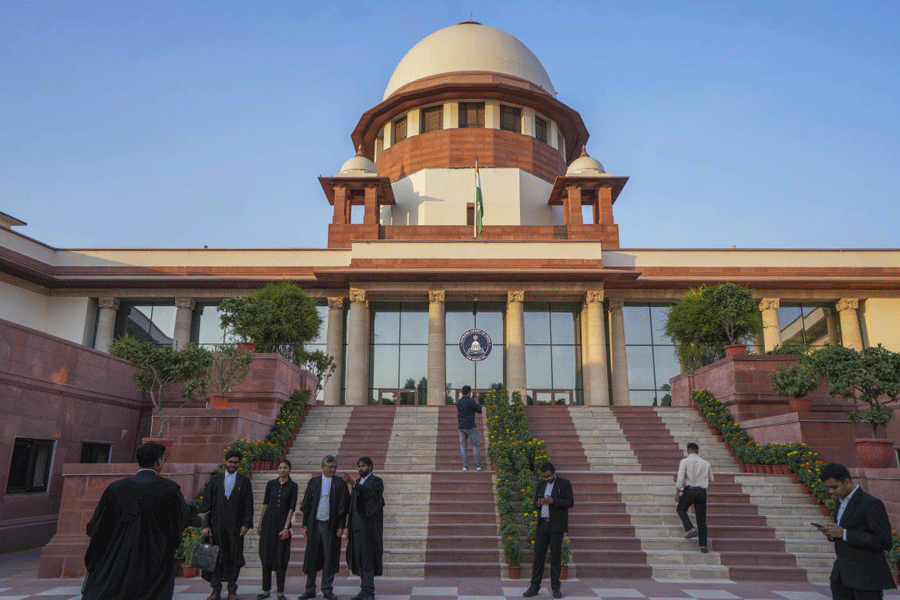
The Supreme Court said marriage prospects and job loss must count in motor accident compensation. The court gave Sunil Kumar ₹77.83 lakh and K.S. Sreejith ₹69.60 lakh for their injuries. Judges noted that permanent disability and lifelong care costs are vital factors when they decide how much money victims get.
Two Kerala accident victims receive Rs 77.83 lakh and Rs 69.60 lakh after the court considers permanent disability, lifelong care costs and loss of earning capacity
The Supreme Court has held that the impact of a disability caused by a motor accident, including marriage prospects, earning capacity and the cost of keeping a lifelong attendant adjusted to inflation, must be considered while awarding compensation to victims.
The apex court steeply enhanced the compensation amounts to be handed over to pillion rider Sunil Kumar and bike rider K.S. Sreejith to ₹77.83 lakh and ₹69.60 lakh, respectively. They had suffered grievous injuries when their bike was hit by another two-wheeler on the Thrissur-Kodara road in Keralam. These amounts are over ₹41 lakh more than the compensation fixed by the high court.
The high court itself had enhanced the compensation amounts of ₹19.91 lakh and ₹16.03 lakh awarded to Sunil and Sreejith by the Motor Accidents Claims Tribunal.
A Supreme Court bench of Justice S.V.N. Bhatti and Justice N.V. Anjaria said Sunil had suffered severe head injuries, an open diffuse axonal injury, a midbrain contusion with Weber's syndrome and a left knee penetrating injury.
"The functional effect of those injuries has to be estimated. They have grave consequences on the earning capacity of the appellant. The appellant would require an attendant and a bystander to look after him throughout his life. The appellant would be suffering from psychiatric disability of higher grade," the top court said.
"Therefore, even though the Medical Board certified the medical disability to be 75.5%, the functional effect can be said to be debilitating for the appellant to the extent of 100%," Justice Anjaria, who authored the judgment, added.
"...The appellant would not be able to do his own work, much less engage in earning activity for himself and his family, leading to total loss of working capacity".
In the case of Sreejith, the bench said the medical board had certified a 62 per cent disability.
"...The appellant became permanently disabled and effectively lost his earning capacity.... The appellant... was an energetic, able-bodied youngster at the time of the incident. Therefore, the loss towards marriage prospects would have to be recognised while determining the amount of compensation," the court said.