
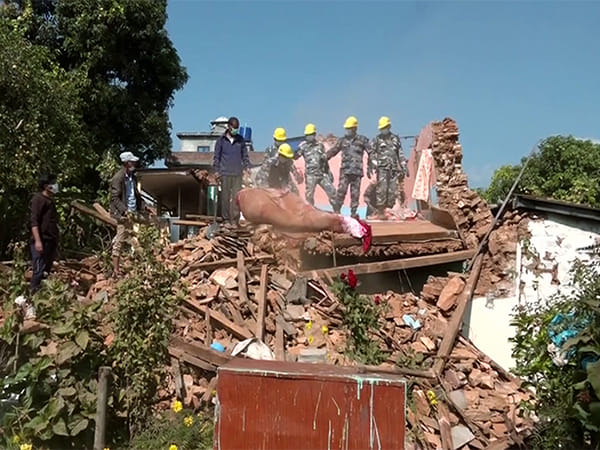
A new IIT-Bombay study warns that the fault system beneath the Uttarakhand Himalayas is building up tectonic strain. Researchers said, “the accumulated strain energy is equivalent to one Mw 8.1 megathrust earthquake every 100 years.” This pressure shows that a major earthquake could hit the region in the future.
New Delhi: The fault system beneath the Uttarakhand Himalayas is accumulating tectonic strain, which could release energy equivalent to a magnitude 8 earthquake approximately every 100 years, a new study has found.
The study, led by IIT-Bombay and published in the journal Earth and Planetary Science Letters, has found that the Main Himalayan Thrust, a major fault system associated with the ongoing collision between the Indian and Eurasian plates, is strongly locked beneath India’s Uttarakhand. This means that while the plates continue to move toward each other, a significant portion of the fault is not slipping freely, allowing elastic strain to accumulate in the surrounding rocks.
Researchers warned that this could point to a mega-earthquake brewing in the region.
“Our results also indicate that the megathrust in the Uttarakhand Himalaya is highly coupled (>0.8) and the accumulated strain energy is equivalent to one Mw 8.1 megathrust earthquake every 100 years along this ∼300 km section of the megathrust,” the study read.
The research, conducted by Dibyashakti Panda, Mridul Yadav, Eric O. Lindsey and G Srinivasa Rao, combined measurements from Global Navigation Satellite System (GNSS) stations with satellite radar observations from Japan’s ALOS-2 satellite to examine how the fault is behaving between major earthquakes.
The analysis indicates a slip deficit of around 18 millimetres per year, and the locked portion of the Main Himalayan Thrust extends across a width of about 115 km.
Findings
For the study, scientists also used Interferometric Synthetic Aperture Radar (InSAR)—a technique that compares radar images acquired by satellites at different times to measure subtle changes in the Earth’s surface.
The observations from ALOS-2 also gave insight into how the peak ground uplift of nearly 4-6 millimetres per year was observed in the study region. Such vertical movements can provide clues into how the rocks above a locked fault are deforming under the pressure of converging tectonic plates.
Scientists warned that the strain accumulated along a 300-km section of the fault was equivalent to that released by a magnitude 8.1 megathrust earthquake roughly once every century. However, scientists also caveated that the estimate should not be interpreted as a prediction that an earthquake of this magnitude will occur every 100 years.
(Edited by Ratan Priya)
Nine Years, Made Possible by Readers
In 2017, Shekhar Gupta started ThePrint with a simple belief: Indian readers want journalism that asks why and what next, not just what. And that enough of them would be willing to pay for good journalism.
Nine years on, that belief has held.
And, in these nine years, we’ve stayed true to our mission. We’ve been asking the follow-up questions, going beyond the headlines and explaining what’s actually happening. We’ve travelled across the country to bring you in-depth, visually-compelling stories from the ground.
It’s been nine years of readers choosing to make this possible. If you’d like to be one of them: