
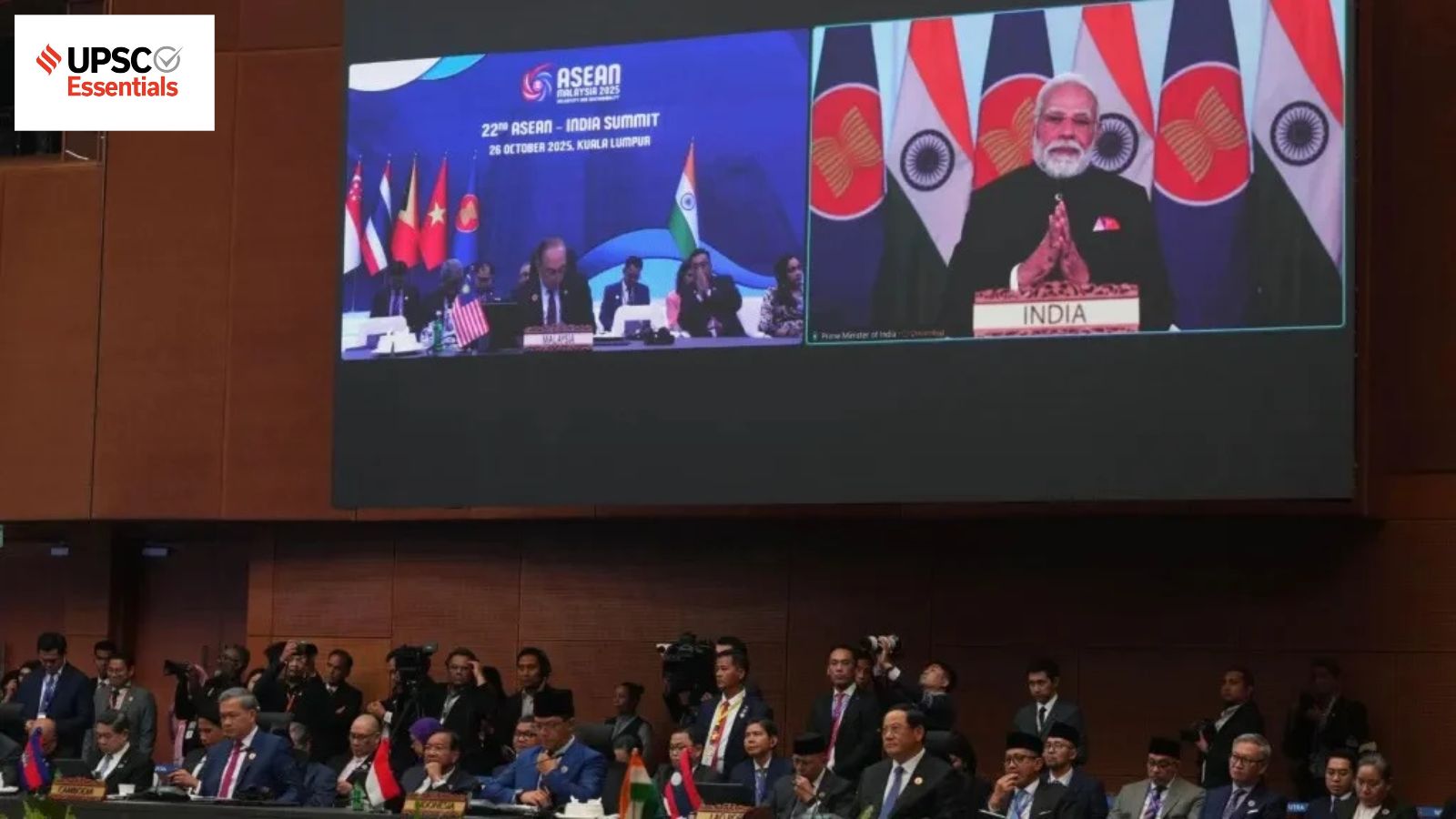
The Mains answer practice GS 2 for Week 177 focuses on India-ASEAN relations and reservation rulings. It suggests that India needs to move beyond simple diplomatic engagement toward sustained strategic cooperation. The guide helps students explore regional security, economic integration, and the Act East Policy through structured thought processes for exams.
QUESTION 2
How does the Supreme Court’s ruling on reservation following conversion highlight the distinction between social backwardness and legally recognised backward-class status? Discuss.
QUESTION 1: “India–ASEAN relations need to move beyond diplomatic engagement towards sustained strategic cooperation.” Discuss.
Relevance: The question is relevant to the GS 2 syllabus under Bilateral, Regional and Global Groupings and Agreements involving India and/or affecting India’s interests. It examines the strategic importance of ASEAN for India’s Act East Policy, Indo-Pacific vision, regional security and economic integration.
Note: This is not a model UPSC answer. It only provides you with a thought process which you may incorporate into the answers.
Introduction:
— India and the Association of Southeast Asian Nations (ASEAN) have a longstanding alliance built on economic integration, regional stability, and a shared desire for an open and inclusive Indo-Pacific.
— However, transforming diplomatic engagement into long-term strategic cooperation remains critical to realising the full potential of this relationship.
Body:
You may incorporate some of the following points in your answer:
Need to deepen strategic cooperation
— Growing geopolitical competition and marine issues need greater cooperation between India and ASEAN countries.
— Regional security can be strengthened by information exchange, coordination between the navy and the coast guard, and combined responses to piracy, trafficking, and illicit fishing. Joint research, development, and production of defence equipment can strengthen local capabilities while reducing supply-chain risks.
— Progress in evaluating the ASEAN-India Trade in Goods Agreement (AITIGA), enhancing connectivity, and strengthening supply chains can all help unleash trade and investment opportunities.
— Regular communication between defence installations, think tanks, and research institutes can foster mutual confidence and translate common priorities into actionable actions.
— Cooperation in humanitarian aid and disaster relief can boost regional resilience and India’s reputation as a dependable partner.
Conclusion:
— India-ASEAN relations must grow from diplomatic goodwill to a partnership based on strong institutions, economic interdependence, and actual security cooperation.
— A sustained, inclusive, and ASEAN-centered approach will help India promote its Act East Policy while also contributing to a stable, prosperous, and multipolar Indo-Pacific.
(Sources: India and ASEAN need to talk more, With uncertainty looming, challenges and opportunities for India’s Act East policy, India-ASEAN ties need a renewed push)
Points to Ponder
How can India strengthen defence cooperation, maritime security and intelligence-sharing with ASEAN member states?
Challenges in India-ASEAN cooperation
Related Previous Year Questions
“IPMDA (Indo-Pacific Partnership for Maritime Domain Awareness) bridges the gap between India’s SAGAR (Security and Growth for All in the Region) vision and the Quad’s collective Indo-Pacific strategy.” Make a critical assessment of the statement focusing on IPMDA (2026)
“BRICS acts as a powerful counterweight in global governance, actively amplifying the voice and influence of the Global South.” Explain the role of BRICS in projecting itself as an alternative to other groupings (2026)
QUESTION 2: How does the Supreme Court’s ruling on reservation following conversion highlight the distinction between social backwardness and legally recognised backward-class status? Discuss.
Relevance: The question is relevant to the GS 2 syllabus under Indian Constitution—historical underpinnings, evolution, features, amendments, significant provisions and basic structure and Mechanisms, Laws, Institutions and Bodies constituted for the protection and betterment of vulnerable sections. It examines the constitutional framework of reservation, judicial interpretation and the relationship between social justice and eligibility for affirmative action.
Note: This is not a model UPSC answer. It only provides you with a thought process which you may incorporate into the answers.
Introduction:
— The Supreme Court recently upheld the Madras High Court’s judgement to overturn a Tamil Nadu government decree that permitted certain converts to Islam to claim Backward Class (Muslim) reservation.
— The judgement emphasises that feeling social adversity and belonging to a constitutionally defined backward class are two distinct legal issues.
Body:
You may incorporate some of the following points in your answer:
Social backwardness vs. legally recognised status
— Social backwardness is a condition, but legal recognition is a separate necessity. Poverty, educational deprivation, discrimination, and limited chances may exist even when a person converts to a different religion. Reservation under Article 16(4) is contingent on belonging to a class designated as backward under the applicable constitutional and legal frameworks.
— Previous caste identification or disadvantage does not imply eligibility for reservation under a different designated social category.
— The Court ruled that conversion to Islam does not automatically grant membership in a certain Muslim community designated as backward in Tamil Nadu. The seven Muslim communities registered under the relevant Tamil Nadu reserve category have different social and historical identities. Religious affiliation does not guarantee membership in one of them.
Conclusion:
— The decision emphasises that affirmative action must address genuine social disadvantage using constitutionally established categories and legally valid qualifying requirements.
— At the same time, successful social justice necessitates that governments investigate persistent hardship using relevant, evidence-based processes rather than viewing religious conversion as proof of backward-class membership.
(Sources: How religious conversion affects eligibility for caste-based reservation, Why SC held that conversion to Islam alone does not qualify a person for BC reservation)
Points to Ponder
How do Articles 14, 15 and 16 establish the constitutional basis for equality and affirmative action?
Related Previous Year Questions
Whether National Commission for Scheduled Castes (NCSC) can enforce the implementation of constitutional reservation for the Scheduled Castes in the religious minority institutions? Examine. (2018)
“Women as a class neither belong to a minority group nor are they regarded as forming a backward class.” In the light of this statement, discuss the evolution of women’s reservation from local bodies to Parliament (2026)
Previous Mains Answer Practice
UPSC Essentials: Mains answer practice — GS 3 (Week 176)
UPSC Essentials: Mains answer practice — GS 3 (Week 177)
UPSC Essentials: Mains answer practice — GS 2 (Week 176)
UPSC Essentials: Mains answer practice — GS 2 (Week 175)
UPSC Essentials: Mains answer practice — GS 1 (Week 176)
UPSC Essentials: Mains answer practice — GS 1 (Week 175)
Subscribe to our UPSC newsletter and stay updated with the news cues from the past week.