
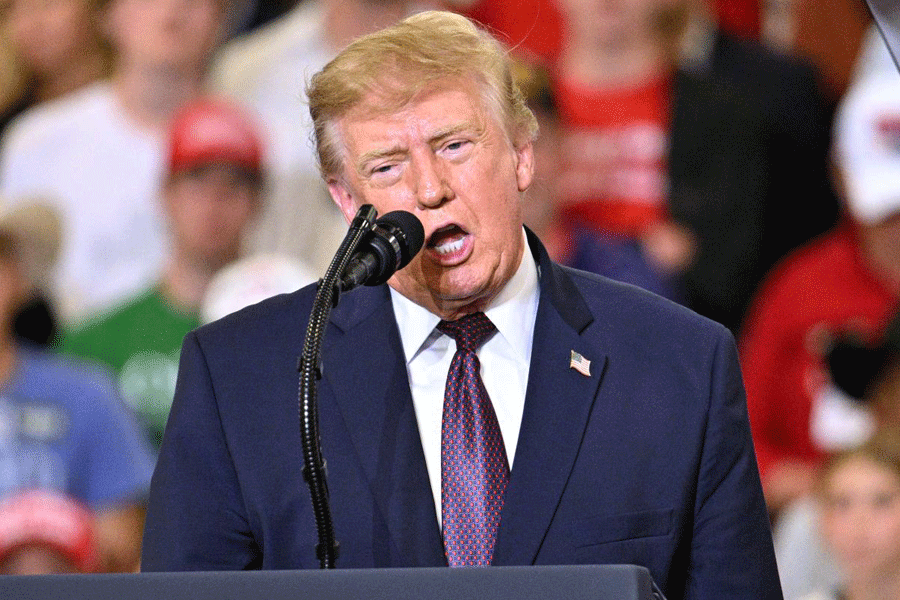
Alaska now faces a political firestorm as a dummy candidate contest mirrors Indian electoral tactics. President Donald Trump ordered a Justice Department investigation into alleged voter fraud before the November 3 elections. Trump said, "This is Voter Fraud at the Highest Level," as his party fights to keep key seats.
While dummy candidates may be commonplace in India and add comic relief to its electoral drama, a similar namesake contest in Alaska has sparked a political firestorm ahead of crucial US mid-term elections
From Hema Malini in Mathura to Rahul Gandhi in Wayanad, dummy candidates have long been part of India's electoral landscape. But a similar namesake contest in Alaska has triggered a political firestorm in the United States, with President Donald Trump ordering a Justice Department investigation into alleged voter fraud ahead of crucial mid-term elections.
Few people in India will recall that Hema Malini contested against another Hema Malini in Mathura in the 2014 Lok Sabha elections. Or that in 2019, Rahul Gandhi faced another candidate named Rahul Gandhi, along with a Raghul Gandhi, in Wayanad.
Such dummy candidates might be commonplace in India and even provide comic relief in its gruelling electoral battles. But thousands of miles away, a similar controversy in the remote US state of Alaska has become a major political issue ahead of the November 3 elections, which are expected to serve as a referendum on Trump's policies and popularity.
Trump is now using the controversy, which appears to have been triggered by an alleged Democratic effort to influence the contest, to his political advantage.
Opinion polls suggest that Trump's Republican Party is trailing nationwide in the elections for the House of Representatives and the Senate, the two chambers of the US Congress. The party is also facing challenges in Republican strongholds such as Alaska, where incumbent Republican Senator Daniel Sullivan is locked in a tough contest against Democratic candidate Mary Peltola.
Trump immediately cried foul and ordered a Justice Department investigation into alleged voter fraud. His administration contends that Alaska Democrats sought to confuse voters by fielding a dummy candidate to divert votes from the Republican incumbent.
"This is Voter Fraud at the Highest Level ... this behavior in our Elections cannot be allowed to continue," Trump wrote on Truth Social, calling for Peltola to be "removed from the ballot and prosecuted."
On Thursday, CNN reported that the Justice Department "has dramatically accelerated a criminal probe" into the matter, issuing dozens of new grand jury subpoenas and examining potential new charges.
On the face of it, there is nothing illegal about a candidate with the same name entering an election. The ballot paper clearly distinguishes between the two Sullivans, identifying one as the incumbent and the other as an independent candidate with no party affiliation.
"But Trump has spent years spinning false conspiracies about Democratic cheating and non-existent electoral fraud. Now, at last he has a data point to sculpt into a suggestive narrative," wrote CNN political analyst Stephen Collinson.
"And whether the OG (original) Dan Sullivan wins or loses, the president will be sure to highlight shenanigans in Alaska to claim Democrats everywhere are corrupt -- especially if the GOP bombs on Tuesday (Nov. 3)," he wrote.
However, under US laws, elections are a state matter. The decision on who enters the ballot rests with the state, leaving the federal government with no direct say in the process. The Justice Department investigation may therefore face legal hurdles.
"But in politics, as opposed to the law, perception has long been as important as reality. Trump understands this more instinctively than any modern president," wrote Collinson.
Trump has political reasons to pursue the controversy. A Republican defeat in the Senate, on top of an expected loss in the House of Representatives, would deal a major blow to his presidency. Control of the 100-member Senate remains uncertain, with a handful of states, including Alaska, likely to determine the outcome.
A New York Times-Siena poll gave Democrats a 51-45 per cent lead over Sullivan. If Alaska ultimately determines which party controls the Senate, the result could trigger major political turmoil, with Trump unlikely to concede defeat without a fight.
India, too, witnessed a legal challenge against duplicate and namesake candidates in 2024, when a public interest litigation was filed over the issue. The Supreme Court, however, dismissed the concerns, observing that a person's name, whether Rahul Gandhi or Lalu Prasad Yadav, cannot come in the way of their right to contest elections.
The master of dummy candidates in India was Congress leader Ajit Jogi. In the 2014 elections, facing BJP candidate Chandulal Sahu in Mahasamund in Chhattisgarh, Jogi managed to get at least seven other candidates named Chandulal into the contest. Three more candidates were named Chanduram.
Despite the multiple namesakes in the fray, the BJP's Sahu won by a narrow margin, even though the other candidates also secured a sizeable number of votes.
For the record, Hema Malini lost the 2014 elections. Not the actress; the other one.