
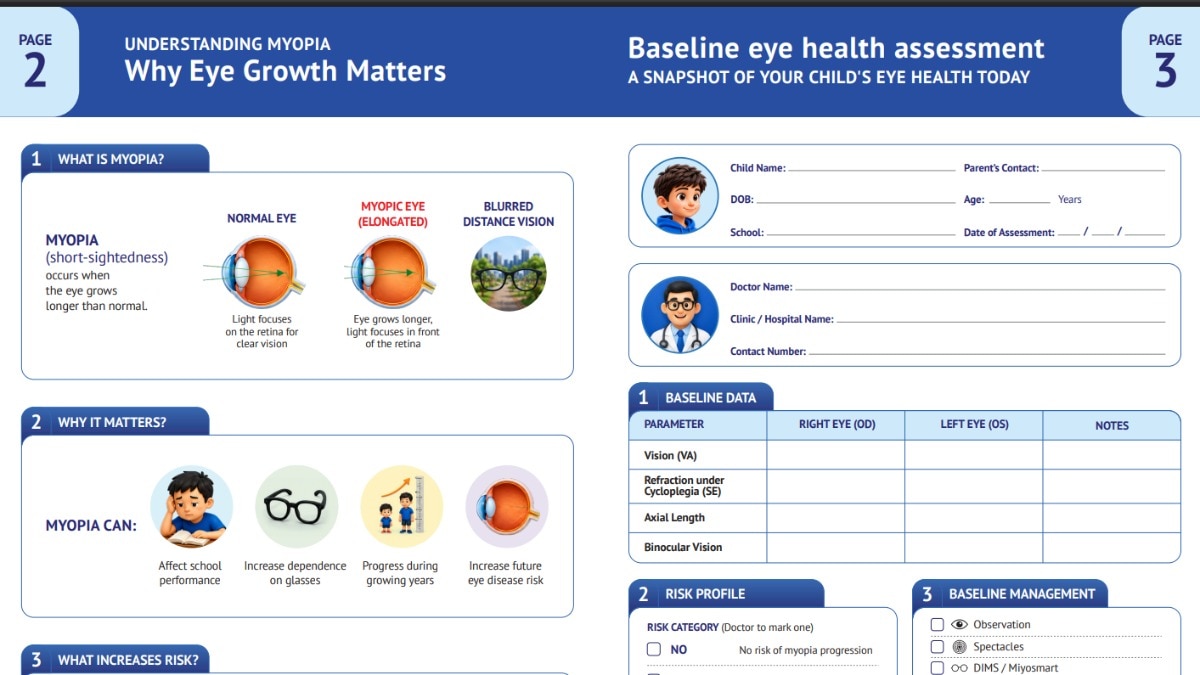
The All India Ophthalmological Society developed a Vision Growth Card with support from Mankind Pharma to track myopia in children. As screen time rises, this tool helps parents and doctors monitor eye health like a standard growth chart. It records vision trends to catch and treat short-sightedness early for kids.
All India Ophthalomological Society (AIOS) has developed a Vision Growth Card with support from Mankind Pharma, a tool that standardises myopia tracking and encourages timely treatment and follow-ups.
India's children are growing up with screens in their hands and less sunlight on their faces. The result is a quiet public health problem: myopia, or short-sightedness, is rising sharply among Indian kids.
To help catch it early, the All India Ophthalmological Society (AIOS), the country's largest network of ophthalmologists which has over 30,000 doctors as its members, has developed the Vision Growth Card, with support from Delhi-based Mankind Pharma.
Much as paediatricians and parents track height, weight and vaccinations on a growth card, this booklet lets families and eye doctors track a child's eye health over time.
Estimates suggest that myopia among Indian children has risen sharply over the past two decades, with urban prevalence jumping from 4.44% in 1999 to 21.15% in 2019, and projections estimating it could affect up to 48.14% of urban children by 2050.
WHY EYE GROWTH MATTERS
Myopia occurs when the eye grows longer than normal, so light focuses in front of the retina instead of on it. The result is blurred distance vision.
The card explains this in simple visuals for parents, and spells out why it matters: myopia can affect school performance, increase dependence on glasses, progress through the growing years and raise the risk of eye disease later in life.
It also names the factors that raise risk: excess screen time, too little outdoor activity, family history, continuous near work and nutritional deficit.
WHAT THE CARD TRACKS
Each section of the card has a clear purpose. It opens with a baseline assessment, a snapshot of the child's eye health today that covers vision, refraction under cycloplegia, axial length and binocular vision for each eye. The doctor also marks a risk category (none, low, moderate or high) and the management chosen, from observation and spectacles to DIMS (Defocus Incorporated Multiple Segments) lenses, atropine therapy, orthokeratology, lifestyle changes and nutritional support.
It also records whether an annual fundus examination is required.
The myopia progression tracker then follows the child visit by visit, logging age, vision, refraction, axial length and treatment, with the doctor ticking progress as stable, slow, moderate or rapid. Graphs of visual acuity, refractive progression and axial length let parents see the trend at a glance.
Next comes the treatment and compliance tracker, which notes the current plan, scores how closely the family is following it from excellent to poor, and fixes the next follow-up date, with a recommended interval of 3, 6 or 12 months.
The red-flag alerts page lists warning signs that should send a child to the doctor sooner: a rapid increase in power, frequent headaches, reduced vision, increased squinting, excessive eye rubbing and difficulty seeing the board in school.
The card closes with a child education summary of five golden rules for healthy eyes. Children should play outdoors daily for at least two hours, reduce continuous screen time by the 20-20-20 rule, keep books and screens 30 to 40 cm from the eyes, wear glasses as prescribed, and never miss follow-up visits.
HOW IT HELPS
Experts said that in the case of parents, the card turns a vague worry into something visible. A rising line on an axial length graph is far easier to act on than a doctor's passing remark. The red flag page gives families clear cues for when to seek help, and the golden rules put simple habits within reach of every household.
In the case of ophthalmologists, a standard format means every child is assessed and followed the same way, with risk categorised early and treatment decisions recorded. The card also nudges parents toward the regular follow-ups that myopia management depends on.
Dr Jeewan Singh Titiyal, AIOS president, underlined the need for tracking. "When the eye issue in kids is properly tracked then only can it be treated," he said. "We want ophthalmologists across the country to adopt and use the chart seriously for all the kids they examine."