
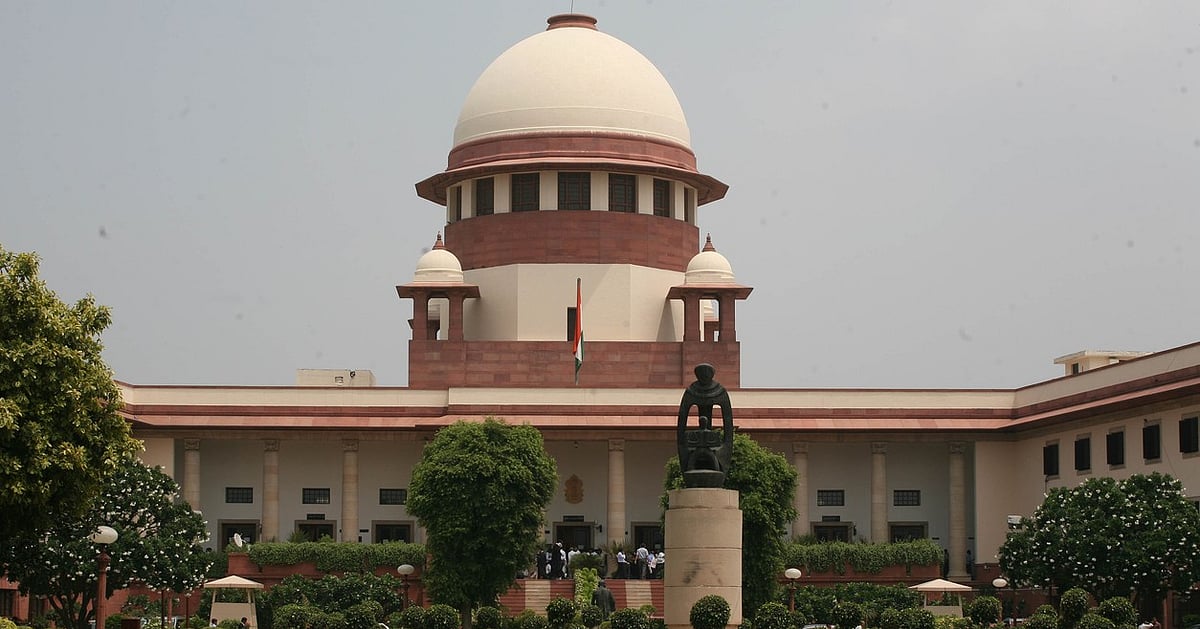
The Supreme Court said last seen evidence cannot form the sole basis of conviction without a minimal time gap. The bench upheld the acquittal of Sudhir Kumar Saxena in a 2007 murder case. It noted that the prosecution failed to prove a complete chain of events beyond reasonable doubt.
New Delhi: The Supreme Court has said last seen evidence cannot form the sole basis of conviction unless the time gap between the circumstance and the discovery of the dead body is so minimal that the possibility of the involvement of any third person is effectively obviated.
A bench of Justices Manoj Misra and Vijay Bishnoi held that mere last seen evidence is insufficient for conviction when there is a significant time gap and no other corroborating evidence.
The court dismissed the Uttarakhand government’s appeal and upheld the acquittal of Sudhir Kumar Saxena in a 2007 murder case, ruling that the prosecution’s evidence was insufficient to prove guilt beyond reasonable doubt.
The court emphasised in cases based entirely on circumstantial evidence, the prosecution must establish a complete chain of events that points exclusively to the guilt of the accused.
If forensic evidence fails to link the recovered articles to the crime and the motive remains unproven, the benefit of doubt must be extended to the accused, the court said.
The case stemmed from the discovery of a man’s body in a sugarcane field on September 27, 2007. The deceased’s wife alleged that Saxena had taken her husband from home on the morning of September 26 after a quarrel over money and that he never returned. The autopsy suggested death around the evening of September 26 from sharp-weapon injuries.
Prosecutors relied on three pillars, motive from a money dispute, last-seen evidence, and recovery of blood-stained clothes and a mini-sword at the accused’s instance. Forensic tests, however, failed to link the bloodstains to the deceased.
The court found the wife’s testimony on motive unconvincing. “If the wife was suspecting the accused of harbouring an ill motive... she would not have waited for two long days to lodge even a missing report,” the bench said. No details of the alleged money transaction were provided, it noted.
On the last-seen theory, the court held the evidence weak. There was no clear proof that the accused was seen with the deceased near the place where the body was found. Even if they were together, a significant time gap remained, it pointed out.
“Ordinarily, last seen circumstance on its own cannot be the basis of conviction unless the time-gap... is so minimal that involvement of any third person in the crime is obviated,” the bench observed. The accused was also not seen carrying any weapon.
The recovery of articles lost value as they could not be connected to the deceased’s blood group or DNA.
Rejecting the state’s plea for an adverse inference under Section 106 of the Evidence Act, the bench said the High Court’s decision to grant the benefit of doubt was a possible view that did not warrant interference.