
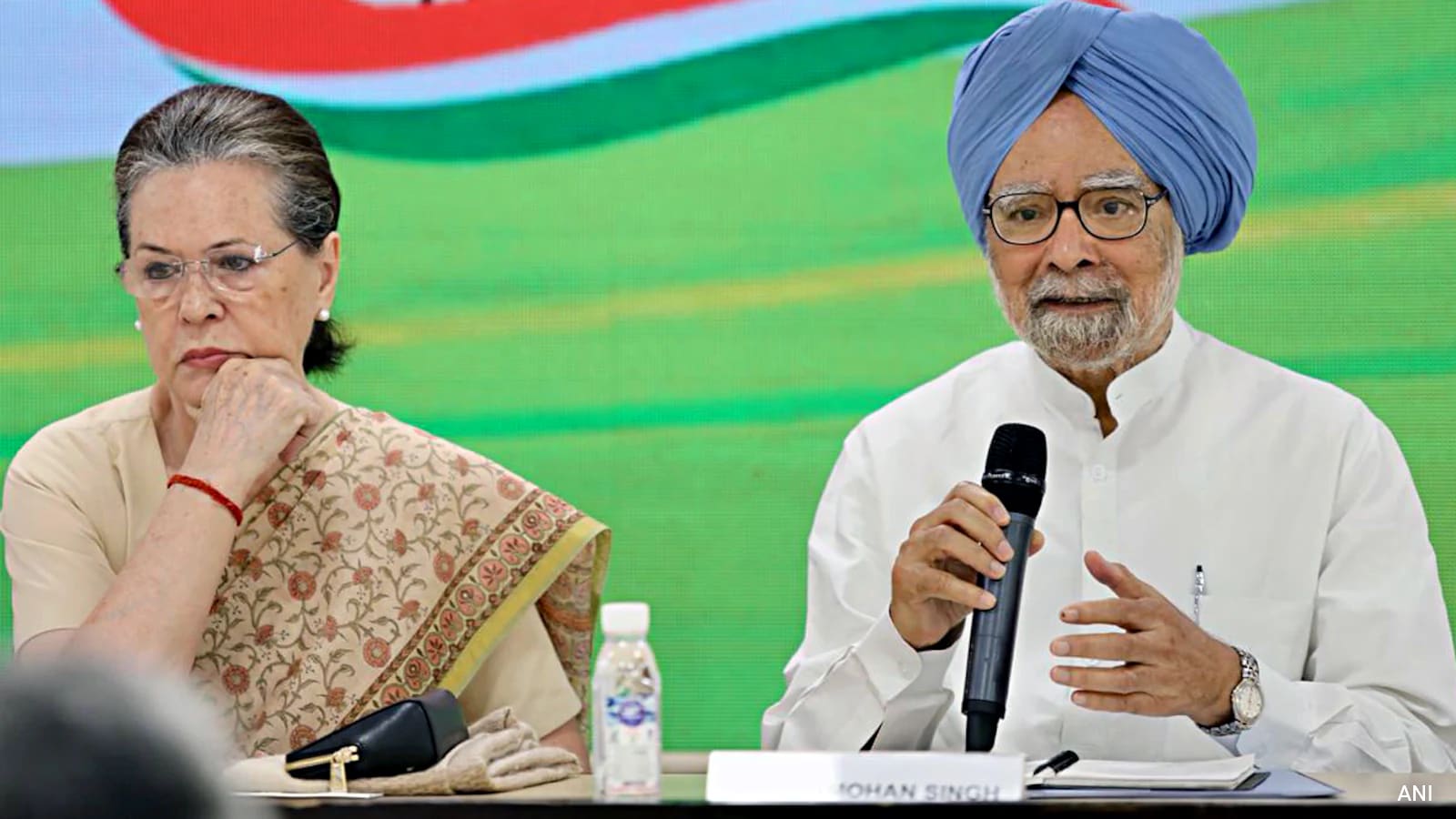
Sonia Gandhi’s memoir, "Belonging: A Journey of Love," hit the stands on Tuesday, explaining why she chose Manmohan Singh as Prime Minister in 2004. She said, "I knew India would be safe in his hands." Gandhi picked Singh for his integrity and deep understanding of governance to lead the country.
Sonia Gandhi said Manmohan Singh was a person of "unquestionable" integrity
New Delhi:
Congress MP Sonia Gandhi's long-awaited memoir, "Belonging: A Journey of Love", hit the stands on Tuesday, offering an account on why she turned down her party's offer to become prime minister and chose Manmohan Singh instead to lead the country in 2004.
She said that she picked up Singh, the two-time prime minister who died at the age of 92 in 2024, as she thought of him as a person of "unquestionable" integrity with a deep understanding of governance.
Gandhi, the then Congress president, said that she believed Singh would also assuage the doubts of many about the UPA's ability to manage and continue the policies that began years ago.
"There were several senior colleagues, seasoned and qualified for the post, who would have been more than willing to accept it but amongst all of them was one who had long been in my sight as a person above reproach, and possessed a deep and consummate understanding of governance. That was Dr Manmohan Singh, a member of the Congress Working Committee," Gandhi said in the book published by HarperCollins India.
She said that Singh, as an experienced economist and the minister of finance, in the early 1990s, introduced economic reforms in India under the then prime minister PV Narasimha Rao.
"He was not allied to any camp in the party. Over a period of time, the Congress had been painted as being left of centre, and our government would now be supported by the Communist parties as well. I thought Dr Manmohan Singh would assuage the doubts of many about our ability to manage and continue the policies that had been begun years ago," she said, elaborating on the reasons why Singh was chosen to lead the country.
He was born into a Sikh family in a village in Punjab that is now part of Pakistan, and having lost his mother at an early age, he knew hardship and struggle well, Gandhi said.
"His keen intellect and hard work had taken him from a remote village school to the universities of Oxford and Cambridge, and on from there to international fora. Aside from all his accomplishments as a scholar and technocrat, what I knew best about Dr Singh was that he had a kind and compassionate heart, and his integrity unquestionable," she said.
"I knew that our beloved country would be safe in his hands. I held consultations with my senior colleagues, and they seemed more reconciled to my decision now. They didn't oppose Dr Manmohan Singh's name when I suggested it to them; no one could contest the depth of his experience or his reputation as an honourable man who would do right by India," Gandhi said.
The 79-year-old recalled that Singh was sounded out privately on whether he would accept the post, and after an initial refusal, his hesitation was overcome, and he was persuaded to agree.
"I asked my colleague Dr Manmohan Singh to accompany me. It was May 18 when we arrived at Rashtrapati Bhawan. Its vast imposing walls stood tall against the sweltering sun. A flock of pigeons flitted about a large sandstone fountain at the centre of what is called the Eastern Court of the palatial building.
Congress leader KC Venugopal, the then UPA Chairperson Sonia Gandhi, Congress leader and MP Rahul Gandhi and Former Prime Minister Manmohan Singh during the Congress Working Committee (CWC) meeting at AICC Headquarters in New Delhi on August 10, 2019
Photo Credit: ANI
"I felt a sudden surge of emotion as our cars pulled up at the entrance. I'd been there many times before with my mother-in-law and with Rajiv, but this time I was walking through the long, dark corridors of Rashtrapati Bhawan for a different purpose," she said.
"We returned from Rashtrapati Bhawan to my home at 10, Janpath. I saw Dr Singh to his car. There had been no discussion about the prime ministership between the two of us on the drive back nor had there been before that. I said nothing to him even now. He had quite naturally assumed, like everyone else, that it would be me," she said.
On Turning Down PM Post
Sonia Gandhi said her children -- Rahul Gandhi and Priyanka Gandhi -- felt she should not become prime minister as they had lived through the trauma of the assassinations of their grandmother, Indira Gandhi, and father, Rajiv Gandhi.
She said that she was internally conflicted over the issue with one part of her rejecting the idea completely, and the other part calling on her sense of obligation towards the party workers who'd be hurt and disappointed by her refusal.
"Some months before the election, my children and I had discussed the issue of my possible prime ministership. One of them asked me straight out whether I would accept the post, just in case our party pulled off a victory. 'Absolutely not!' I'd said, almost indignantly. 'Are you sure?' they pressed me. 'I'm very clear,' I said emphatically," Gandhi said.
"They'd lived through the trauma of their grandmother's assassination and the brutal murder of their father. In their minds, holding that office was intrinsically linked with heightened danger. They looked relieved and I, too, felt lighter, having said my views out loud on the question for the first time. And there the matter rested. I never spoke of it to anyone else," she said.
She said that throughout the 2004 election, she had given a noncommittal answer whenever she was asked this question in public.
"Years ago, when I took the first step of the journey that had brought me to this point, I knew in my heart what my husband and my mother-in-law would have expected of me. I had felt an inner call of duty towards them and all that they had fought for throughout their lives. But now I was at sea; I had to search within my troubled self for an answer."
"... My emotions were changing, moment to moment. One minute I was clear, the next, I was torn," she wrote.
She said that some alliance leaders met her and urged her to agree to their proposal.
"As the discussion comes to an end, they look towards me for a response. I muster up as much courage as I can and I say my piece. There is an uproar amongst them, they stand up and move towards me. I, too, stand up. They physically surround me.
"'We will not accept this,' one of them says. 'You cannot take this decision, Madam,' says another. Their tone is forceful, almost aggressive. 'We will not take no for an answer.' I am shaken. I feel overpowered. 'Theek hai,' ('All right,'), I mumble almost inaudibly. The assembled leaders don't even wait for me to finish my sentence, they begin to congratulate me, one by one," Gandhi recalled.
She said she later had an argument with her children.
"One voice within me said, 'Sonia, this is a ridiculous proposition. You were born and brought up in Italy and here you are, being chosen to lead a nation of more than a billion people at the other end of the world.' "Another voice replied, 'This is your country; you owe your whole adult life and allegiance to it. When you lost the man you loved, it took you in its arms as one of its own. Its people have comforted you and nurtured you through shattering tragedies. How can you abandon your responsibility to those who have placed their faith in you, in your party?" she wrote.
How may i help you today
Show full article
Track Latest News Live on NDTV.com and get news updates from India and around the world