
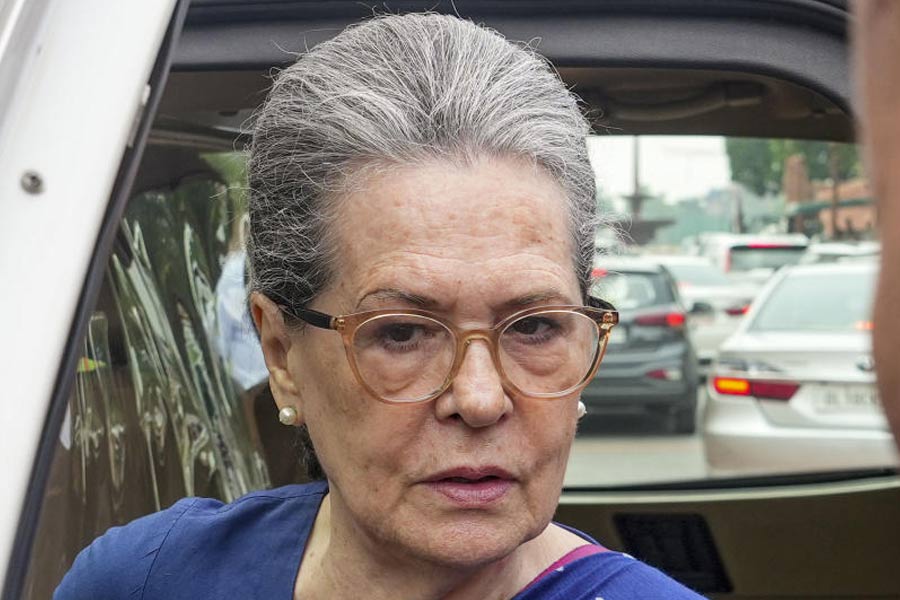
The BJP on Saturday told Sonia Gandhi to lose her "Italian lenses" after she claimed Narendra Modi damaged India’s democracy. MP Tarun Chugh said, "If you take off your Italian lenses, you will see India clearly." The party also questioned her views on the 1975-77 Emergency and past scandals.
The BJP on Saturday prescribed that Sonia Gandhi should lose her "Italian lenses", responding to her assessment in an expansive interview that the Narendra Modi years had damaged India's democratic institutions,
In an interview with The Hindu's N. Ram before the release of her memoir, Belonging: A Journey of Love, next week, Sonia had accused the Modi government of inflicting "great damage" on India's democracy, institutions and social fabric
"If you take off your Italian lenses, you will see India clearly," quipped BJP Rajya Sabha MP Tarun Chugh.
"Sabka saath, sabka vikas, sabka prayas [with everyone, everyone's progress, everyone's efforts] and India rising as a global power at a 7.8 per cent [GDP] growth rate," Chugh told PTI Videos, accusing Sonia of being unable to digest "a new tide of faith sweeping the country."
"Write the book by all means," Chugh said, adding that she should also take into account the Congress's record.
"You should write who from your family was involved in the Bofors gun kickbacks. You should write about why the culprits of the Bhopal gas tragedy were allowed to flee, and at whose behest," the BJP leader said.
"Explain why you had tears in your eyes and cried all night when a terrorist was killed in the Batla House encounter? The nation wants to know why, to this day, you did not utter a single word on the martyrdom of Indian soldiers," he claimed.
Chugh also asked Sonia to write about her husband and then prime minister Rajiv Gandhi's remark about the 1984 anti-Sikh riots following his mother Indira Gandhi's assassination: "When a big tree falls, the earth shakes.".
BJP targets Emergency remarks
Sonia's comments on the Emergency drew a separate line of attack.
Sonia acknowledged that the government curtailed democratic rights and suspended habeas corpus during the 1975-77 Emergency, but said: "but it was done constitutionally".
She also offered a defence of her mother-in-law's circumstances at the time.
"Yet, when I take myself back to that period and try and see it from Mrs Gandhi's point of view, I see her struggling to cope with the rapidly deteriorating prevailing circumstances: violent protests, government offices and public transport set on fire, widespread organised unrest and even a call for the bureaucracy and armed forces to disobey orders," Sonia said.
She also pointed to Indira's subsequent decision to call elections and her public acknowledgment of and apology for the excesses committed during the Emergency.
Naqvi questions memoir's account
Former Union minister Mukhtar Abbas Naqvi said he had expected an honest account from someone who had led the Congress and chaired the United Progressive Alliance that ruled India for 10 years.
"However, it appears to be a bundle of dishonesty, with more political rhetoric than genuine memories," he said.
"Rather than reflecting on her own experiences, it seems to attack the BJP and other non-Congress parties. It appears to be a compilation of the Congress party's old resolutions from the past 20-30 years."
Beyond the political sparring, the memoir also revisits the personal tragedies that shaped the family and its place in Indian politics.
In one passage, Sonia recounts the hours after Indira Gandhi was assassinated by her bodyguards on October 31, 1984, and the moment Rajiv told her he had been asked to take over as prime minister.
"I felt as if a knife had been plunged right into my heart," she writes, recalling how she pleaded with him not to accept the post, fearing that he too would be killed.
Rajiv's response, she says, was: "They will kill me anyway."
The book also revisits the deaths of Sanjay Gandhi and Rajiv Gandhi, Sonia's marriage into the Nehru-Gandhi family and her adjustment to life in India. It is to be released in India on Tuesday.