
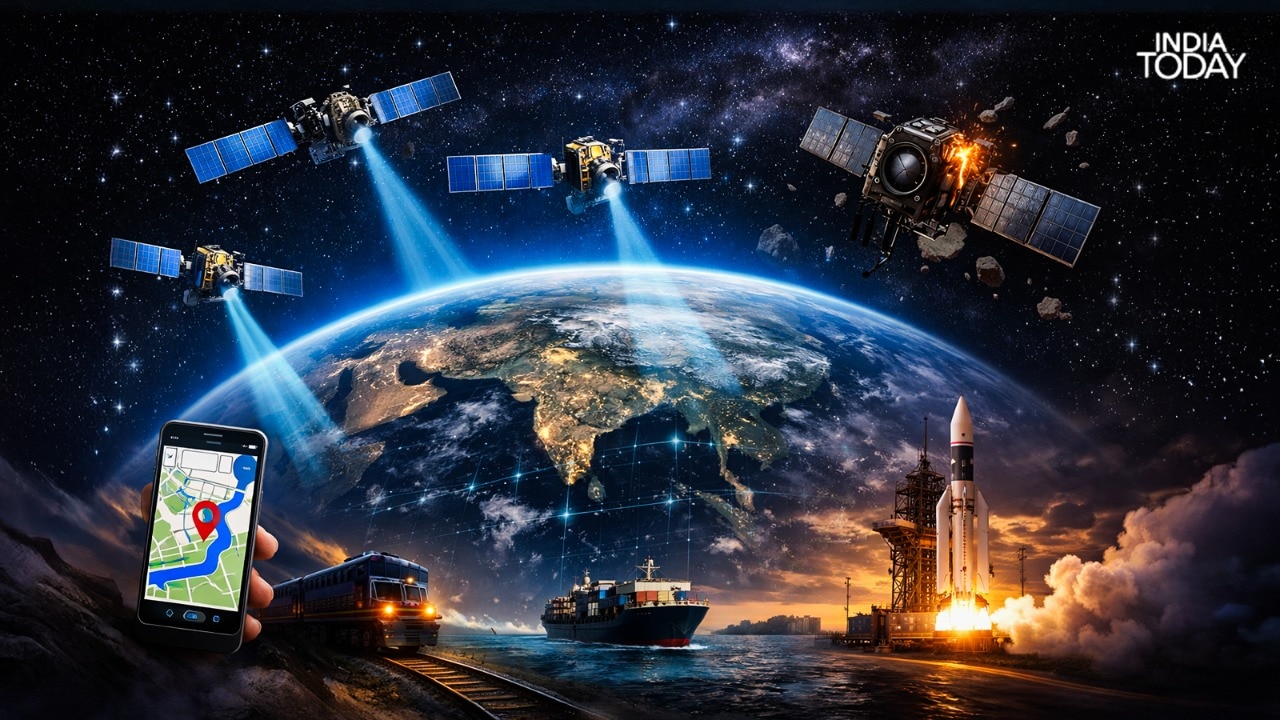
Isro will launch the NVS-03 navigation satellite on October 30 at 11.51 pm IST from Sriharikota. This mission uses the GSLV-F18 rocket to boost India’s NavIC system. Currently, the network faces a shortage of operational satellites, and this launch aims to restore independent positioning services for the country’s own navigation constellation.
The Indian Space Research Organisation (Isro) is preparing to launch its NVS-03 navigation satellite on October 30, a mission that could help restore India's ability to determine locations independently using its home-grown satellite navigation system, NavIC.
The launch is scheduled for 11.51 pm IST aboard the GSLV-F18 rocket from the Satish Dhawan Space Centre in Sriharikota, Andhra Pradesh.
NVS-03 will be the third satellite in the second-generation NavIC series.
Its launch comes as Isro works to strengthen the system after a series of setbacks involving older satellites and a shortage of operational spacecraft.
WHAT IS NVS-03?
NVS-03 is a navigation satellite designed to support NavIC, short for Navigation with Indian Constellation. The system provides positioning, navigation and timing signals that help compatible receivers work out their location and maintain accurate time.
NavIC is India's regional alternative to satellite navigation systems such as the United States' Global Positioning System (GPS).
The constellation is designed to cover India and an area extending around 1,500 km beyond its borders.
These signals support applications ranging from road transport and maritime navigation to disaster management and strategic operations.
Having an indigenous system also reduces India's dependence on navigation services operated by other countries.
WHY IS ISRO'S NVS-03 LAUNCH IMPORTANT?
The problem with that ambition is that NavIC is currently facing a critical shortage of operational satellites.
In a July reply to Parliament, the government said only three satellites were providing positioning, navigation and timing services through the system.
A receiver generally needs signals from at least four satellites to calculate its position independently.
With only three operational satellites available for this purpose, NavIC cannot currently provide standalone positioning services, although its timing service remains functional.
The problem follows setbacks involving earlier satellites.
NVS-02, launched in January 2025, reached an initial transfer orbit but could not be manoeuvred into its intended orbit after a propulsion-system problem.
NVS-03 is part of a planned series of five second-generation satellites intended to strengthen the constellation, with Isro also working on NVS-04 and NVS-05 to improve the system's long-term reliability.
A successful launch will therefore only be the first step.
NVS-03 must reach its intended orbit, undergo checks and be commissioned before it can provide operational services.
The satellite is expected to help restore NavIC's independent positioning capability, but the extent of that recovery will depend on its successful deployment and the system's operational status.
The October 30 mission is therefore undeniably an important step in rebuilding India's home-grown navigation network for civilian and strategic use.