
A report in The Lancet named obesity the world's leading avoidable health threat. India faces a major crisis, with projections showing nearly one in three Indians could be overweight or obese by 2050. Christopher Murray said the key point is that humanity "still has the agency to act."
A report in The Lancet has named Obesity as the world's leading avoidable health threat for this century.
The Lancet Commission on 21st Century Global Threats to Health reviewed hundreds of possible dangers using risk modelling for 204 countries and territories by the Institute for Health Metrics and Evaluation (IHME). The Commission narrowed these to 17 catastrophic threats, a list that includes pandemics, climate change, antimicrobial resistance and nuclear conflict. Measured by the health loss that could be prevented, excess body fat came out ahead of all of them.
The journal's editors cautioned that the report is not a fixed ranking of policy priorities. Commission co-chair Christopher Murray of the University of Washington said the key point is that humanity "still has the agency to act."
For India, the report follows several years of warnings from earlier Lancet studies. Those studies show obesity rising steeply across age groups. They project that nearly a third of Indians could be overweight or obese by 2050. India already has more than 100 million people living with diabetes coupled with the Obesity numbers, Diabesity is a pandemic of crippling proportions.
A Steep Climb Among Adults
India's adult obesity rates have risen many times in the last three decades. In February 2024, the NCD Risk Factor Collaboration (NCD-RisC) published a global analysis in The Lancet, produced with the World Health Organization. It found that obesity among Indian women rose from 1.2% in 1990 to 9.8% in 2022. Among men, it rose from 0.5% to 5.4%.
Those rates are still modest by global standards. In 2022, India ranked 182nd of 197 countries for obesity prevalence in women and 180th for men. What worries experts is the speed of the rise and the sheer size of India's population.
A separate Global Burden of Disease forecast, led by IHME and published in The Lancet in March 2025, shows how large the numbers are. In 1990, about 15 million Indian men and 21 million Indian women were overweight or obese. By 2021, the total had reached about 180 million. By 2050, it is projected to reach 218 million men and 231 million women. That is nearly 450 million people, roughly one in three Indians. Only China could have a larger number.
Children Are Gaining Weight Fastest
The sharpest change has been among the young. According to NCD-RisC, the number of obese Indian children and adolescents aged 5 to 19 rose from 0.4 million in 1990 to 12.5 million in 2022. Of those, 7.3 million were boys and 5.2 million were girls.
The IHME data point the same way. Overweight and obesity among Indian children aged 5 to 14 rose from about 10 million in 1990 to about 25 million in 2021. India now ranks second in the world, behind only China.
Shockingly, in 2021, India had more overweight or obese young people than any other country, overtaking both China and the United States. By 2050, India is projected to have the world's largest number among 15- to 24-year-olds: over 22 million young men and nearly 17 million young women. It's not something to be proud of, neither is it a fact that can be ignored only at our own peril.
Doctors say the effects already show in their clinics. Childhood obesity is linked to early-onset type 2 diabetes, fatty liver disease, high blood pressure and sleep disorders. It is also linked to low self-esteem and anxiety. Many habits formed in childhood carry into adulthood, which turns today's overweight children into tomorrow's heart and diabetes patients.
What Is Driving The Rise
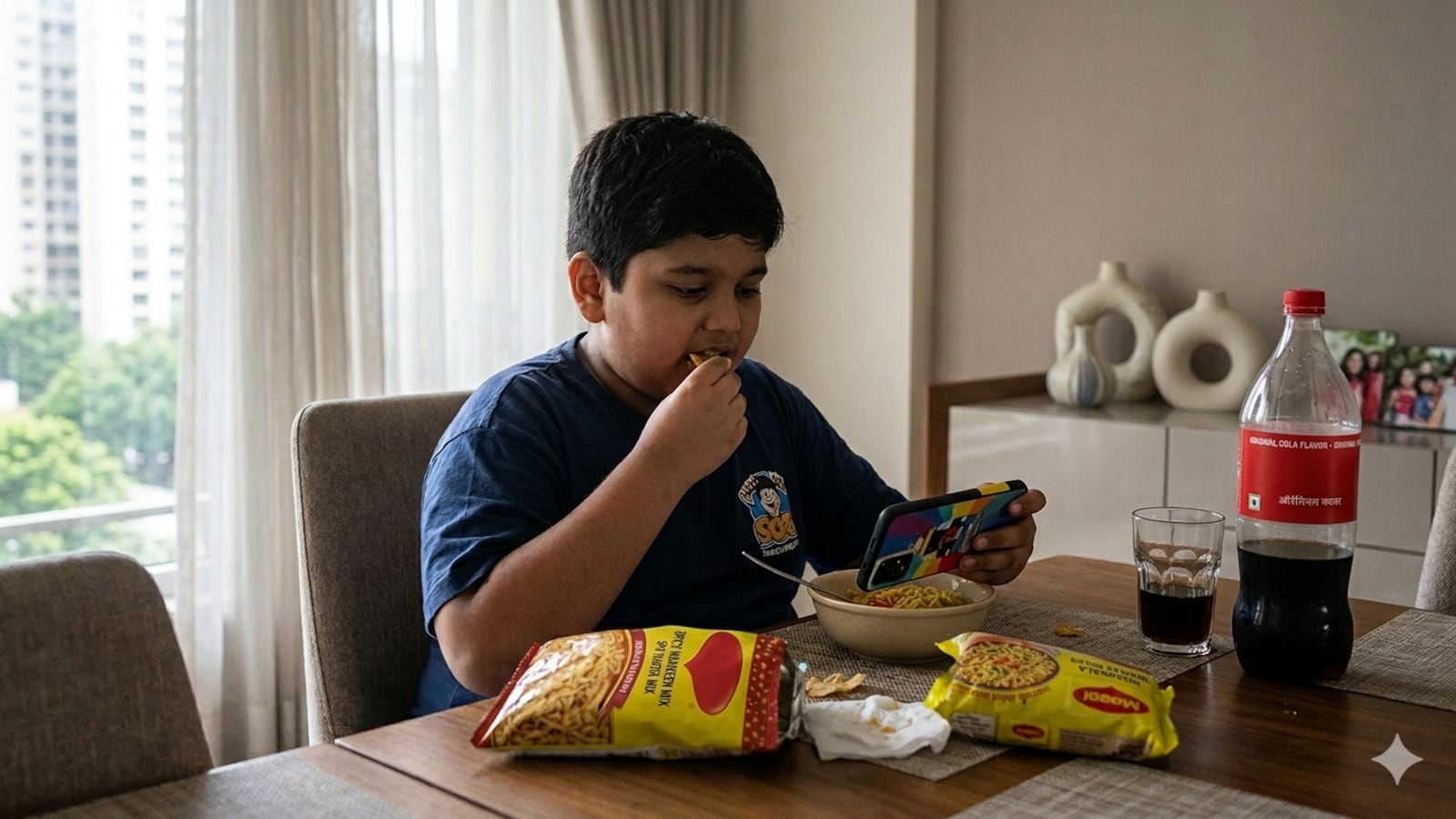
The biggest driver is what Indians eat. The rise in obesity closely tracks the spread of ultra-processed food. Between 2009 and 2019, India recorded some of the fastest growth in the world in per-capita sales of these products, alongside Cameroon and Vietnam. Packaged snacks, sugary drinks and fried foods - high in fat, sugar and salt have moved from occasional treats to daily staples. This shift has reached both cities and small towns.
Physical activity has fallen at the same time. Health experts link long hours on phones and television, together with poor or irregular sleep, to weight gain at every stage of life, from childhood to adulthood. Other factors make it worse. More people work desk jobs, depend on motorised transport, and live in crowded cities with little safe space for children to play.
The ICMR and NITI Aayog have called investment in adolescent nutrition a national priority. Their reasoning is that the teenage years are when these habits take hold.
A Double Burden, And A Hidden Risk
Obesity in India is no longer a problem only of the rich. The Lancet analyses show it spreading among poorer households, often in the same communities where children are still underweight. Thinness remains a serious problem, especially among girls. This means India faces a "double burden" of malnutrition, and its health system has to deal with both extremes at once.
Women are hit harder than men, with obesity rates roughly twice as high. Researchers point to hormonal and life-stage changes, along with fewer chances to exercise, raising the risk of sarcopenic obesity.
Many Indians also face a hidden risk. They tend to store fat around the abdomen, and abdominal fat is more dangerous than weight spread across the body. Dr Guha Pradeepa of the Madras Diabetes Research Foundation is a co-author of one of the Lancet studies. She has noted that waist size predicts disease risk better than body mass index (BMI). As a result, BMI alone can understate India's problem.
This concern shaped another Lancet Commission, published in January 2025. It proposed diagnosing obesity using waist measurements as well as BMI. It also suggested two new categories: "clinical obesity", where excess fat is already damaging organs, and "pre-clinical obesity", where health risks are raised but no illness has developed yet.
The Cost, And The Response
The health costs are already visible. More than 100 million people with diabetes, some states face especially severe problems. Virologist Peter Piot, who was part of the team that discovered Ebola, recently noted that diabetes prevalence among adults in Kerala is close to 25%. Obesity also raises the risk of heart disease, stroke and several cancers, which will put pressure on a health system still dealing with infectious disease and undernutrition.
The government has begun to act. Prime Minister Narendra Modi urged citizens to tackle obesity in his Mann Ki Baat radio address in February 2025. In June 2025, the Food Safety and Standards Authority of India (FSSAI) launched an awareness drive under its Eat Right India programme. The drive includes "sugar and oil boards" in schools to show children how much of each is in common foods.
The new Lancet Commission calls for more. It urges governments to build health systems ready for these threats and to invest heavily in innovation. It also proposes a permanent monitor to track global health risks over time. The Commission encourages public-private partnerships to lower the price of new anti-obesity medicines. India's generic drug industry could become a major producer of the new oral GLP-1 drugs.
Clinicians warn that drugs alone will not solve the problem. Bariatric surgery is the answer but is considered far too morbid or risky albeit without medical evidence, hence accepted by less than 1% of the eligible population. Without changes to what Indians eat, how much they move and how early risk is detected, the numbers projected for 2050 could become a stark reality that our healthcare can ill afford.
(By Dr Muffazal Lakdawala, Director, General & Minimal Access Surgery, Sir H. N. Reliance Foundation Hospital)