
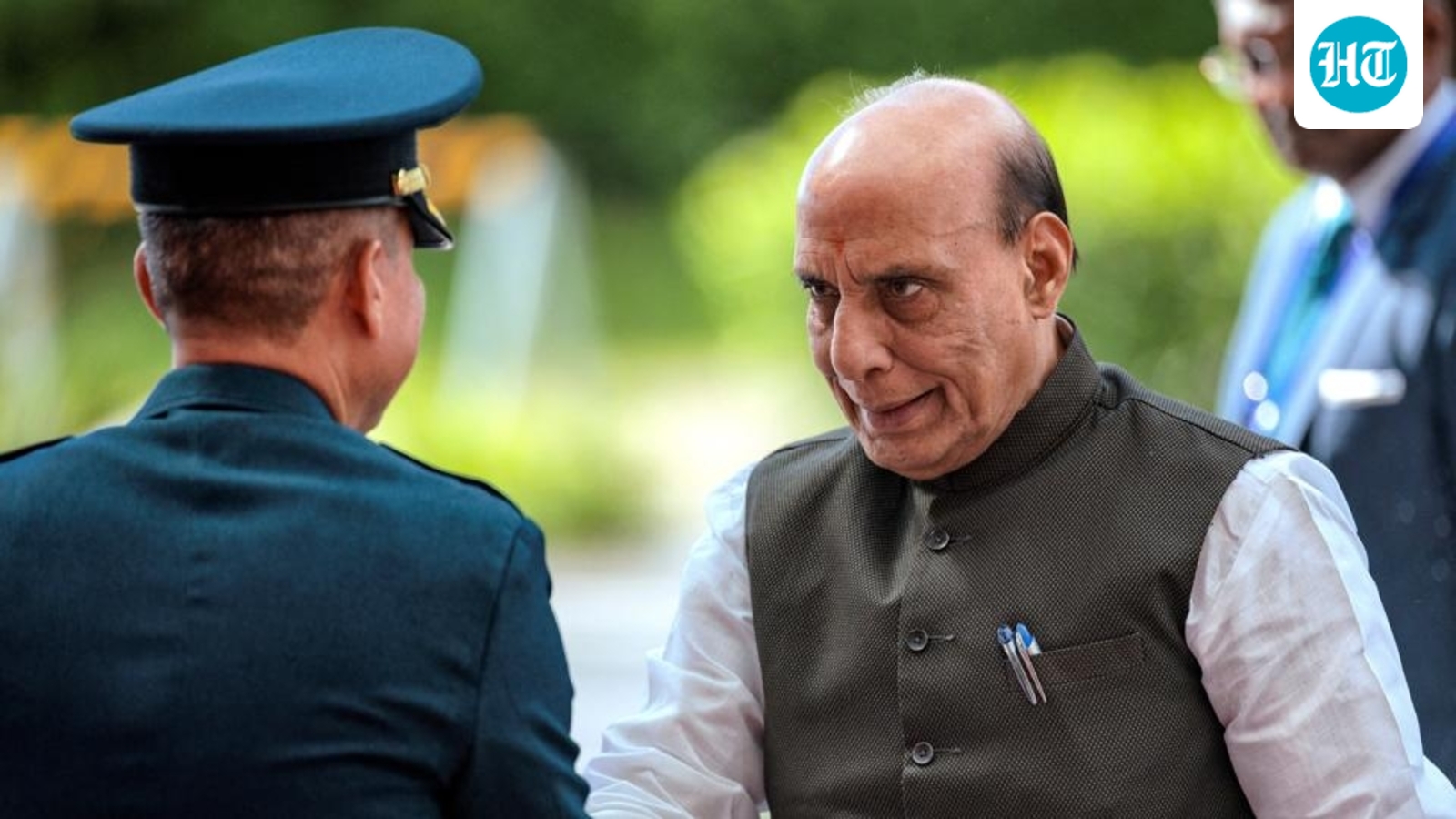
Defence minister Rajnath Singh attended the 13th ASEAN Defence Ministers' Meeting-Plus in Cebu, Philippines, from October 28 to 29. He held bilateral meetings to strengthen strategic partnerships. Singh said, "India's expertise in counter-terrorism is not theoretical classroom knowledge." India also continues to focus on maritime security and regional cooperation.
Defence minister Rajnath Singh, accompanied by a high-level Indian delegation, attended the 13th ASEAN Defence Ministers' Meeting-Plus (ADMM-Plus) in Cebu, Philippines from October 28 to 29, 2026. At the Summit, he exchanged views on regional and international security issues. He also held a series of bilateral meetings with his counterparts including Australia, Japan, the US, South Korea, Singapore and the Philippines, where they reviewed the ongoing defence ties and explored new opportunities for further strengthening strategic partnerships. The ADMM-Plus platform has emerged as a cornerstone of India's defence diplomacy which bridges its Act East Policy with practical defence cooperation among the participating countries.
The ADMM-Plus framework was established in October 2010 to facilitate dialogue and practical cooperation between the ASEAN member States and eight external partners. Since then, the framework serves as the highest-level defence consultative and cooperative mechanism in the wider Indo-Pacific region. It brings together defence ministers from the 11-ASEAN members and eight dialogue partner countries--Australia, India, Japan, New Zealand, Soth Korea, Russia, China and the US--to discuss and develop practical cooperation across seven key areas such as counter-terrorism, maritime security, humanitarian assistance and disaster relief (HADR), peacekeeping operations, military medicine, humanitarian mine action and cyber security.
Currently, India alongside Malaysia is co-chairing the Experts' Working Groups (EWGs) on counter-terrorism for the 2024-2027 cycle. It is sharing tactical insights, intelligence frameworks, and joint responses against international terror networks. Addressing at the ADMM-Plus summit in Cebu, Philippines, Singh offered India's counter-terrorism expertise to the ASEAN and dialogue partner countries. Singh said that India's expertise in counter-terrorism is not theoretical classroom knowledge. It is an experience hard-earned on the ground through decades of directly confronting complex, cross-border security challenges. He underlined that terrorism knows no borders and India stands ready to share its practical, battle-tested experience through joint exercises, capacity-building programmes, and intelligence sharing to strengthen collective capabilities.
Maritime security is another important area of cooperation under the ADMM-Plus framework and remains crucial to India's engagement with the ASEAN member countries. Aimed at further strengthening maritime cooperation, India has designated the year 2026 as ASEAN-India Year of Maritime Cooperation. Meanwhile, the Indian and the Philippines navies co-hosted the second edition of ASEAN-India Maritime Exercise (AIME) which was conducted under the theme Anchored in Trust, United at Sea at Subic Bay, Philippines, from September 28 to October 2, 2026. The AIME focused on tactical drills, air defence, and regional trust building. The exercise plays a crucial role in operationalising the maritime dimension of India's Act East Policy, its broader MAHASAGAR vision and the Indo-Pacific Oceans Initiative (IPOI). India has positioned itself as a 'first responder' under its Indo-Pacific strategy and emphasises collaborative capacity building, maritime domain awareness (MDA) and sustainable regional growth.
Amidst Chinese PLA's growing assertiveness in the region, the Indian Navy has been maintaining an uninterrupted, active presence in highly volatile corridors like the Gulf of Aden 'without coercion or unilateral actions that undermine the rights of other nations.' The Indian Navy extends protections to commercial shipping irrespective of their nationality. It has successfully escorted thousands of merchant vessels and thwarted dozens of high-seas hijackings by deploying frontline warships like INS Vikrant, INS Vikramaditya, INS Sahyadri and INS Kulish. India's emphasis on the rule of law, particularly the United Nations Convention on the Law of the Sea, and support for freedom of navigation and overflight, underscores its responsibility and priority to safeguard the collective interests of all regional stakeholders who depend on open sea lanes and stable maritime governance.
India's growing engagements with regional defence ministries at the ADMM-Plus have opened new avenues for bilateral defence industrial and technological cooperation. It promotes India's defence exports to the regional countries who are looking alternative defence technology supplies. India has already exported $ 375 million multi-battery shore-based anti-ship BrahMos missile system to the Philippines in 2022. It has also signed defence deals with Vietnam and Indonesia for exporting the naval variant of BrahMos missiles worth around $600 million each. In addition, Indonesia signed deal for procuring Astra missiles from India. All three Southeast Asian countries have disputes with China in the South China Sea and seek to protect vital maritime security interest by enhancing their defence capabilities.
India attaches importance to ASEAN centrality and to a secure, open, inclusive, resilient, and rule-based Indo-Pacific region, where peace and stability are not just aspirations but a result of collective commitment. It sees the ASEAN countries as friendly foreign countries with whom it can share advanced defence technologies to counter common security challenges. India's strategic engagement with ASEAN is thus long-term rather than transactional and rooted in shared interests, mutual respect and practical cooperation. The second ASEAN-India Defence Ministers' Informal Meeting took place in Kuala Lumpur, Malaysia, in October 2025 to advance the defence and security components of the ASEAN-India Comprehensive Strategic Partnership and the ASEAN-India Plan of Action for 2026 to 2030. At the 13th ADMM-Plus summit, Singh proposed establishment of a defence Youth Bridge to boost ASEAN-India connectivity, digital innovation and capacity-building.
During his meeting with US secretary of defence Pete Hegseth, both sides reviewed progress on operational coordination, information sharing, and defence industrial cooperation. They exchanged views on areas for further collaboration to expand their major defence partnership (MDP) in support of shared interests across the region. Given that the US paying less attention to the region under President Donald Trump's second tenure, and changed the name of the US Indo-Pacific Command to its original US Pacific Command, India has been trying to navigate its overall strategic ties with the US amid Trump's global tariff war and anti-immigration policies.
India's engagements with other strategic partners, therefore, have become crucial to maintain regional order.
In the rapidly evolving geopolitical landscape and great power competition, therefore, the ADMM-Plus has emerged as a crucial institutionalised framework for India's defence diplomacy and helps advance its foreign policy goals under the Act East Policy, MAHASAGAR vision and the IPOI. India is effectively leveraging the ADMM-Plus framework to promote regional peace, stability and collective security in the greater Indo-Pacific region, which is vital to achieve regional prosperity.