
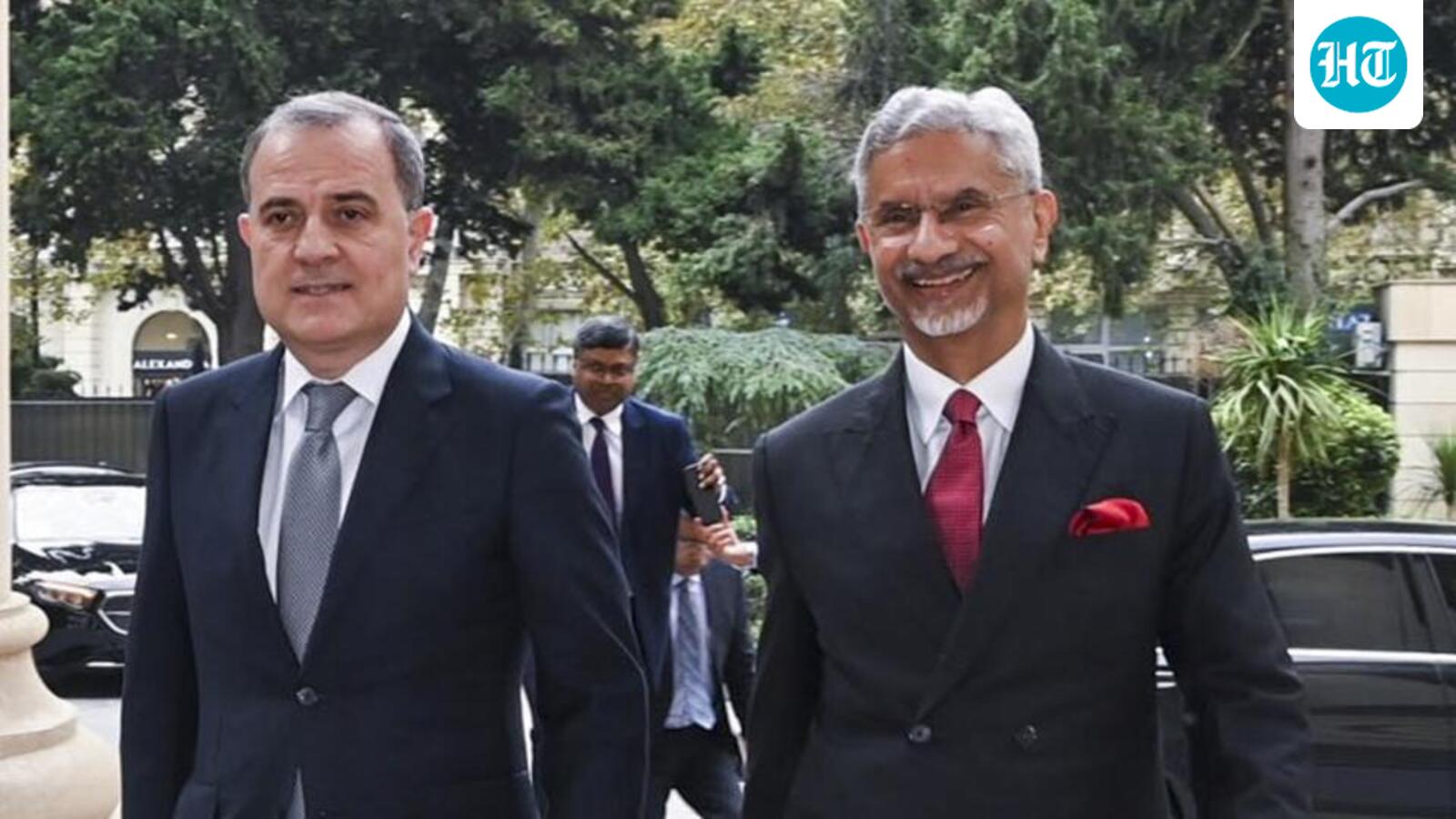
External affairs minister S Jaishankar met President Ilham Aliyev in Baku on Friday to boost trade and energy ties. This visit marked the first such trip in eight years. Jaishankar said his discussions focused on "what we could be doing more, what we could be doing differently" to improve relations.
India and Azerbaijan on Friday explored ways to expand cooperation in trade, investment, energy and connectivity as external affairs minister S Jaishankar met President Ilham Aliyev and foreign minister Jeyhun Bayramov in Baku to take forward a reset in bilateral ties that have been fractious in recent years.
This was the first visit by an Indian foreign minister to Azerbaijan in eight years, against the backdrop of a thaw in bilateral relations, which have been impacted in the past by Azerbaijan's close ties with Pakistan. During the four-day conflict with Pakistan in May 2025, India was angered when Azerbaijan's foreign ministry issued a statement condemning the military attacks on Pakistan.
At his meeting with Aliyev, Jaishankar conveyed the greetings of President Droupadi Murmu and Prime Minister Narendra Modi and discussed the strengthening of bilateral ties. "Appreciate his positive sentiments for this shared endeavour," Jaishankar said on social media.
Jaishankar said his "productive discussions" with Bayramov had "charted a pathway forward for our relationship". The two sides agreed to deepen political consultations, exchange visits, enhance economic activities, build connectivity and foster people-to-people ties.
The two foreign ministers also discussed regional and global developments, including the peace process between Azerbaijan and Armenia and the shared threat of terrorism, and Jaishankar said the two sides had a "common interest in promoting peace, progress and prosperity".
Bayramov said he emphasised the "importance of continued dialogue and exploring opportunities for cooperation in areas of mutual interest".
Jaishankar's visit was a follow-up to a meeting between Modi and Aliyev on the margins of the Shanghai Cooperation Organisation (SCO) Summit in Kyrgyzstan in September and the first bilateral foreign office consultations in almost four years in April. People familiar with the matter said that the visit was part of efforts to reset the overall relationship.
At a media interaction with Bayramov, Jaishankar said that his discussions with the Azerbaijan President focused on ongoing cooperation, including "what we could be doing more, what we could be doing differently". Bayramov added that the discussions would help elevate ties to a higher level.
Despite the presence of more than 1,000 Indian firms in Azerbaijan and ONGC Videsh Ltd's investment of $1.2 billion in the Azeri-Chirag-Gunashli oil and gas fields and the associated Baku-Tbilisi-Ceyhan pipeline, two-way trade languished at around $600 million in the first half of 2026. Both ministers spoke about expanding economic cooperation**,** and Bayramov highlighted the potential for collaboration in energy, pharmaceuticals, digital services and mining.
Connectivity, including additional flights, also figured in discussions**,** as Azerbaijan has become a popular destination for Indians, receiving 166,944 tourists from the country in 2025. India was the fourth-largest source of tourists, after Russia, Türkiye and Iran.
Jaishankar noted that both sides had agreed to coordinate more closely on the International North-South Transport Corridor, and said, "Air connectivity is also something that we value. There are daily flights, but obviously to deepen the relations we have to think about how to grow that further."
He also thanked the Azerbaijan government for helping in the evacuation of Indian nationals from Iran after the start of the West Asia conflict earlier this year.
The peace process between Azerbaijan and Armenia also figured in the discussions, and Jaishankar said India welcomed the peace agreement reached by the two countries in August 2025 and hoped it would lead to a durable peace. "India has a very clear position that disputes should be settled through dialogue and diplomacy, and in that context, our discussions covered West Asia, Europe, Eurasia," he said. "We have a common interest in promoting peace, progress and prosperity. And threats like terrorism, conflict and instability are our common enemies."