
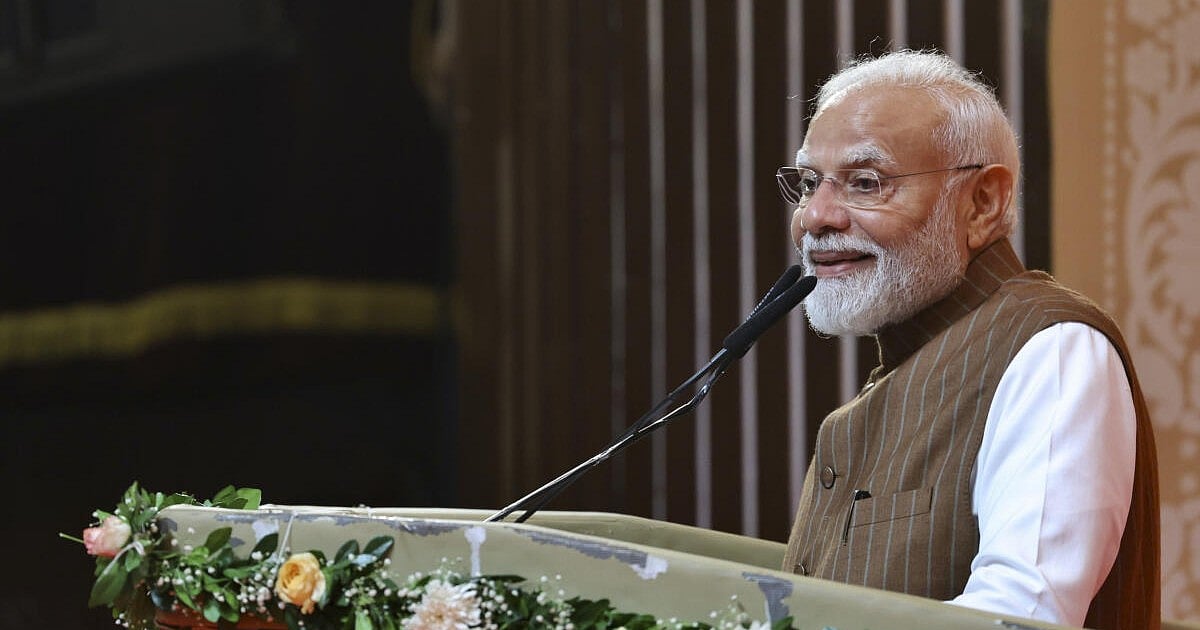
Prime Minister Narendra Modi said on Saturday that India has shown in the last 12 years that breaking mindset barriers unlocks potential. He noted, "Our strength is determined by how courageously we dare to challenge challenges." His government worked to empower the poor and lift many people out of poverty.
Kharagpur (WB): Prime Minister Narendra Modi on Saturday said India has demonstrated in the last 12 years that breaking barriers in mindset could unlock the country's potential, create opportunities and empower the poor, while asserting that he believed in challenging challenges rather than allowing limitations to hold the nation back.
"Our strength is determined by how courageously we dare to challenge challenges. People often ask me about challenges. I tell them that it is in my very nature that I cannot rest without challenging a challenge," he said, adding that people often imposed limitations on themselves.
"Nations recognise their true capabilities only when they break the limitations of their thinking. India has demonstrated precisely this over the past few years. India has declared with confidence: break the limits, unlock the possibilities. Over the past few years, India has shown this," he said.
The prime minister said his government had worked over the last 12 years to change the prevailing mindset about poverty and empower people through various initiatives.
Recalling that poverty was once considered an insurmountable challenge, Modi said successive governments had raised slogans about eradicating it, but the administration had failed to act because of a belief that poverty could not be eliminated in a country with such a large population.
"Until 20 years ago, poverty was considered a permanent problem in our country. Five decades ago, slogans about eradicating poverty were raised from the ramparts of the Red Fort. Yet, whenever it came to taking action at the policy level, the entire system would simply bury the matter in files," he said.
"When I announced from the Red Fort that I would build toilets for the poor, people in Parliament made fun of me... Such people could not understand how important a toilet was for a poor family, particularly for poor women," he said.
In the last 12 years, the central government sought to change this mindset, he said, adding that he believed in the principle of "power to empower".
Citing a World Bank report, Modi claimed that around 50 crore people had been brought out of poverty in India in the last 12-13 years, describing it as the outcome of a mindset that believed in breaking limitations.
"This is no small achievement. It is the result of a mindset that believes in breaking the limits," he said.
Emphasising the importance of putting national interests first, Modi urged students to follow the mantra of "nation first", saying it would create new opportunities for them while contributing to the country's development.
"Nation first... When you move forward with this mindset, it will certainly bring new opportunities for you as well, and the country will also benefit greatly," he said.
"By 2047, many of you will be in leadership roles... Let us resolve that in the next 20 years, we will achieve the 'Viksit Bharat' goal and work hard to realise it," Modi said, adding that the coming two decades would be the most productive years of the students' lives and decisive for the country as well.
Recalling that a company had approached India around 50 years ago to manufacture semiconductors but was turned away, Modi said that when his government announced the Semiconductor Mission, some people had argued that the country had already missed the opportunity.
"You will be surprised to know that a company had come to India 50 years ago to manufacture semiconductors here, but it was shown the red flag and sent back.
"And that is why, when I spoke about the Semiconductor Mission, people again said that it was already too late. But I was determined. I said, even if there was a delay earlier, does that mean India should continue to sit idle now? We went ahead and initiated the mission, and today, India has begun exporting chips," he said.
Citing the example of Pawan Kumar Chandana, an IIT Kharagpur alumnus and co-founder of Skyroot Aerospace, he said the company's work on India's first privately developed rocket had given a fresh impetus to the country's space programme.
When the institute began its journey, India had only recently gained freedom and had not yet held its first general election, he said.
The country then needed engineers to develop its industries and infrastructure, while graduates of the institute subsequently contributed to strengthening India's scientific capabilities, including its space and atomic energy programmes, he said.