
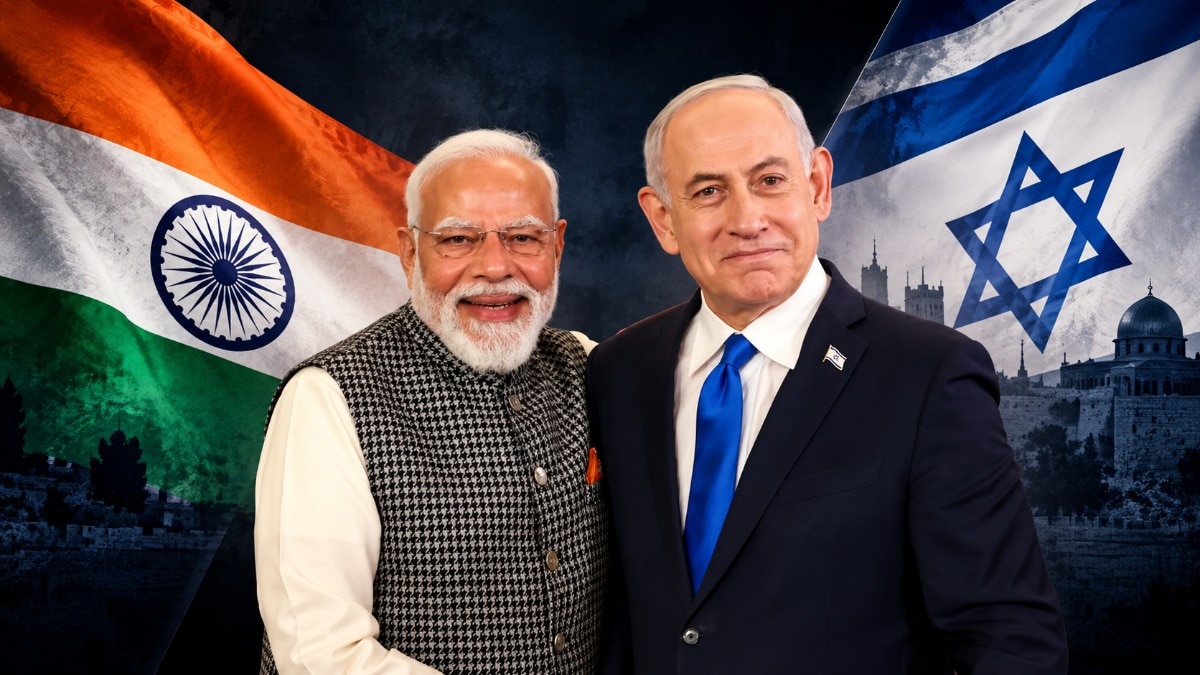
Israel votes on Tuesday, October 27, as Prime Minister Benjamin Netanyahu fights to remain in power. His close friendship with PM Narendra Modi helped deepen defence and technology ties. Many now wonder if a new government would change this partnership, as India watches the election results with great strategic interest.
Israeli PM Benjamin Netanyahu's friendship with PM Narendra Modi has helped deepen India and Israel's defence, technology and diplomatic ties. But as Israel votes on Tuesday, could Netanyahu's possible exit alter New Delhi's equations? What would it mean for India's investments, defence deals and ambitious connectivity projects involving Israel?
In July 2017, Israeli Prime Minister Benjamin Netanyahu raised a toast to PM Narendra Modi at a banquet in Jerusalem, celebrating a friendship that he said had taken 70 years to reach Israel's doorstep. Nine years later, Netanyahu is fighting to remain Israel's prime minister, and India is watching the contest closely.
His friendship with PM Modi has helped transform bilateral ties, particularly in defence, intelligence, technology and diplomacy. But Israel's relationship with India now extends well beyond the two leaders. If Netanyahu, who is trailing in pre-poll surveys, loses, will New Delhi lose its special place in Israel's strategic calculations? Will the India-Israel partnership lose steam if a change of guard takes place in Jerusalem?
What would happen to India's ambitious India-Middle East-Europe Economic Corridor (IMEC), its investments in Israel's Haifa Port, defence cooperation, joint military projects and the proposed free trade agreement if Netanyahu loses power?
Israel votes on Tuesday (October 27), with former military chief Gadi Eisenkot emerging as Netanyahu's principal challenger. Netanyahu, who has recently identified India as a key partner in reducing Israel's dependence on the United States, appears to be prepared for a future in which Washington might become less supportive.
Eisenkot, however, has emphasised rebuilding Israel's relations with traditional Western partners. That raises the important question about whether India would enjoy the same diplomatic prominence under a new Israeli government, if one barring Netanyahu, comes to power?
For New Delhi, the stakes are beyond PM Modi's personal equation with Netanyahu. Israel is a major defence and technology partner, while India's equally good relationships with Iran and all the Gulf countries make regional stability important.
HOW MODI AND NETANYAHU BUILT A SPECIAL RELATIONSHIP
India established full diplomatic relations with Israel in January 1992, long before Modi and Netanyahu developed their personal rapport. But Modi's July 2017 visit to Israel, the first by an Indian prime minister, brought the relationship into the public spotlight.
Welcoming Modi, Netanyahu said, "We've waited for you for 70 years."
The visit was marked by unusually warm personal diplomacy, including the two leaders' much-publicised walk along the Mediterranean coast. In January 2018, Netanyahu reciprocated with a visit to India.
The test of the relationship was evident during Operation Sindoor, when India struck terror infrastructure in Pakistan and Pakistan-occupied Kashmir following the Pahalgam attack. Israel was among the countries that openly backed India's right to self-defence. Israeli Ambassador Reuven Azar said, "Israel supports India's right to self-defence. Terrorists should know there's no place to hide from their heinous crimes against the innocent."
The partnership expanded further during Modi's February 2026 visit to Israel, when the two countries elevated relations to a Special Strategic Partnership for Peace, Innovation and Prosperity. The agreements covered defence, artificial intelligence (AI), cybersecurity, semiconductors, agriculture and other emerging technologies.
These institutional arrangements are why India and Israel are likely to remain close, regardless of who comes to power in Israel.
NETANYAHU LOOKS AT INDIA FOR POST-TRUMP AMERICA
On October 18, just nine days before the election, Netanyahu presented a security doctrine that revealed how prominently India figures in his post-Donald Trump diplomatic calculations. Warning that a future American president could be hostile towards Israel, Netanyahu argued for strengthening alternative partnerships.
"The second thing is to create other alliances. That is what I am working on now with many countries in our region and outside it. India is not a small country, and there are many others," Netanyahu said. The remarks are significant because the US remains Israel's principal military and diplomatic backer.
Netanyahu has also pointed to Latin America as another region where Israel could cultivate new partnerships. In May 2026, he described India as a "huge power" and spoke of the "absolutely crazy love for Israel" in the country.
However, Netanyahu's main challenger, Eisenkot, has criticised the prime minister's October 18 security doctrine. He accused Netanyahu of presenting slogans rather than a credible strategy.
Unlike Netanyahu, Eisenkot has not publicly outlined a detailed India-specific policy. His broader foreign-policy stresses on "repairing" Israel's international relationships.
WILL INDIA-ISRAEL TIES OUTLAST NETANYAHU?
Israeli author and political analyst Alec Pollard said he believed that India and Israel's growing cooperation in defence, technology and diplomacy has made their relationship strong enough to withstand a change of government, even if Netanyahu's personal friendship with Modi is difficult for his successor to replicate.
"Whoever wins the election, Israel and India will continue to be good friends and to be close," Pollard told PTI.
He said the partnership was highly valued in Israel, although a new prime minister would have to establish his own rapport with Modi.
"I know Netanyahu has forged a close personal relationship with Narendra Modi. We've seen increasing cooperation in technology, military affairs and other areas. I think that's a relationship Israel values a lot. We also see eye to eye with India when it comes to dealing with Islamic fundamentalism. There's a feeling that India understands this threat better than the Europeans do," added Pollard.
Former diplomat Anil Trigunayat, who served as India's Ambassador to Jordan, Libya and Malta, offered a similar assessment.
"Relations between India and Israel, again, irrespective of the government which will come into power, will remain the same," he told PTI.
Trigunayat pointed to defence, security, intelligence, counterterrorism and agriculture as the foundations of the relationship.
His assessment is supported by the breadth of existing cooperation and shared concerns between the two countries. India and Israel signed a defence cooperation memorandum in November 2025. Their February 2026 joint statement subsequently identified opportunities in critical technologies, cybersecurity, space and defence manufacturing. The two countries are also pursuing a free trade agreement, while bilateral merchandise trade stood at approximately $3.93 billion in FY2025-26.
Meanwhile, India and Israel share concerns over terrorism, cross-border security threats and regional instability, which have, in fact, brought them closer in defence, intelligence sharing and counterterrorism cooperation. Both countries also seek to strengthen cybersecurity, protect critical infrastructure and reduce their dependence on foreign suppliers for advanced military technology.
COULD EISENKOT CHANGE ISRAEL'S PRIORITIES?
Eisenkot, who served as Israel's military chief from 2015 to 2019, joined Netanyahu's emergency government after the October 7 Hamas attack. He lost his son, Gal, in the Gaza war, and left the emergency government alongside Benny Gantz, a former Israeli defence minister and opposition leader, in June 2024, criticising the absence of a clear post-war strategy.
Eisenkot now leads the Yashar party and is one of Netanyahu's main rivals in the election. Eisenkot's emphasis on repairing Israel's international standing could alter the country's diplomatic priorities. Although he has not said much on Israel's potential India policies, there is little evidence that he intends to downgrade relations with New Delhi.
Moreover, Eisenkot's positions on Iran, Hamas and Israeli security remain broadly hawkish. A change of government would therefore not automatically mean a major shift in defence policy or an end to regional hostilities.
The election could also produce a deadlock. Neither Netanyahu's coalition nor the opposition is assured of the 61 seats needed for a majority in the 120-member Knesset.
INDIA'S BIGGER CONCERN IN MIDDLE EAST
Former Indian diplomat Trigunayat believes India's greatest challenge is not Netanyahu's political future but the wars involving New Delhi's strategic partners.
"Israel is our strategic partner. Iran is our strategic partner. The US is our comprehensive global strategic partner," Trigunayat told PTI.
Trigunayat noted that India's relationships with Gulf countries were equally important, particularly because of the millions of Indians working in the region, remittances, energy supplies and maritime trade. He said that he was concerned that India's partners were increasingly finding themselves on opposing sides of regional wars.
"A friend of yours attacks another friend of yours and you get hurt in the process," Trigunayat added.
The concern was evident in PM Modi's latest conversation with Netanyahu on October 22. According to New Delhi's Prime Minister's Office, the leaders reaffirmed their commitment to strengthening bilateral ties, but Modi also reiterated India's call for dialogue and diplomacy to restore peace and stability in the Middle East.
Trigunayat argued that Netanyahu had projected India's support for bilateral relations as broader support for Israeli military actions. "Mr Netanyahu projected as if all his actions are being supported by India, but that's not true," he told PTI.
India's position, therefore, remains distinct from Netanyahu's political and military agenda. For New Delhi, the ideal outcome would be continued defence and technology cooperation with Israel alongside reduced tensions in the Middle East. So, Netanyahu's departure would change the personal chemistry and other priorities of the relationship. But the interests and concerns shared by India and Israel are unlikely to disappear with Netanyahu's political exit, if it happens.