
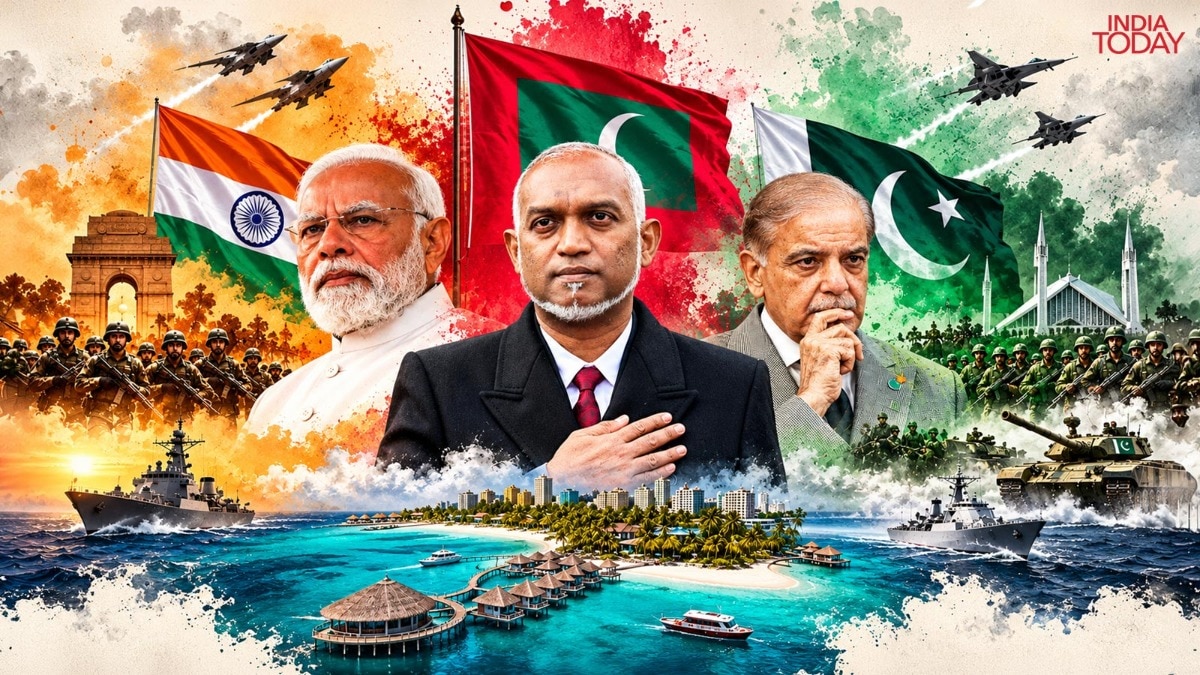
Maldives President Mohamed Muizzu’s visit to Pakistan has sparked a political backlash at home. Opposition leaders warned that closer security ties with Islamabad could strain relations with India. Former president Mohammed Nasheed said, "If India feels their security is being compromised, it will have very bitter repercussions for the Maldives."
Maldives President Mohamed Muizzu's visit to Pakistan has triggered a political backlash at home. Opposition leaders in Male have warned that closer security ties with Pakistan could strain relations with India.
For the Maldives, President Mohamed Muizzu's growing engagement with Pakistan is turning into a diplomatic tightrope, with opposition leaders, including former president Mohammed Nasheed, warning that his outreach to Islamabad could strain ties with the island nation's closest neighbour, India.
The first visit by a Maldivian president to Pakistan in 11 years has triggered a political debate over Male's foreign policy, with opposition leaders questioning whether Muizzu, who came to power on an anti-India campaign, is putting the country's security and long-standing partnership with New Delhi at risk.
The sharpest warning came from Nasheed, chairperson of the opposition Maldivian Democratic Party (MDP). Speaking at a press conference in Addu City on October 25, Nasheed accused Muizzu of "recklessly" drawing the Maldives into the long-running tensions between India and Pakistan.
"While the risks faced by small nations, especially the Maldives, are significant, President Muizzu visited Pakistan without due consideration, once again bringing the Maldives into the middle of the disputes between India and Pakistan," Nasheed said, according to reports by the Maldivian news outlet Sun Online.
The warning by the former president was particularly pointed. "If India feels their security is being compromised, it will have very bitter repercussions for the Maldives," he said, arguing that the country could pay a price if New Delhi viewed its growing engagement with Islamabad as a security concern.
Muizzu's Pakistan visit was also questioned and criticised by other opposition leaders of the Maldives. Former Maldivian foreign minister Abdulla Shahid, who is running for the leadership of the opposition MDP ahead of the Presidential elections in 2028, accused that Muizzu will start an "anti-India campaign again" like he had done in 2023.
Former president Abdulla Yameen questioned Pakistan's decision to confer an honorary doctorate on Muizzu during the visit. These remarks reflected the growing domestic debate over the strategic implications of Male's outreach to Islamabad.
Nasheed's remarks capture the central tension surrounding Muizzu's trip to Pakistan. The Maldives has every right to cultivate ties with multiple countries, but its longstanding location and security dependence on India mean that defence and maritime cooperation can carry implications beyond bilateral diplomacy.
MUIZZU'S PAK VISIT: 20 MoUs AND DEFENCE PACTS
Muizzu's three-day visit to Pakistan, from October 20 to 22, was the first by a Maldivian president in 11 years. It coincided with the 60th anniversary of diplomatic relations between the two countries and produced 20 memorandums of understanding (MoUs) covering sectors ranging from healthcare and education to trade, agriculture, cybersecurity, defence and maritime security.
According to the official statement by the Maldives President's Office, the agreements were intended to expand cooperation across areas of mutual interest. The two governments also agreed to work towards increasing bilateral trade from around $13 million to $200 million within two years.
But it was the security dimension of the visit that drew the greatest attention. Muizzu met Pakistan's Prime Minister Shehbaz Sharif and President Asif Ali Zardari, as well as Field Marshal Asim Munir, Pakistan's army chief and chief of defence forces. Their discussions included regional security, defence cooperation and military training.
WHAT INDIA SAID ON MUIZZU'S PAKISTAN VISIT
India responded to Muizzu's Islamabad outreach cautiously. On October 24, Ministry of External Affairs spokesperson Randhir Jaiswal said New Delhi was monitoring the agreements and would take appropriate steps if necessary.
"It has been reported that agreements were signed between the two countries. We are monitoring these developments closely and will take any necessary steps if required," Jaiswal said.
India's version underscored New Delhi's attention to developments in a country situated close to key Indian Ocean shipping routes and within its immediate maritime neighbourhood.
THE MALDIVES CANNOT AFFORD CRISIS: EX-DEFENCE MINISTER WARNS
The concerns of the opposition leaders are not just about the number of agreements signed between Male and Islamabad. They are mainly on whether the Maldives can expand its relationship with Pakistan without creating uncertainty in its ties with India.
In an opinion article published by the Maldivian news outlet Adhadhu on October 25, former defence minister Mariya Ahmed Didi argued that the security agreements deserved scrutiny because of the continuing tensions between India and Pakistan.
Didi acknowledged that cooperation with Pakistan in healthcare, education, trade, agriculture and tourism could offer genuine opportunities. She also stressed that the Maldives had every right to maintain independent relations with both countries.
"These relationships are not mutually exclusive," she wrote in her Op-ed published by the Male-based digital news outlet.
But Didi also warned that diplomatic engagements could be interpreted as signs of a wider strategic alignment, regardless of the government's intentions.
"Individual agreements, public statements and diplomatic gestures can be interpreted as evidence of wider strategic alignment, even when that is not the intention," the former defence minister of the Maldives wrote.
She cautioned that an escalation between India and Pakistan could place Male under pressure over its diplomatic positions, security partnerships, intelligence relationships and the use of its facilities and capabilities.
Didi was not suggesting that the Maldives should avoid Pakistan. Rather, she questioned whether the Muizzu-led government had adequately assessed the long-term consequences of its security commitments and whether sufficient safeguards were in place to protect the country's strategic autonomy.
Her concerns also reflect the economic strains of the Maldives. Tourism is a major source of foreign exchange, while the country depends heavily on imports. Any prolonged regional instability that affects connectivity, visitor confidence or trade could have consequences for ordinary Maldivians.
For a small island state, maintaining peace and stable relations with its neighbours is therefore both a security priority and an economic necessity.
PAK RAISES KASHMIR ISSUE, MUIZZU KEEPS MUM, CALLS FOR SAARC REVIVAL
The diplomatic significance of the visit was further sharpened by Pakistan bringing its disputes with India into discussions.
Pakistan PM Sharif shared Islamabad's position on Jammu and Kashmir and the Indus Waters Treaty (IWT) with Muizzu.
Islamabad has opposed New Delhi's decision to place the IWT in abeyance in April 2025, following the Pahalgam terror attack. Muizzu did not publicly endorse Pakistan's positions on Kashmir or the treaty during the visit.
He did, however, call for the revival of the South Asian Association for Regional Cooperation (Saarc), the regional grouping whose last summit was held in Kathmandu in 2014. The 19th summit of the grouping, that was set to take place in Pakistan in 2016, was cancelled following the Uri terror attack the same year.
Muizzu said the Maldives was ready to work with member countries to convene another summit. The proposal comes against the backdrop of a long-standing India-Pakistan impasse that has stalled the organisation.
India, for its part, has maintained that regional cooperation cannot advance without an environment free of terrorism. The revival of Saarc would therefore require addressing the political obstacles that have prevented its summits from taking place.
MUIZZU'S POLITICAL JOURNEY: FROM 'INDIA OUT' TO A DELICATE BALANCING ACT
Muizzu's engagement with Pakistan becomes more vital because of his political past with India.
He led the People's National Congress (PNC) to power in 2023 on an "India Out" platform, demanding the withdrawal of Indian military personnel stationed in the Maldives. In May 2024, Indian military personnel operating and maintaining aircraft used for humanitarian assistance and medical evacuations were replaced by civilian technical personnel.
Since then, Muizzu has sought to repair ties with New Delhi, including through a state visit by Prime Minister Narendra Modi to the Maldives in July 2025.
Former Maldivian foreign minister Abdulla Shahid, who is seeking the leadership of the MDP ahead of the 2028 presidential election, has accused Muizzu of moving in an "anti-India" direction again. In an interview with The Hindu newspaper, Shahid argued that the president could revive anti-India rhetoric as the next election approaches.
"The President [Muizzu] is trying to make India the issue again, because for him, he hasn't been able to perform," Shahid told the newspaper, alleging that the government had failed to deliver on its promises.
However, these are opposition assessments, and not clear proof that Muizzu intends to revive the campaign or align the Maldives against India. His government has continued to describe its foreign policy as "Maldives First", emphasising engagement with multiple partners.
The challenge is to turn that principle into a credible balancing act. The Maldives can maintain relations with Pakistan while preserving its vital partnership with India, but defence and maritime cooperation require clarity about their scope and implications.