
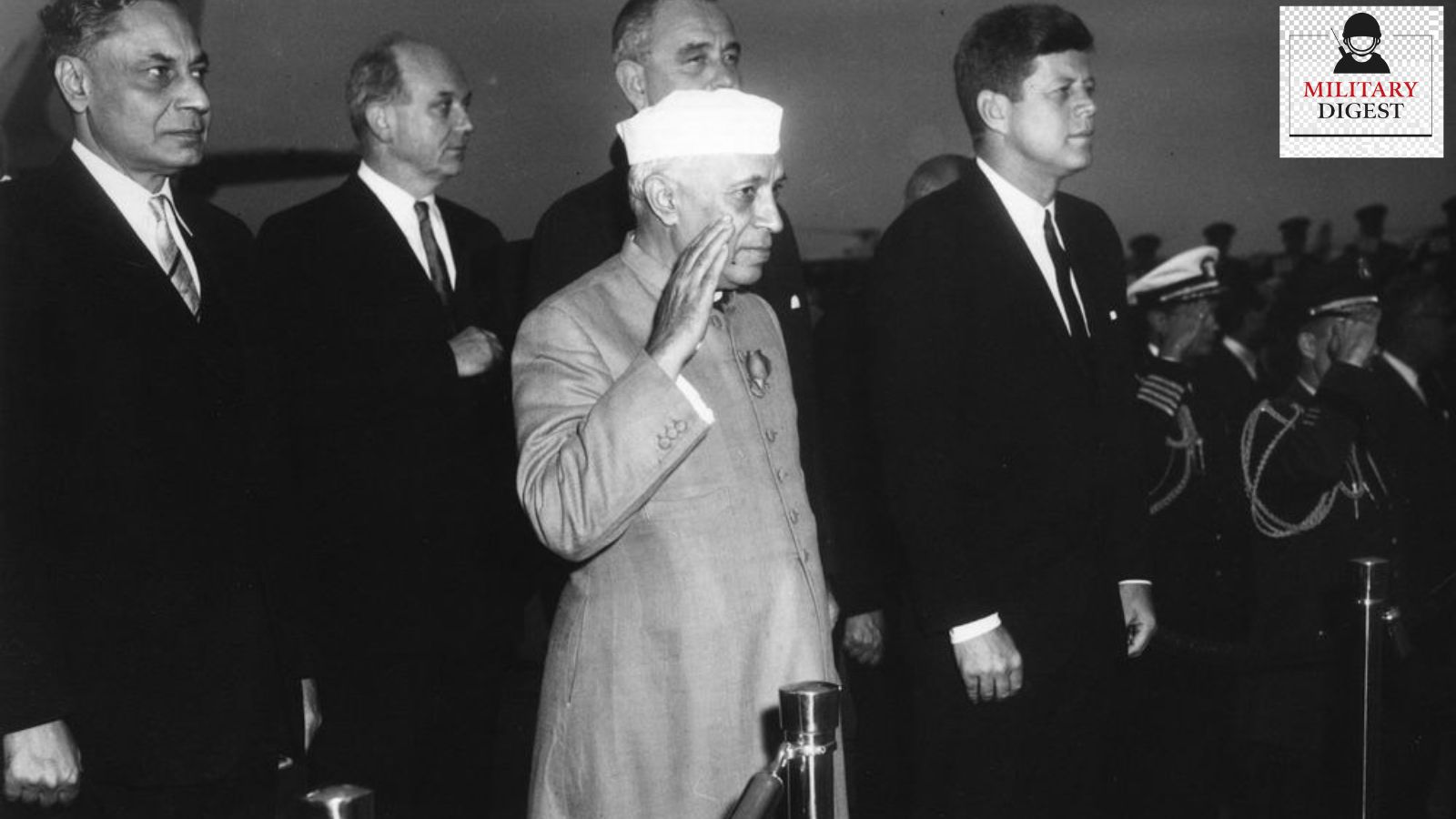
US and UK leaders tried to create a joint India-Pakistan defence against China after the 1962 war. Archives show British PM Harold Macmillan wrote to President John F. Kennedy on December 13, 1962, proposing this plan. They linked military aid to a Kashmir settlement, but the effort eventually got nowhere.
US archives reveal how British PM Harold Macmillan and US President John F. Kennedy proposed a joint India-Pakistan military defence and a Kashmir settlement following the 1962 war, an effort that ultimately collapsed.
In 1962, India was engaged in a bitter, desperate struggle against a Chinese invasion in Ladakh and the North East Frontier Agency (NEFA). The Chinese forces had launched a massive attack, pushing back Indian troops along multiple fronts. The then prime minister, Jawaharlal Nehru, made a frantic request to Western powers, particularly the USA and the UK, to rush much-needed military aid to help India stop the relentless advance of Chinese forces.
While the military aid from Western powers did come through and the war came to an end in November of 1962 with the Chinese announcing a unilateral ceasefire and withdrawing from most occupied territory in the east, the danger from China's belligerent policy was still ever present.
It is in this backdrop that the UK and USA began exploring a previously floated idea of a joint defence of India and Pakistan against China to protect the subcontinent from Communist forces.
US State Department archives include a letter British Prime Minister Harold Macmillan wrote on December 13, 1962, to President John F. Kennedy proposing a joint India-Pakistan defence of the subcontinent against China as a strategic response to the 1962 Sino-Indian War.
It linked short-term military aid to longer-term political settlement of Kashmir, limited Western commitments, and the possibility of bringing both countries under a Western nuclear umbrella via regional pacts.
Backdrop of 1962 war
The war began on October 20, 1962, with coordinated Chinese offensives in Ladakh and the North-East Frontier Agency. Better prepared and acclimatised for high-altitude mountain warfare, Chinese forces advanced rapidly. Indian troops, poorly equipped for the terrain and hampered by logistical and political shortcomings under the "forward policy," suffered severe losses.
By mid-November, a second Chinese push threatened deeper advances toward the Assam plains. On November 21, China announced a ceasefire and withdrew from most occupied territory in the east while retaining control of Aksai Chin. The outcome was a military and political humiliation for India.
Prime Minister Jawaharlal Nehru's non-aligned, idealistic foreign policy and underinvestment in defence were exposed. India urgently sought Western military assistance, and Nehru even requested US Air Force squadrons manned by Americans and radar support to protect cities and support the Indian Air Force.
Pakistan, a formal ally in Central Treaty Organization (CENTO) and Southeast Asia Treaty Organization (SEATO), watched warily. The US archives reveal that it feared that large-scale Western arms to India would alter the military balance on the subcontinent and reduce Western leverage on the Kashmir dispute. Simultaneously, Pakistan was negotiating its border with China in the territories it occupied in Kashmir, leading to an "agreement in principle" announced on December 28, 1962 and a formal treaty in March 1963 ceding the Shaksgam tract.
US and British officials urged Pakistan not to exploit India's crisis and restrained any opportunistic moves on Kashmir.
Macmillan's proposals
Macmillan's letter, sent shortly after the ceasefire, set out a coherent Western approach which advocated immediate re-equipment of the Indian Army. He stated that five or six Indian divisions facing China should be equipped as specialised mountain troops rather than conventional plains forces. Roughly two brigades had lost all equipment, and three divisions had been badly mauled. Experts estimated the cost at under $120 million, to be shared between the United States and Commonwealth countries during the "emergency" phase.
Long-term joint defence
The British PM stated that any sustainable defence against a massive Chinese invasion required a joint Indian-Pakistani plan for the entire subcontinent. This would be more efficient, free Indian troops from the Pakistan border, and avoid alienating Pakistan, a loyal Western ally.
Macmillan judged that neither country, under democratic constraints, could sustain the necessary priority of "guns over butter" alone. Joint defence should therefore be followed by integration into a regional military pact (CENTO/SEATO-style). This would deter China through the implicit threat of a Western nuclear response, the same logic that constrained Soviet moves in Europe.
Kashmir settlement as prerequisite
Macmillan suggested that Pakistan should retain the areas it already occupied with possible adjustments and India should keep Jammu and Ladakh. The intractable Vale of Kashmir could become an autonomous entity guaranteed by both countries. A full plebiscite was unrealistic given Indian opposition. India would need to make the first concession; the West could then press Pakistan to moderate maximalist demands, he said.
These ideas built on earlier thinking. In 1959 President Ayub Khan of Pakistan had proposed joint defence of the subcontinent against China, contingent on resolving Kashmir and other issues. Nehru rejected it, viewing it as incompatible with non-alignment and questioning "against whom?" it was directed.
Diplomatic follow-through and Kashmir talk
US Assistant Secretary Averell Harriman and British Commonwealth Secretary Duncan Sandys visited India and Pakistan in late November 1962. They secured a joint Nehru-Ayub communiqué on November 29 committing both sides to ministerial talks on Kashmir and related matters, with a possible later summit.
At Nassau, Kennedy and Macmillan reviewed the situation. They agreed on a prudent, limited programme of emergency military assistance to India, a joint US-UK air-defence study team, and strong encouragement of the India-Pakistan dialogue. Aid was not to be rigidly conditioned on an immediate Kashmir settlement, but longer-term support would take account of progress on the issue.
Letters to Nehru and Ayub conveyed this balanced message that Chinese aggression threatened the whole subcontinent, and reconciliation was essential for effective defence.
India and Pakistan held six rounds of talks. India offered limited territorial adjustments beyond the ceasefire line. Pakistan rejected these, insisting on far larger transfers or a plebiscite and prioritising Kashmir almost exclusively. The simultaneous China-Pakistan border agreement in principle, announced as the Indian delegation arrived in Rawalpindi, and the March 1963 treaty with China severely damaged trust. Talks collapsed in May 1963 without agreement. Pakistan also rebuffed subsequent Western mediation offers.
Outcomes and strategic consequences
No joint defence arrangement materialised. Emergency Western aid arrived, and a more substantial package to equip mountain divisions and air defence was discussed. Overall Western military assistance remained limited. US military sales to India rose temporarily but were curtailed after the 1965 Indo-Pakistani War. India dramatically increased its own defence spending, reformed its military, and increasingly turned to the Soviet Union for major equipment while Pakistan deepened its "all-weather" relationship with China.
The failure reinforced India's perception of a two-front threat of China and Pakistan. It contributed to the environment that produced the 1965 war and, later, closer Indo-Soviet ties culminating in the 1971 treaty.