
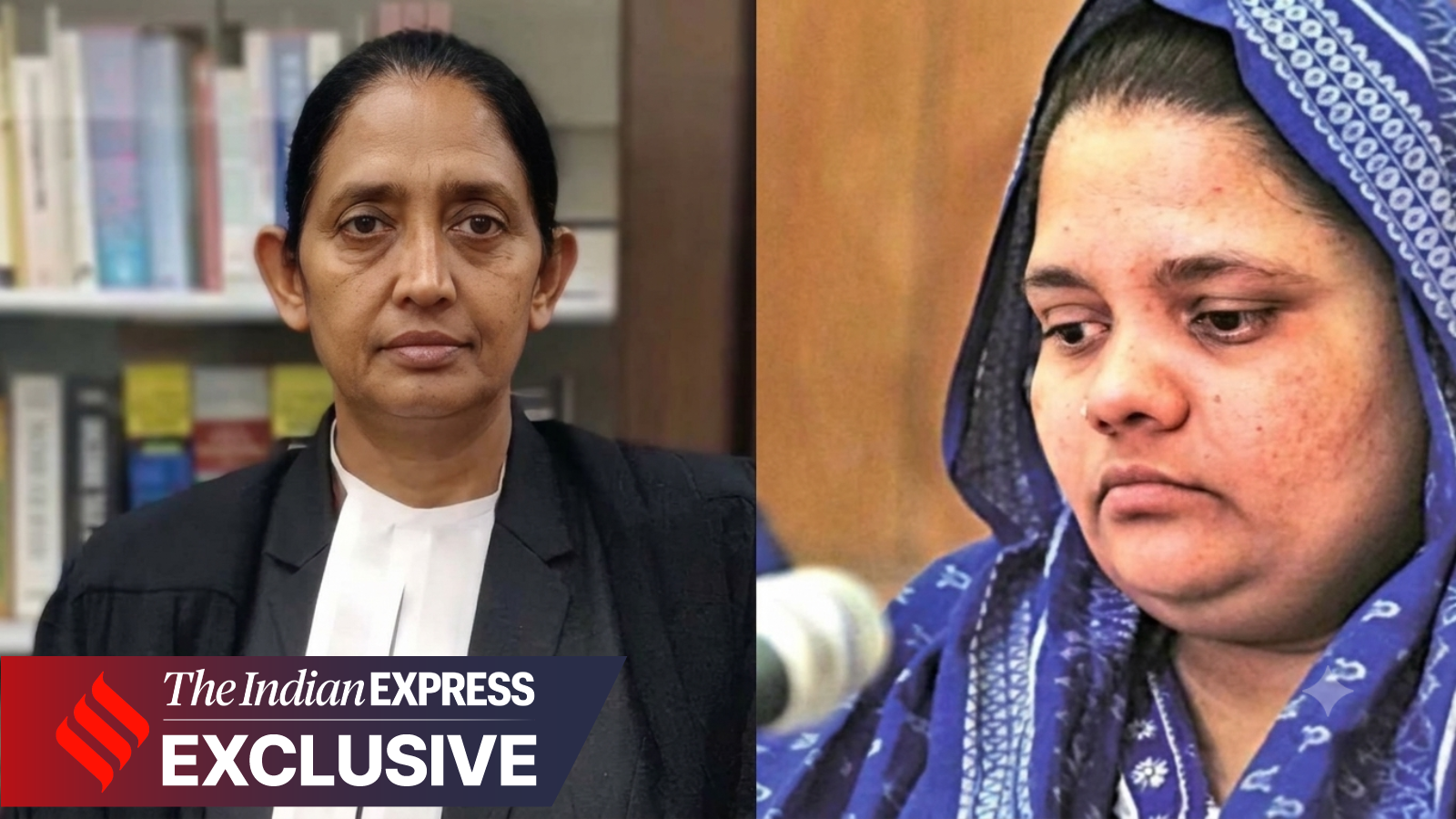
Bilkis Bano’s lawyer Shobha Gupta questioned the relief given to convicts in the 2002 Gujarat riots case. The violence started after the Sabarmati Express burning on February 27, 2002. Bilkis survived a brutal attack where fourteen family members were killed. Courts later accepted that the crime involved deep communal hatred.
Edited excerpts:
Tell us about the case.
Shobha Gupta: All this started after the burning of the Sabarmati Express on February 27, 2002. Then came the…retaliation…and the Muslims in Gujarat started running. There was an impression that they were being targeted… Bilkis and the family ran from village to village. Her cousin was full-term pregnant. Her mother, her phufa, phupi, cousin sisters, children, minor sisters, minor brothers…they took shelter…changed their attire to give an impression that they are not Muslims.
But in the FIR, they were apparently being chased by a group of people, saying, “They are the Muslims, kill them.” This is what exactly Bilkis says in her FIR and statements, and the other witnesses also say so. On this particular night between March 3 and 4, they were hiding in a jungle. These neighbours of Bilkis came – some of whom she called chacha, etc, and she knew them.
Her father was a milkman, so they would buy milk from him. She was five months pregnant, had a daughter who was 3.5 years old… The perpetrators…attacked them. She could identify 12 of them by name. She pleaded to them, “I’m like your daughter. I’m like your sister.” This is all part of the FIR and her statement.
They raped Bilkis and she became unconscious. They thought she’s no more. They smashed her daughter’s head on a stone and she saw it. If you see the postmortem report and the photographs, the other women were gang-raped. The men were brutally murdered. Fourteen people were killed, including eight minors. Fortunately, Bilkis survived.
She regained consciousness in the morning…found herself without any clothes…dead bodies of her family members around. She walked to a village uphill… taking the clothes from the dead bodies…and was finally taken to a relief camp. It’s a brutal, barbaric case…
They kept saying, “They are Muslims, kill them. They are Muslims, kill them.” This is the narration given by Bilkis, accepted by the court which had noted that it was a crime committed because of communal hatred. That’s part of the judgment. So it’s not somebody’s allegation.
The trial court, high court and Supreme Court took cognisance of the same. In her statement, she named every single one…The postmortem was very dodgy – again taken note by a judicial order – and doctors have been punished for that. This is maybe one of the rarest cases where the two doctors on postmortem duty were convicted. Six policemen were convicted in this case, and the 12 perpetrators who committed the real crime.
The FIR was not properly registered…the constable who had to enter the FIR…said 400, 500 people came in two jeeps. Just to make the entire story unbelievable. How will they reach…through the thin, narrow jungle lane? So now that’s part of the investigation. The chargesheet has been filed but they said the accused are untraceable.
We got the NHRC (National Human Rights Commission) involved and its team visited the relief camps and met Bilkis because of the exceptional, egregious crime committed to her… And the NHRC chairperson told me that when he met her, she said, “I have not been raped once. I’m being raped again and again each time when I’m asked to narrate that entire incident, each time to again and again to everyone who is visiting this place.” And that completely moved the then chairperson.
When this was closed…I was approached through the chairperson in 2003 and we filed a petition in the Supreme Court, a writ petition…fortunately, the Supreme Court intervened…
Ultimately, all these 12 people were convicted for life imprisonment by the trial court, including the one police officer who did that fudging…in the FIR. The high court then convicted the rest of the five police personnel, observing that this is not a case of poor investigation… This is, unfortunately, a case of deliberate investigation to completely subvert everything or to help the accused. So that is the first particular observation. Many of them went to Supreme Court challenging that.
In 2017 itself, their SLPs (special leave petitions) were dismissed, their review petitions were dismissed, and then came this 2022… Bilkis was sure that she would not get justice because these were the very police officers who were supposed to maintain law and order…found siding with the accused, so we filed an application seeking transfer of the trial from Gujarat to Maharashtra, and the Supreme Court even allowed that.
So a charge sheet was filed by the CBI, and the matter was tried before the Maharashtra Special Court…one of the prayers was for exceptional compensation because of all the wrong done to her. This petition was finally allowed in 2019 by the Supreme Court, where she was given highest ever compensation in the history of Indian courts to a rape victim…Rs 50 lakh. The state of Gujarat was directed to give her a house. In this case, they gave her land because she wanted it in a particular area. By 2019, we were still defending those appeals filed by the accused and the appeals were dismissed by Justice (Sharad) Bobde, making a specific observation that you have been let go very easily. With a crime of this nature, only life imprisonment…
In 2022, they got their SLP numbered. It was dismissed by the court, but the court in January 2022 observed that they had the liberty to apply for remission… Then convict Radhe Shyam came to the Supreme Court without disclosing so many facts, including that the Gujarat High Court dismissed his application saying the jurisdiction lies with the Bombay High Court.
The Supreme Court allowed the writ petition. Bilkis was never given a notice. The state of Gujarat was directed to decide their remission application within three months. Taking advantage of that order, rest of the convicts also filed their applications. And Gujarat then decided in quick pace all these applications, and they came out on August 15, 2022. The moment they were garlanded and celebrated, sweets circulated, we all came to know.
Then we started doing the search and realised it is an order that was challenged. Many from the civil society also filed petitions. Bilkis also filed. And the Supreme Court, after a detailed hearing and very good and detailed judgment, set aside the remission in January 2024, and asked all 11 to go back. One of them died during trial. This is a historic order. Never ever happened in this country that 11 of them were asked to go back. They filed applications for extension – dismissed. Gujarat government later filed some review application – dismissed.
Since then, but most of them are getting easy paroles. Every single convict, till we came to Supreme Court…had enjoyed cumulatively a parole of – someone had five years of parole, someone had four and a half years, somebody had three years, three and a half years…And those periods would be counted as sentenced. And now during this period also, they were out. Now in 2025, two of them filed SLP against the Bombay High Court judgment of 2017…
When we got to know that two of them have been granted bail and their sentence has been suspended, I was checking the record and realised that the court had condoned the delay of eight years by observing that they were in custody, therefore they could not file the SLP. As I told you, they were on parole for four years, five years cumulatively, and for that period from August 2022 till January 2024, they all were out…as remission (was) granted. So now we have to see the record, how many things they have concealed from Supreme Court to get this order now.
When we see the heinousness of the crime and various developments in the case, whose job is it to tell the Supreme Court that the victim must be heard too?
Shobha Gupta: This is possibly the most important question in this case with the recent development. I’ll add a few more questions with this and then reply… I would add a question: Is Supreme Court just gullible?
Is it this easy in this country to mislead the Supreme Court, to conceal the facts? If you ask me my experience of 30 years, the, the straight answer is absolute no. Why? Because the Supreme Court rules require, and we have seen judges being extremely, extremely strict on coming to know that they were actually misled. They directly indict the lawyer involved in that case.
So that’s why in Supreme Court not everybody can come and file matters. It’s only the advocate-on-record (AOR) who has passed an exam after completing five years of practice in Supreme Court. And the rules are very clear that the person’s advocate-on-record designation can be taken away the moment it comes to know that the person has…allowed a wrong affidavit to be filed.
Who drafts a matter? The advocate-on-record, not the client. Even the registry…is required to check by putting the dates, the judgment details. If you are challenging… Assume, like in this case, the Bombay High Court judgment was challenged. So they were required to put the names, the Bombay High Court judgment details to check whether these persons came before. Is there any judgment passed before? If so, then the rule requires that this matter go before the same judge, same bench, if the judges are still there, not retired.
Are you saying the Supreme Court bench has been misled in this case?
Shobha Gupta: I’m assuming, honestly. Because of the language in the order… See, I don’t have the petition so far… I have all the reason to assume because court says they were in custody, which is incorrect. They were not in custody all along… So the persons who are in custody don’t get the legal aid to file the petitions. For these convicts, they are almost before court all the time. Best of the lawyers representing them in revision case.
This is not the case that they were not in touch with lawyers. The condonation of delay application must have made the wrong statement, so the court recorded that. Then the court says this person is severely handicapped. Now, what is that severe handicap?…there should have been a mention of the severity and the degree of handicap… For granting bail or suspending sentence, court does not go by my assertion alone. Court asks for medical proof. I don’t see the order where it says we are asking for a medical board to be constituted. We are asking the jail authorities to file an affidavit. I don’t see any order in this case. It simply says the lawyer submitted, hence sentence suspended.
Should the remission part have been informed to the court and found a mention in the order?
Shobha Gupta: That is what I’m assuming…certainly in the petition, they had no choice but to state it. If a lawyer or a party does not mention that important factor, where the Supreme Court was sitting over their case, and given a verdict of cancellation of their remission, asking them to go back till their case is matured for the remission policy of Maharashtra to be invoked. And the Maharashtra policy is a minimum 28 years. How come they did not mention that?
I can bet with anyone for that if this was mentioned, this matter would have then been listed before the bench of Justice (B V) Nagarathna. Because…if a matter has been heard, a substantive detailed judgment has been passed by a bench, and the judges are still there in the Supreme Court, the matter had to be listed before the presiding judge, which is Justice Nagarathna and Justice Ujjal Bhuyan…Five times this matter was listed, not once it went to Justice Nagarathna’s court. How come? It is only possible when they have not stated about the remission order…
But here, mind you, I am saying this with all sense of responsibility. I have not yet read the petition, but I can tell you with my experience, after seeing the order, not only the advocate-on-record would have to be asked questions about what have you stated, but the registry has also failed in their job.
Because even as, as an outsider, if you today put the details of the Bombay High Court judgment, you would find reference to the Supreme Court’s order in the remission case. That was a duty of the registry…registry makes an office report. They don’t even clear the matter till you put all the documents on the court…
The senior counsel appearing in the remission case also appeared here in this case… We all lawyers are officers of the court. Even if the client wants, we cannot allow this to happen. See, after all, how would the judges get the correct information? So they have…advocates-on-record, who are again court officers, and the registry. If everybody fails, then certainly judges would also fail, and judges have failed in this case. So…it was not only the duty of the registry, but the lawyers, the AOR, everyone in this case appears to have deliberately failed. I’m so sorry to use this expression, but this appears to be the very correct case, that everybody deliberately, consciously failed.
Otherwise, it’s not this easy to fool our registry. I always say Supreme Court’s registry is possibly the best registry in the country when it comes to the courts. The most meticulous… But if this is happening, then that’s very, very serious. I am troubled as a lawyer, I tell you, not only as Bilkis’s lawyer, as a lawyer with 30 years of practice… Your heart bleeds when you have to say that the system failed because of the deliberate acts of a few…
Now…about the notice to the victim. Court says that in a crime like sexual assault, the victim should be involved at each stage… Now, in remission case also, we took this plea very seriously that she was not even called upon. This time, I believe we have to get the law settled once again, and I’m very, very clear this time, we are actually going to request the court to pass an order that in Bilkis’s case, especially this case, this should happen in all cases of sexual assault. You are not going to pass an order without hearing the victim.
But for Bilkis’s case, I’m actually going to now request the court to please pass a categorical order that henceforth any petition to be filed, her name must be mentioned in the petition, she must be made party, and no order shall be passed without hearing her. Because this shock treatment, you know, this time it is very serious for Bilkis. For all of us. We all are troubled as a society, but I tell you, this has caused irreversible damage to her faith, and that’s very unfortunate. Faith to the system.
You can take it, you can take the blow once, you can take the blow twice, but to live under this apprehension, this fear that, you know, suddenly some order would come and criminals of this nature…whose hatred can go to this extent, would be coming and living next to you…
You were only seven years into the profession when you got roped in into the Bilkis case, and now you’re a senior Supreme Court counsel. You have seen her journey as a survivor, been a part of her legal battle. What is the impact on her mental health?
Shobha Gupta: I was put in the matter by NHRC… It was a different time, different age… I was taking care of the judicial side… But Bilkis was fortunate to have social workers surround her…to not let any hard wind come to her. And this role we all, including me, play even now. We ensure that nothing comes to her directly… This is the duty we discharge to her…as a part of a responsible society.
We always do it, as a representative of the larger society that is India, telling her that you are not alone. That is not a singular battle which you have to fight out. It is a battle of all of us… You are not alone pained or affected by any adverse order. We all are equally or more affected… We will put up the fight for you and for us.
So this has been a constant effort that we don’t let her feel that we are doing it for her or that this is her fight. We make it…a collective fight, and that she’s one of us.
When this news broke that Supreme Court has given bail to two of them…so many journalists called me saying, “Ma’am, not again.” We have not suffered that direct crime upon us, but trauma we all suffer. Now, just understand her trauma through this. Her husband called me when he read the news…saying “Shobha ma’am, dobara kar diya inhone (They did it again).” And I was speechless.
Things become more worse when you are receiving it out of the blue. You are living in peace, you are trying to, you know, regroup things around you…and suddenly something like this comes. And the first reaction is, “Oh, my God. Not again.” So we have to restart it. So each time they would go mislead the court, and these people would come back and say, “See this brutality, this egregious crime. I suffered like this. Don’t let this happen to me.”
So why this misplaced sympathy for the, for the criminals who did this crime? Ek baar aur (once again). So this trauma, unfortunately these orders are making her to relive ek baar aur… She must be more than 45 now. She has shown the nerves of steel. I call her Himmat (courage). That’s my way of referring to Bilkis. So yesterday when I was having a video call with her and she was crying, I said, “You know, what do I call you?” And she had a smile. She said, “Yes, Himmat.” So I said, “Well, you know what is your name. What do you mean to us? How come you cry?” But…how many times her himmat has to be tested? How many times she has to be dehumanised? How many times she has to relive the trauma?
When would the Supreme Court, the judiciary, the system allow her to forget everything? To be able to live in peace, not to relive ever again. When are we going to make this promise to her? As a society, as a system. See, system has not given her any protection. It’s not the case as if the state has given her protection…and she not worry.
She has now grown-up daughters. (Former) Supreme Court Chief Justice (Ranjan) Gogoi in his order, he took judicial notice of the fact that they lived a life of nomad for 17 long years. They changed 24 times the place of residence just to make sure that they live to see justice. But how long? That time the children was small. When the (convicts) came out on remission, they had to run helter-skelter… They are now behind by two years in their education. You can’t afford to do that again and again. I’ve never seen the state coming forward and saying, “Oh, you are Bilkis’s children. We’ll ensure your free education as well as we’ll make sure that you are getting better placements.”
See, as a benevolent state, when we know one of our child has suffered, she still tried to survive, live life, have children. Why can’t, as a state, I guarantee her, “Don’t worry. Your children are my children. I’ll take care of them”?
How do you want to move forward?
Shobha Gupta: First of all, the petition filed by the convicts has to be obtained. She is not a party. She has not been served. She doesn’t know what they have written. Then certainly she would be going back to the Supreme Court asking for cancellation of this suspension of sentence. That order has to be recalled.
And the settled position of law is that suspension of sentence is not a routine exercise. Extraordinary case, compelling circumstances when the petitioner establishes that given the facts and circumstances, it is necessary for sentence to be suspended, then only sentences are suspended. We don’t see… that in the order. So, according to me…the order has to go. And then the SLP filed by them has to be opposed. To ensure that the same is dismissed because you cannot have multiple judgments of Supreme Court on one issue itself. Supreme Court has already given its opinion.
Once they accepted the judgment, asked for remission, the Supreme Court examined their plea and cancelled the remission order, and asked them to wait for 28 years to complete, then certainly no occasion for them to now challenge the Bombay High Court judgment.
I’m more than sure with the past practice, that they would have made their case worse by concealing the facts. So that itself would help us in getting the petition dismissed.