
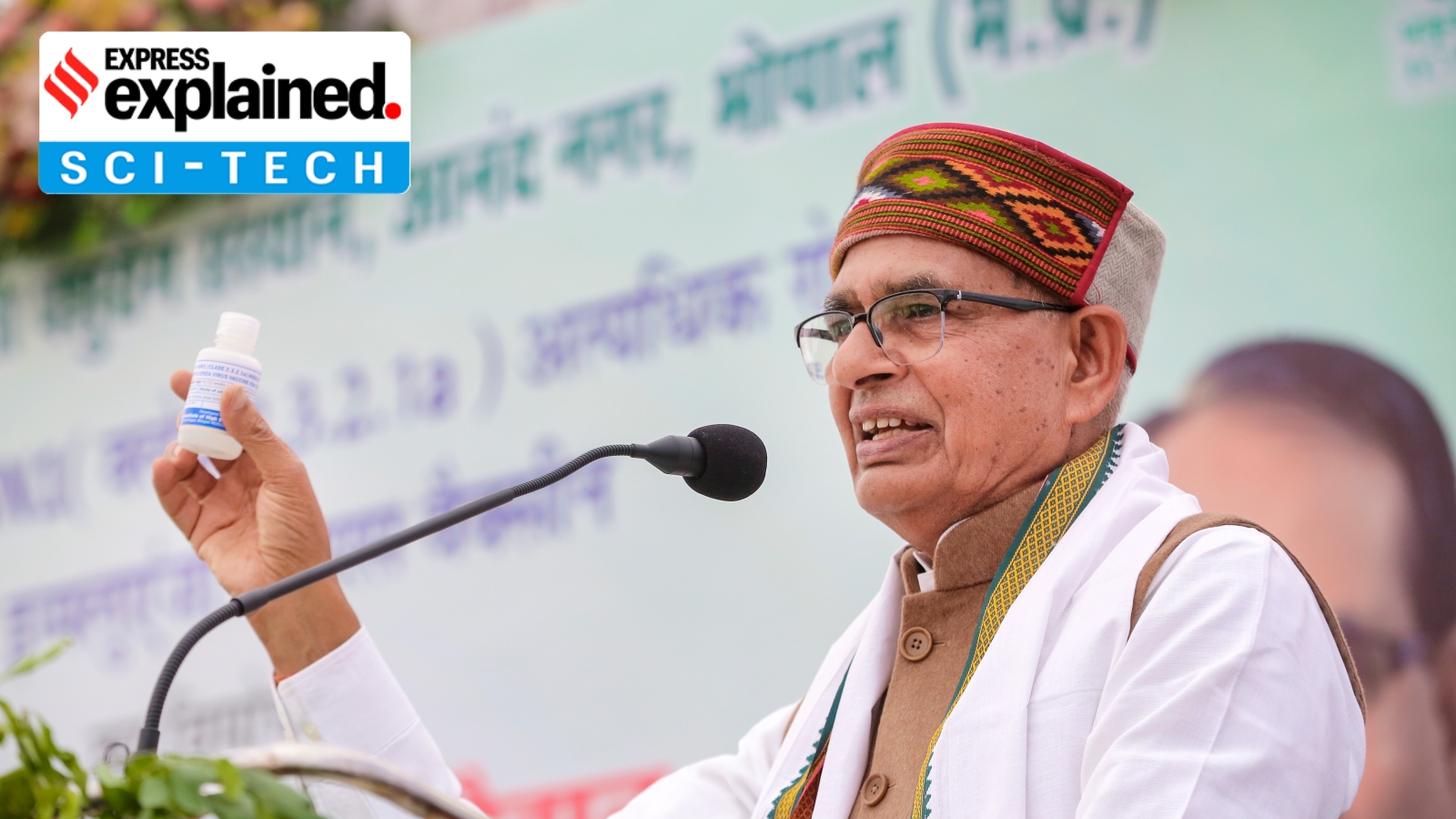
Scientists at the ICAR-National Institute of High Security Animal Diseases in Bhopal developed India’s first indigenous bird flu vaccine for chickens. Announced by Union Agriculture Minister Shivraj Singh Chouhan on Friday (November 20), the vaccine costs Rs 1-2 per dose. It aims to control outbreaks and prevent huge economic losses.
Scientists at the ICAR-National Institute of High Security Animal Diseases (NIHSAD) in Bhopal have developed India's first indigenous vaccine for chickens against the H5N1 strain of avian influenza. We explain its significance.
For years, India has dealt with recurring outbreaks of bird flu, caused by the highly pathogenic H5N1 strain of avian influenza. While the disease has primarily affected poultry, the virus has increasingly been detected in other animal species, including tigers, leopards, and other mammals. It has also infected humans, raising concerns about its potential to pose a wider public health threat.
Now, scientists at the ICAR-National Institute of High Security Animal Diseases (NIHSAD) in Bhopal have developed India's first indigenous vaccine against H5N1 for chickens. The vaccine, which costs Rs 1-2 per dose, was announced by Union Agriculture Minister and former Madhya Pradesh chief minister Shivraj Singh Chouhan in Bhopal on Friday (November 20).
We explain why the vaccine was needed, the challenges involved in developing it, and what the trials established.
Why India needed a bird flu vaccine
India's first bird flu outbreak was reported in 2006 in Navapur, Maharashtra. Since then, the country has recorded more than 500 outbreaks, according to figures shared by Chouhan. Outbreaks have resulted in large-scale deaths and culling of poultry, affecting farmers and the wider poultry industry.
The vaccine targets a particular genetic group of the virus known as H5N1 Clade 2.3.2.1a, which has been responsible for a majority of bird flu outbreaks in Indian chickens since 2011.
A clade is a genetic grouping of viruses that share a common ancestry. H5N1 is the name of the virus subtype, while 2.3.2.1a identifies a particular genetic lineage within it. This is important because influenza viruses continue to change over time, and vaccines need to be suited to the strains circulating in a population.
Dr S Nagarajan, principal scientist at NIHSAD who led the team of scientists involved in the vaccine's development, told The Indian Express, "These outbreaks have caused huge economic loss to the poultry industry... Hence, the vaccine is important to control the clade 2.3.2.1a H5N1 virus strain to mitigate the economic losses to the farmers and to prevent emergence of a human pandemic virus."
The concern over this particular clade extends beyond poultry. "Outbreaks involving the same viral group were reported in several mammalian species, including tigers, lions, domestic cats, leopards and jungle cats in 2025," Nagarajan said. According to him, three human deaths involving H5N1 viruses belonging to the same clade were also reported from Haryana, Andhra Pradesh, and Karnataka.
The vaccine is intended to protect chickens, not humans. Its potential public health benefit lies in reducing the circulation of the virus among birds and, consequently, the opportunities for transmission to people who come into contact with infected poultry.
Challenges in development of the vaccine
The vaccine was developed at ICAR-NIHSAD, an institute in Bhopal specialising in the diagnosis, surveillance, and research of high-risk animal diseases.
The institute has been working on avian influenza for years. Its research includes monitoring the different strains circulating in India, studying how the virus changes, and examining its ability to infect different animal species.
Nagarajan said the biggest challenge was the time taken to develop the vaccine. "It took a lot of dedicated efforts and hard work to develop this vaccine. The biggest challenge was racing against the time to develop the vaccine within the minimum possible time," he said.
The demands of the work also extended beyond the laboratory. Officials said the scientists worked through weekends and holidays and followed strict biosafety protocols throughout the research period. These included sanitisation procedures before and after leaving the laboratory, extensive bathing procedures and restrictions on keeping pets at home to minimise the possibility of carrying infection outside the facility.
How effective is the vaccine?
The vaccine has passed safety, efficacy, and potency tests in accordance with the prescribed guidelines of the World Organisation for Animal Health (WOAH). According to Nagarajan, experimental trials showed that it provided 100% protection against the targeted H5N1 clade throughout the 24-week observation period following booster vaccination.
The 24-week finding, however, refers to the period observed after the booster dose under experimental conditions. Further details about the number of birds involved, the trial design, and performance under commercial farm conditions would help establish the vaccine's efficacy when used on a larger scale.
Another important finding was that the vaccine prevented the transmission of the virus between chickens. In the trials, vaccinated chickens were kept in contact with unvaccinated birds. The researchers found that the vaccinated birds did not transmit the virus to their unvaccinated counterparts.
This is important because a vaccine that protects individual birds from developing severe disease can reduce deaths on poultry farms. Preventing transmission can also help limit the circulation of the virus among birds and reduce the risk of further outbreaks.
What does it mean for poultry farmers?
The vaccine has been priced at Rs 1-2 per dose, making it relatively inexpensive for poultry farmers. Its intended use is to protect chickens, particularly layers and growers, against clinical disease and deaths.
Layers are chickens raised for egg production, while growers are birds being raised towards maturity. Preventing infection in these populations could help farmers avoid losses and disruptions to production.
Nagarajan said that properly administered vaccination would protect chickens against clinical signs and deaths and prevent transmission to unvaccinated birds. It could also reduce environmental contamination by limiting the circulation of the virus.
The vaccine, however, is not yet available for farmers to use commercially. The next step is the transfer of technology to manufacturers who can produce it at scale and make the vaccine available to poultry farmers. Nagarajan said that transfer of technology "will be initiated at the earliest possible" and the time for actual vaccine availability will depend on the process proposed by the Centre's Department of Animal Husbandry and Dairying.
What does this mean for India's animal disease research?
NIHSAD has previously developed indigenous vaccines for diseases including Gumboro, Brucella abortus, Classical Swine Fever, and African Swine Fever. Its research also covers disease surveillance, diagnostics, and the study of pathogens that can spread between animals and humans.
The H5N1 vaccine adds to this work by giving India a vaccine specifically developed against the clade responsible for most outbreaks in its poultry population.
Nagarajan said India was not dependent on other countries for vaccines against animal and bird diseases. The achievement, therefore, is not about ending dependence on foreign vaccines but developing a vaccine suited to a particular strain circulating in India.