
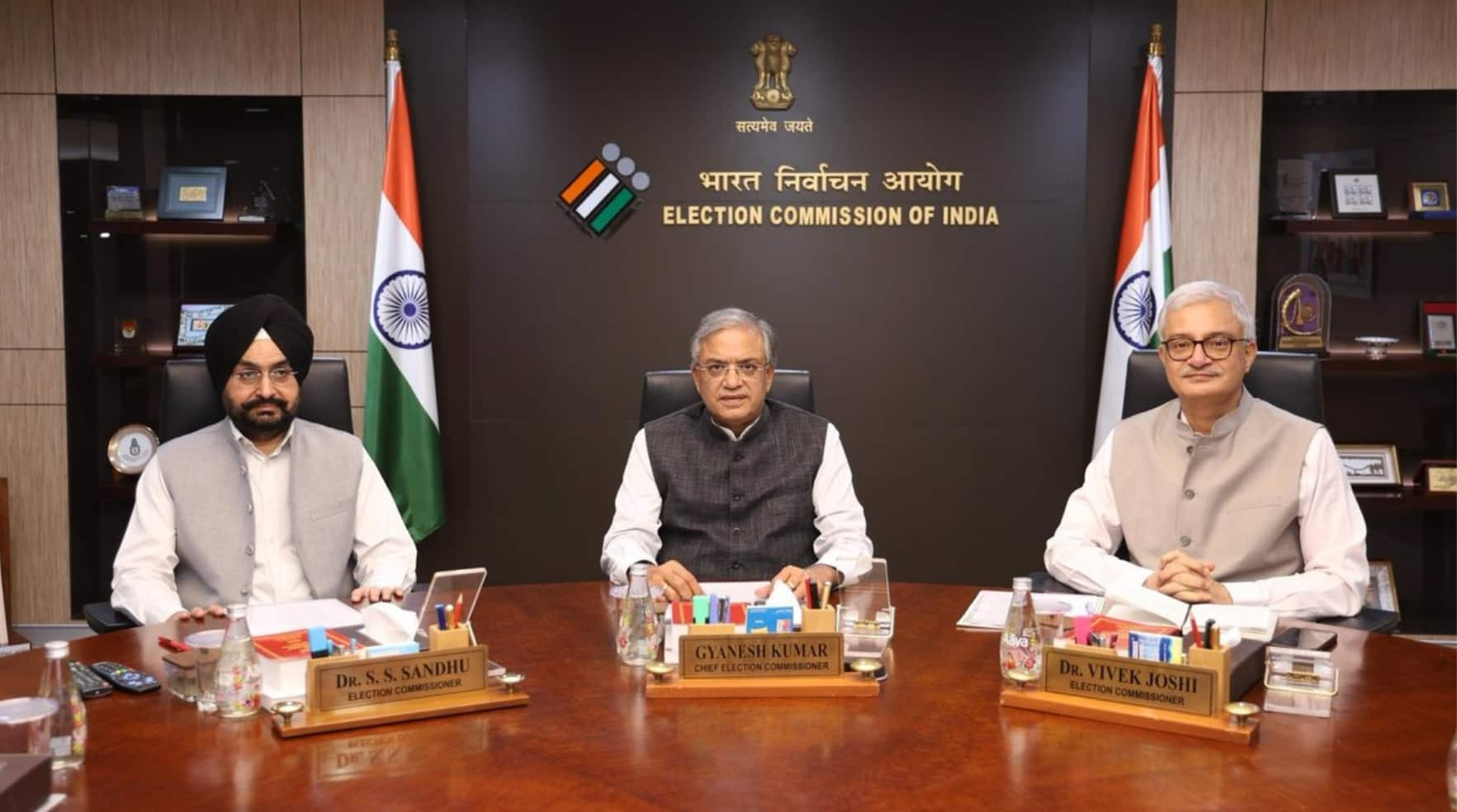
The Election Commission of India defended its Special Intensive Revision of electoral rolls in the Supreme Court on Monday, October 26. The poll body said decisions were taken unanimously and denied changing Form 6. It also noted, “In the eyes of law, a newspaper report is not treated as evidence.”
Market Mastery
Webinar by Vishal Malkan
Find the weak links
in your portfolio by Vishal Malkan
The Election Commission of India (ECI) has mounted a legal defence of its Special Intensive Revision (SIR) of electoral rolls, telling the Supreme Court that decisions concerning the exercise were taken unanimously and rejecting allegations that it altered the statutory Form 6 used for voter registration.
In a counter-affidavit filed on Monday (October 26) in the case brought by Rakesh Kumar Singh alias Rakesh Singh, and accessed by Moneycontrol, the poll body has challenged the basis of allegations surrounding its internal decision-making, defended the process through which Commission decisions are recorded, and sought to distinguish the SIR declaration from the prescribed application form for enrolling new voters.
The affidavit comes amid questions over whether important decisions concerning the SIR were taken despite objections from Election Commissioners and whether the changes introduced during the exercise effectively altered the requirements for voter registration.
At the centre of the dispute are three issues: how the ECI reaches decisions, whether Form 6 was changed during the SIR, and what safeguards apply to voters whose details cannot be linked to earlier electoral rolls.
Why ECI is challenging allegations
The controversy follows an Indian Express report that said 14 important decisions related to the Special Intensive Revision (SIR) of electoral rolls had been taken in the name of the Election Commission despite objections recorded by the two Election Commissioners .
The ECI has disputed the reliance placed on the report, arguing that a newspaper account cannot, by itself, establish the facts alleged in the petition.
“In the eyes of law, a newspaper report is not treated as evidence of the facts it narrates. The Commission has neither released nor authorized the release of any internal note/file to any news agency,” the affidavit states.
The Commission has argued that the petition relies on material that was not independently verified with the respondents. It has also denied authorising the disclosure of internal notes or files to the media.
The ECI's objection goes beyond the report's source. It concerns how internal discussions should be interpreted when determining whether a formal decision has been taken by the constitutional body.
According to the Commission, queries, observations and suggestions recorded while a file is being processed do not automatically amount to decisions of the ECI. Internal deliberations, it maintains, must be distinguished from the Commission's final, formally adopted position.
How ECI says its decisions are taken
The affidavit maintains that the Commission's decisions on the SIR were unanimous. It specifically addresses three orders dated June 24, 2025, October 27, 2025, and May 14, 2026.
The counter-affidavit was filed by Deputy Election Commissioner Bhanu Prakash Yeturu and was approved "unanimously" by Chief Election Commissioner Gyanesh Kumar and Election Commissioners Sukhbir Singh Sandhu and Vivek Joshi.
The ECI has also explained its internal file-processing procedure. Files are ordinarily placed before one Election Commissioner, then the other, and subsequently the Chief Election Commissioner. The Commission argues that observations made during this process should not be treated as proof of a disagreement over the final decision.
The legal framework governing the process is also central to its defence. Section 18 of the Chief Election Commissioner and Other Election Commissioners (Appointment, Conditions of Service and Term of Office) Act, 2023, provides for decisions to be taken unanimously “as far as possible”. Where unanimity cannot be achieved, the decision is determined by a majority.
The Commission has further stated that electronic approval may be obtained in urgent matters, with the approval recorded subsequently.
Its position is that the existence of internal notes or comments does not, by itself, establish that the Commission's final decisions were invalid or that the statutory procedure was breached.
On Form 6 controversy
The second major issue concerns Form 6, the prescribed application used by eligible individuals seeking inclusion in electoral rolls.
The ECI has maintained that Form 6, prescribed under the Registration of Electors Rules, 1960, was not amended for the SIR. It has argued that any amendment to the statutory form falls within the authority of the Central Government, rather than being something the Commission can independently do through the SIR process.
The controversy arose over the declaration required alongside applications during the revision exercise. The additional declaration seeks information that can help establish a connection between an applicant and earlier electoral rolls.
The Commission's argument is that this declaration is a separate document and should not be confused with an amendment to Form 6 itself.
The ECI has acknowledged that the way the application process appeared online could create the impression that Form 6 had been modified. It said the online process was separated into Form 6 and the SIR declaration from October 21, 2026, in line with the distinction followed for physical applications.
The distinction is significant because the dispute is not merely about the name of a form. It concerns whether the additional information sought during the SIR constitutes a change to the statutory application process or a separate mechanism for verifying electoral-roll links.
The ECI maintains that it has not altered Form 6 and that the declaration serves a different purpose within the revision exercise.
On voters not mapped to older rolls
A further question concerns electors whose details cannot be linked to previous intensive revisions of electoral rolls.
The ECI has said that Booth Level Officers (BLOs) collect the necessary information from voters' homes and upload it to the ECINet platform for Electoral Registration Officers (EROs) to examine.
According to the Commission's explanation, an inability to map a voter to an earlier roll does not automatically mean that the person must attend a hearing. Hearings are intended for exceptional cases, with online proceedings preferred where possible.
The Commission has also stated that no name can be added to or deleted from an electoral roll on ECINet without an order from the competent ERO.
These explanations address concerns over how the SIR is implemented on the ground, particularly for voters whose records do not readily match earlier electoral rolls. The procedure for collecting information, assessing eligibility and issuing notices is therefore an important part of the wider legal dispute.
The ECI has also referred to a committee involving experts from IIT Madras and the Indian Institute of Science, Bengaluru, to examine compliance and the functioning of the ECINet platform.
On Chief Election Commissioner be restrained
The affidavit also contests the request to restrain the Chief Election Commissioner. The ECI has invoked Article 324(5) of the Constitution, which provides protection concerning the removal of the CEC, who can be removed only in the same manner and on the same grounds as a Supreme Court judge.
The Commission has also referred to earlier Supreme Court consideration of challenges concerning the credibility of electronic voting machines.
The petitioner, meanwhile, has questioned the functioning of the CEC and the legality of certain decisions attributed to the Commission. The ECI has sought to have the allegations assessed against the applicable legal framework rather than on the basis of reported internal deliberations.
The counter-affidavit is a preliminary response. The Commission said it was filing a short reply because of the intervening Dussehra holidays and reserved the right to submit a detailed, paragraph-wise response.
Matter to be heard on October 27
The Supreme Court is scheduled to hear the matter on October 27, 2026, before a bench led by Chief Justice of India Surya Kant, also comprising Justices Joymalya Bagchi and V Mohana.
On October 5, the court had issued notice in the case but declined to grant an ex parte interim order suspending the CEC. The bench had indicated that it would examine the decisions in question and intervene if they were found to be incompatible with the law.