
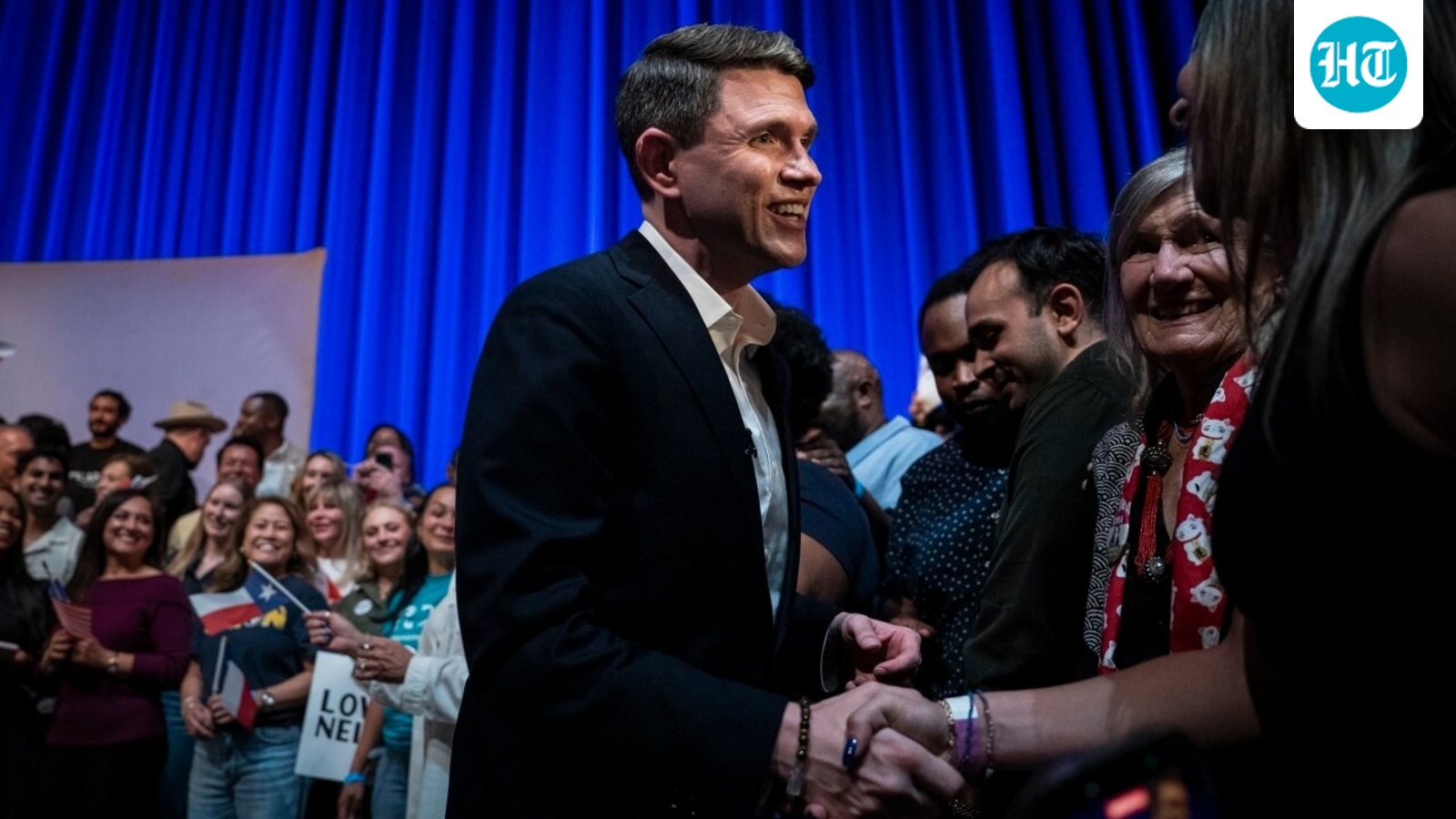
Democrats won control of Congress and many governorships after focusing on the economy. Candidates kept the spotlight on affordability, as 89% of voters said the cost of living was a major factor. Strategist Jamal Simmons said, "The risk for Democrats is that we start arguing about which ideological car."
Democrats won control of both chambers of Congress, a majority of governorships and more in a massive midterm rebuke of President Trump. In doing so, they pulled off a feat that has bedeviled them for years: uniting around a message -- affordability.
The party mostly managed to keep the spotlight on the economy as candidates drove home that Trump's policies are hurting pocket books. They coalesced around this message, even as a fight for the party's direction continues to boil. Centrist and far-left candidates alike drilled down on the economy, and largely avoided being drawn into culture wars that have cost Democrats in recent elections.
High fuel and food prices were a top voter concern, with 89% saying the cost of living was a crucial or major factor in how they voted for Congress, according to the Voter Poll for the Associated Press and the major television and cable news networks.
Democrats also largely managed to pick high-quality candidates able to appeal even to independent voters in a number of critical races, including in states Republicans have dominated for decades such as Texas, Kansas and South Carolina.
They will enter 2027 with a comfortable Senate majority -- 54 seats won and the party leading in two uncalled races -- and a House majority that is expected to rival the size that former President Obama had in his first term in office.
Their victory, while historic, was more a rejection of Trump than a mandate for the Democratic Party's agenda. How the party moves forward in 2027 will have serious implications for a 2028 presidential primary race that will start almost immediately.
"The risk for Democrats is that we start arguing about which ideological car we're going to drive before we have agreement on where we're going," said Jamal Simmons, a Democratic strategist who advised Vice President Kamala Harris.
The results also underscored how quickly the coalition Trump assembled in 2024 unraveled. Many of the groups, like young and Latino voters, that propelled his return to the White House swung back toward Democrats.
Democrats after two years out of power in Washington made their gains despite a deeply unpopular brand. The Voter Poll showed the Democratic Party is viewed unfavorably by 52% of midterm votes, compared with 60% for the Republican Party.
"After 2024, the Democratic brand was in the toilet. It was really at a low point and it still needs a lot of work," said Lis Smith, a Democratic strategist. "But 2026 is where the Democratic comeback begins. It's going to be a bigger-tent party."
Democrats' economic message echoed that of a surprising source -- Zohran Mamdani. The popular New York City mayor made affordability a central pillar of his campaign, though centrists prescriptions for remedying the problem differ radically from the Democratic socialists'.
Headaches remain for a party still facing deep policy divisions and already debating the message voters sent. Progressives are pointing to their wins -- including in presidential battleground states -- and calling for a shift to the left in the party's agenda.
The party also risks misreading the moment, as it did after 2022 midterm elections when former President Joe Biden was in the White House. Those actions helped President Trump win his 2024 victory.
"The celebration over the victory should last all of one minute," said former Rep. Cheri Bustos, a centrist Democrat who repeatedly won a western Illinois congressional district filled with Trump supporters." She said Democrats should not "squander this new majority with divisive nonsense that fuels the base, but ignores the real needs of everyday people."
The Democratic wins were impressive in both scale and geographic breadth, potentially altering the map for the 2028 presidential election. Starting in 2027, Democrats will hold all the governorships in all seven battleground states that decided the 2024 presidential election. And their success could expand the presidential map, making the possibility of competing for electoral votes in traditional Republican states like Texas a reality.
Democrats fielded an assortment of candidates with a range of backgrounds and political profiles, some of which had endorsements from both the progressive and centrist wings, including Bobby Pulido, a Tejano singer in Texas; Sam Forstag, a former smokejumper in Montana; Brian Poindexter, a union ironworker in Ohio; and two clergy members in Iowa. Those candidates all either won or were leading in their race.
The Democrats touted their candidates for being messengers with real credibility, committed to public service and holding a real connection to their districts, part of the party's strategy to reclaim working-class voters.
As House Democratic leader Hakeem Jeffries watched early returns foreshadowing a strong night for the party, he noted that the party had recruited "doctors and nurses and pastors and farmers and union leaders and educators and police officers and firefighters and combat veterans -- people who have already lived a life of service to their community."
Democrats have dominated the Northeast in recent cycles, although Trump made inroads during the 2024 campaign in the New York and New Jersey suburbs and maintained his strength in northern Maine.
Those gains appeared to be dashed in the election: Democrats ousted Republican Sen. Susan Collins of Maine, the longest-serving GOP woman in the Senate, and in the state's rural second congressional district.
In New Hampshire, Democratic Rep. Chris Pappas trounced former Sen. John E. Sununu, a member of the state's most durable Republican family, by nearly 15 percentage points to win a Senate seat.
In the Midwest, the party won races in states Trump had won by double digits that had previously been viewed as almost permanently red. Democrats benefited from the pain rural America is feeling from the spike in fuel and fertilizer prices that have followed the president's trade policy and the war in Iran.
State Auditor Rob Sand became the first Democrat to win Iowa's governorship in two decades, running almost as a nonpartisan candidate and criticizing both Republicans and Democrats as he called for more government accountability. He won by 11 percentage points, a stunning 24-point swing, when compared with Trump's 13-point margin there in 2024.
A similar campaign approach was run by state Sen. Josh Turek, who became the first Iowa Democrat to win a U.S. Senate seat since 2028. The two-time basketball Paralympic gold medalist sold himself as someone willing to buck his own party, while also benefiting from headwinds faced by his GOP opponent from Trump's tariffs and the Iran war.
In nearby Kansas, Democrat Adam Hamilton snapped a nearly 100-year winning streak for Republicans in the state's Senate races. The Methodist pastor cast himself as a "radical centrist," securing a win in a state Trump carried by 16 percentage points in 2024.
The party also won open-seat governorships in Wisconsin and Michigan, while Pennsylvania Gov. Josh Shapiro, a likely 2028 presidential candidate, was re-elected in a landslide victory.
In ruby-red Texas, Democrats flipped both a U.S. Senate seat and the governor's mansion, a stunning feat in a state where the party had not won a statewide race since 1994. There, Democrats James Talarico and Gina Hinojosa ran on a populist message, emphasizing affordability, fighting corruption and taking on the billionaire class. Hinojosa's victory, in particular, sent shock waves through political circles. She unseated three-term Gov. Greg Abbott, a Trump ally and architect of conservative policies.
Across Texas and beyond, Latino voters swung back toward Democrats, marking a sharp reversal from 2024 when many shifted toward Trump. Nowhere was that shift more evident than in South Texas.
In the Rio Grande Valley, Republicans -- at Trump's urging -- had targeted two Democratic-held seats that Texas Republicans had redrawn to be more favorable to the GOP during mid-decade redistricting. But Democrats held both of those seats -- and they flipped a Republican seat in a neighboring district Trump won by 18 percentage points in 2024.
In that district, the Democrat was Bobby Pulido, a Tejano singer and local celebrity who ran as a moderate focused on affordability. Part of Pulido's approach was one that a number of Democrats embraced in 2026: distancing themselves from partisan politics and criticizing their own party. His campaign slogan was "Not team red, not team blue. Team you."
Jonathan Cowan, president of a group called Third Way that is trying to push Democrats more to the center, said there is a risk party progressives will misinterpret the message from voters.
"There is one fact that just can't be argued away: moderates made both the Senate and House majority," he said.
Cowan pointed to how all the Senate seats flipped by Democrats featured more moderate candidates, with the only exception being Troy Jackson's victory in Maine.
Progressives are pointing to the Senate win of Jackson, as well as those of Abdul El-Sayed in Michigan and Lt. Gov. Peggy Flanagan in Minnesota as signs their candidates can win competitive statewide races.
"Winning a single U.S. Senate seat was never the goal. The goal is to use that seat to transform our politics," El-Sayed said in his victory speech early Wednesday. He then repeated his campaign slogan: "Money out of politics. Money in your pocket. Medicare for all."
Cowan argued Democrats would be wise to stay focused on the issues that helped get them elected. "It is not a mandate for impeaching the president, nor it is a mandate for extreme issues like the Green New Deal and Medicare for All," he said.