
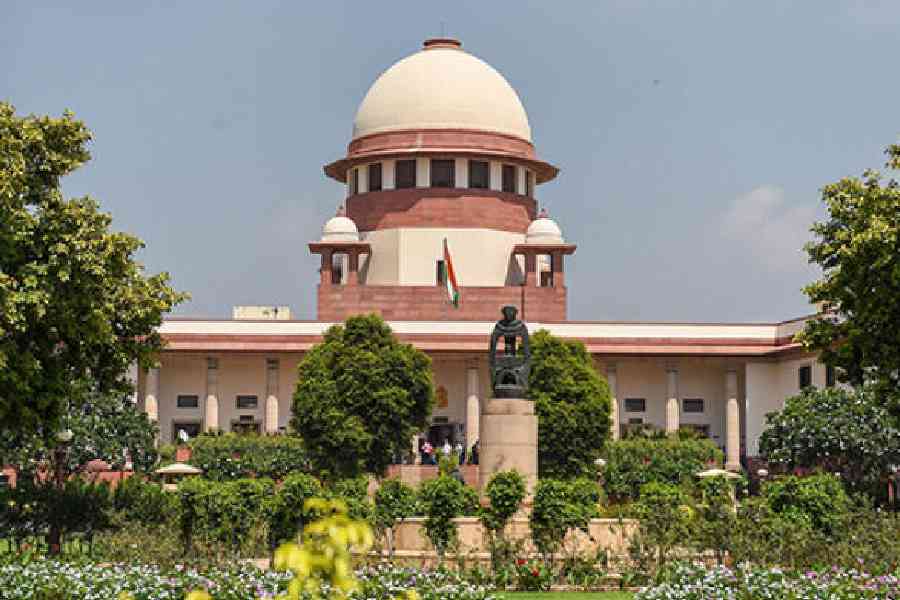
The Supreme Court ruled on Thursday that Hindus who convert to Islam or Christianity cannot claim reservation benefits. The bench said, "A caste identity cannot be treated as an immutable personal attribute." This judgment upheld a Madras High Court order, confirming that such status does not automatically transfer after conversion.
The judgment upheld Madras High Court's quashing of a Tamil Nadu government order that had accorded Backward Class status to Hindus who had converted to Islam
A Dalit, Backward Class or Most Backward Class Hindu who converts to Islam or Christianity cannot continue to claim reservation benefits, the Supreme Court ruled on Thursday.
"A person who converts to Islam does not, by that act alone, become a member of any one of the seven notified Backward Class Muslim communities in the state (Tamil Nadu)," the bench of Justice Prashant Kumar Mishra and Justice Shree Chandrashekhar said.
"His former caste or community status cannot automatically be transposed into the Muslim Backward Class category, nor can a private (Muslim) religious body (that certifies the conversion) conclusively determine such statutory entitlement."
The judgment upheld Madras High Court's quashing of a Tamil Nadu government order that had accorded Backward Class status to Hindus who had converted to Islam.
The judgement referred to Paragraph 3 of the Constitution (Scheduled Castes) Order, 1950, made under Article 341 of the Constitution, which restricts the Scheduled Caste status to Hindus, and to later constitutional amendments that extended the status only to Sikhs and Buddhists.
"The provision operates specifically in the field of Scheduled Caste status and cannot, by itself, determine every question arising under Article 16(4) (Backward Classes) of the Constitution," the judgment, authored by Justice Mishra, acknowledged.
"It nevertheless reflects the constitutional understanding that the status attached to caste-based disability is not wholly detached from the social and religious order within which that disability is constitutionally recognised," it added.
"...A caste identity cannot be treated as an immutable personal attribute carrying with it, irrespective of a change in religious affiliation, every constitutional protection or benefit which was available on account of that identity and the social backwardness attaching to it.
"Consequently, where a person was receiving affirmative action under Article 16(4) of the Constitution in the Hindu social order... conversion to Islam, Christianity or to any other non-Hindu social order brings such entitlement norms to an end.
"The legal consequence of conversion cannot be treated as a one-way bridge by which the old caste is simultaneously extinguished for one purpose and transported into a different community for another purpose."
The case relates to Sameer Ahmed, born Paramasivara to Hindu parents in Tuticorin in 1993. On September 11, 2015, the Islamic religious body Sunnath Jamath, Kayathar, issued a certificate saying he had embraced Islam and changed his name to Sameer Ahmed.
Subsequently, Sameer claimed Backward Class status and reservation benefits, but the local authorities turned him down.
On March 9, 2024, Tamil Nadu authorities issued a government order (GO), No. 314, that granted 3.5 per cent reservation to Backward Class Muslims, invoking a 2007 state law. The GO recognised seven Muslim communities as Backward Classes for the grant of reservation benefits.
It said any member of the Hindu Backward Classes, Most Backward Classes and de-notified communities who received reservation benefits could, on conversion to Islam, be considered a member of any of the seven recognised Backward Class Muslim communities and continue to receive the benefits.
Madras High Court, on June 25 this year, held that a convert to Islam could not, merely through the conversion, acquire the membership of a particular Muslim community recognised as a Backward Class.
It further held that the executive could not, through a government order, alter the legal position declared in earlier judicial decisions. It therefore declared GO No. 314 as unconstitutional. The state then appealed in the apex court.
Thursday's judgment said that entitlement to reservation benefits "is founded upon the disabilities which arose within, and were produced by, that (Hindu) social structure".
"Upon conversion to Islam or Christianity, or to any other non-Hindu social order in which caste is not recognised as the basis of social status and classification, that foundational basis ceases to operate in the same manner," it said.