
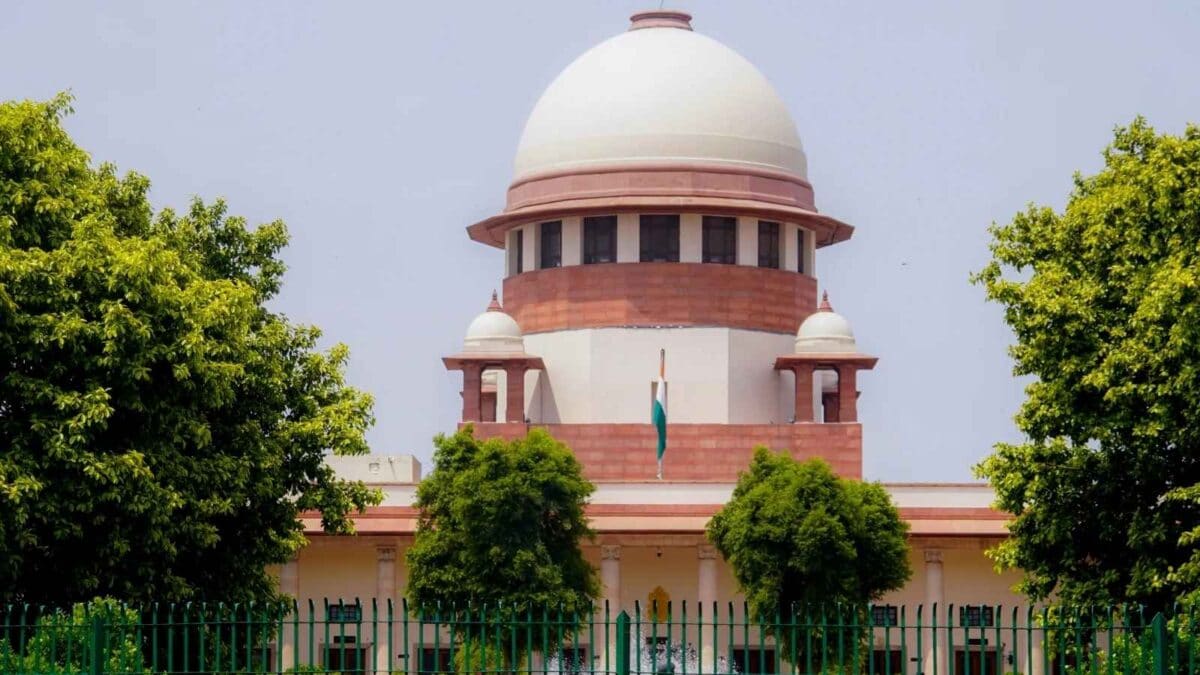
The Supreme Court of India ruled that a son cannot claim a birthright in property his father inherited from a grandfather under Section 8 of the Hindu Succession Act, 1956. The court said such land becomes the father’s individual property, so he got the full right to sell it.
Hindu Succession Act for grandfather-grandson inheritance: The ruling emerged from a lawsuit filed by a minor son challenging the sale of a land plot by his father
The Supreme Court of India recently ruled that a son (or grandson) cannot claim a birthright or coparcenary share in property that his father inherited from the grandfather under Section 8 of the Hindu Succession Act, 1956.
In the landmark judgment (J. Rajesh v. M. Kumaran), a bench of Justices Augustine George Masih and Sunita Agarwal clarified that once a grandfather’s property is partitioned and inherited by his Class I legal heirs, it becomes the exclusive, individual property of the father.
KEY TAKEAWAYS FROM THE SUPREME COURT RULING
No Automatic Birthright: A son does not automatically acquire a coparcenary right by birth in his father’s inherited property if that property devolved via Section 8 of the Act.
Individual vs. Joint Family Property: Property inherited by a male Hindu from an intestate ancestor under Section 8 is held in his individual capacity, not as the Karta of a Hindu Undivided Family (HUF).
Right to Sell: Because the property is treated as individual self-acquired property, the father has the absolute right to sell, gift, or transfer it without the consent of his children.
Grandchildren Excluded: Under Section 8’s Class I schedule, a “son’s son" (grandson) is not an heir while his own father is still alive. The old personal Hindu customs that gave grandchildren a birthright were replaced by the codified 1956 law.
PROPERTY RIGHTS UNDER THE ACT
Section 8 Inherited / Partitioned Property: Inherited individually after a partition or intestate death
Can the Son Claim a Share During Father’s Lifetime?
No. It is treated as the father’s individual property.
Pure Ancestral Property: Unpartitioned property passing down 4 generations
Can the Son Claim a Share During Father’s Lifetime?
Yes. Coparcenary rights apply by birth.
Self-Acquired Property: Bought by the father using his own earnings
Can the Son Claim a Share During Father’s Lifetime?
No. The father has full autonomy to dispose of it.
THE CASE
The ruling emerged from a lawsuit filed by a minor son challenging the sale of a land plot by his father. The father had received the land through a 1994 compromise decree following a partition suit.
The Supreme Court dismissed the son’s appeal, stating that since the property lost its joint family character post-partition, the son had no legal grounds to block the sale or demand a half-share.