
Urdu dailies said the US midterm results and the October 27 Israel elections showed the power of the people's vote. The Inquilab editorial noted, "The outcome of these polls has humbled two controversial strongmen of world politics and dashed their dangerous designs." Both leaders faced setbacks due to public discontent.
The US-Israel poll results send a message to the authoritarian leaders across the world that power is not meant for personal myth and glory, but is a sacred trust to make people's lives better and their future brighter, writes Inquilab.
One of the dominant themes marking the pages of the Urdu dailies last week was the outcome of the US midterm polls which saw the Democratic Party routing President Donald Trump's Republican Party to clinch both chambers of Congress. They spotlighted Democratic candidate Abdul El-Sayed who won the Michigan contest to become America's first Muslim Senator. El-Sayed's wife Sarah Jukaku has roots in India.
The dailies also kept the focus on Israel's post-poll scenario where, in a blow to Prime Minister Benjamin Netanyahu, President Isaac Herzog mandated his Opposition rival Gadi Eisenkot to take the first shot at the formation of the new government.
INQUILAB
Commenting on the unprecedented loss suffered by President Trump's party in the US midterms and the stinging setback faced by Netanyahu in the October 27 Israel elections, the New Delhi edition of Inquilab, in its November 5 editorial, says these results yet again showed the power of people's vote. "The outcome of these polls has humbled two controversial strongmen of world politics and dashed their dangerous designs," it says. The Democratic Party's resounding win in America and the incumbent Israeli coalition led by Netanyahu's Likud falling eight seats short of a majority in the 120-member Knesset highlighted public discontent against their policies defined by war, aggression and conflicts.
The daily says these results also underlined that in a democracy conflating people's silence with endorsement of a ruler's policies may turn out to be a "political blunder". "Both Trump and Netanyahu put their high-handed decisions and military adventurism at the centre of their politics. They launched war on Iran which not only put West Asia on the edge and threatened world peace, but also roiled their domestic situation. They invoked their national security and interests to build up their narratives, which could however cut no ice with their voters," it says. The fallout of the war on the American economy in terms of the affordability crisis and high fuel prices sealed Trump's fate. Israel, too, faced growing costs, disquiet and divisions, whose consequences were seen in the polls, the edit says. "The message for both leaders is loud and clear: people would always judge any government's plan of action by its success in ensuring their security, happiness and peace."
The editorial points out that in a democracy power is never permanent. "Trump's second term and Netanyahu's long tenure triggered anti-incumbency. Public dissatisfaction rises when rulers start trashing every criticism or dissent, just believing that they are above any accountability," it states.
The edit notes that the Middle East policies of the US and Israel have also faced a blowback from the international community. "Coalitions, respect for multilateral institutions and diplomacy hold the key to a country's real power which cannot drive the world unilaterally for an extended period," it says. The US-Israel poll results send a message to the authoritarian leaders across the world that power is not meant for personal myth and glory, but is a sacred trust to make people's lives better and their future brighter.
SIASAT
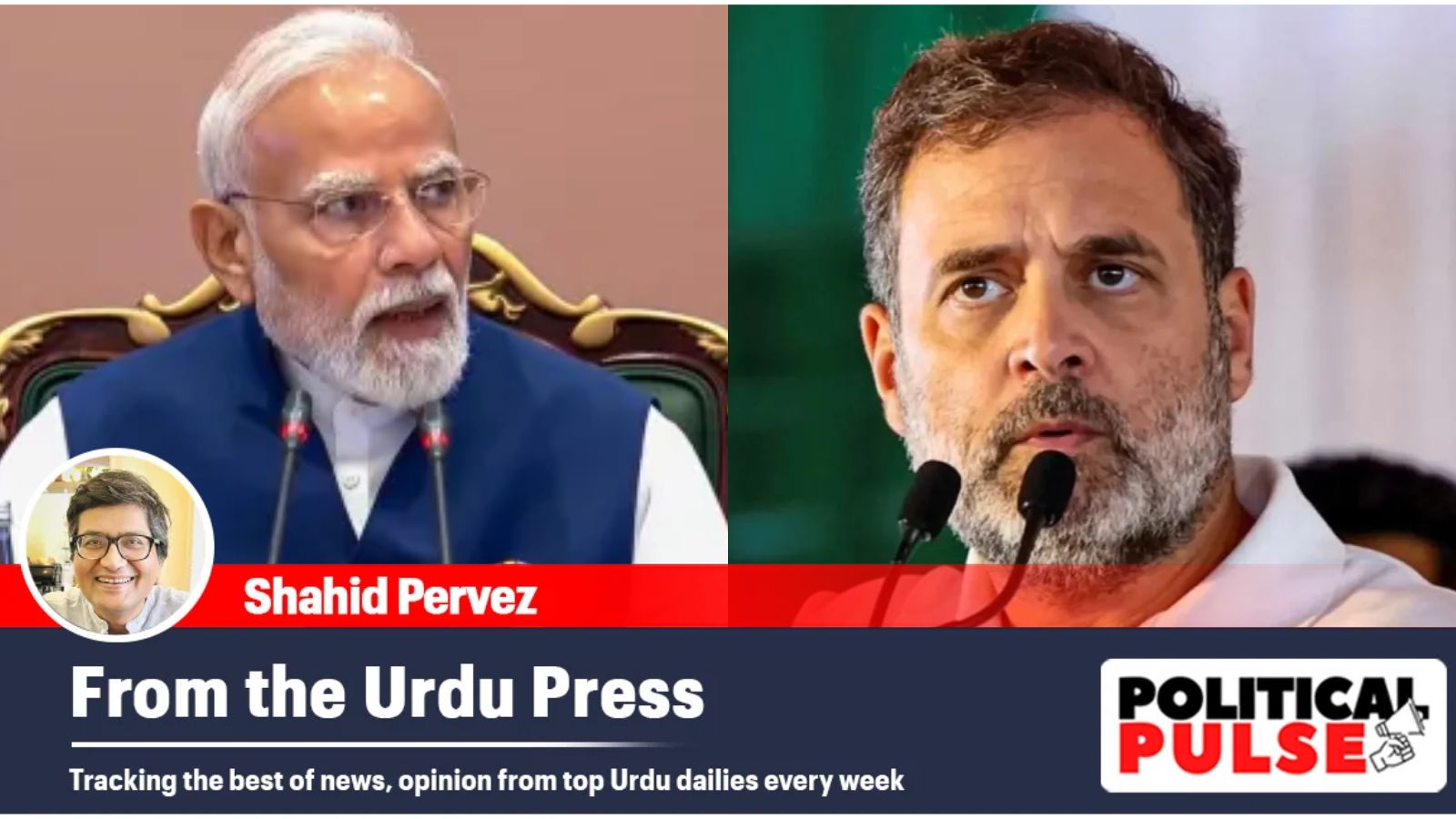
Noting an escalation in conflict between the ruling BJP and the Congress-led Opposition, the Hyderabad-based Siasat, in its November 6 leader, says both sides have intensified their battle of words since November 1 when the INDIA bloc held a rally at Delhi's Ramlila Maidan over various alleged electoral irregularities and the Special Intensive Revision (SIR) of electoral rolls. The editorial says Lok Sabha Leader of Opposition (LoP) Rahul Gandhi has doubled down on his onslaught against the BJP-led NDA government, sharpening his attack on Prime Minister Narendra Modi. It points out that Rahul has been repeatedly challenging Modi to a debate with him on various issues, but to no avail.
"Rahul has accused Modi that he became the PM with foreign help, challenging him to an open debate. While Modi has not responded, Home Minister Amit Shah has countered him, saying the government is ready for a debate on any issue," the daily notes. Shah has dared Rahul to write to the PM to seek a special session of Parliament for a debate on the SIR row, it says. "Shah has also alleged that Rahul is only interested in street spectacles and not in a House discussion."
The editorial points out that Modi recently made a jibe at Rahul, saying the Congress had tried to launch a "failed product" repeatedly. "The BJP is however adopting double standards in its response to Rahul's dare. In 2013, as the BJP's PM face then Gujarat chief minister Modi had dared PM Manmohan Singh for a debate on pressing issues of governance," it says. "The irony now is that even Delhi CM Rekha Gupta has dared Rahul for a debate in Parliament even though she is not an MP. On his part, Modi has maintained a silence on this demand, which is aggravating the charged political atmosphere," the edit states. "While Rahul has been vigorously raising various issues of public concern, the BJP has singled him out for its assault. It seems the ruling dispensation has realised Rahul's growing traction among people."
URDU TIMES
you may like
Referring to PM Modi's latest "dimagi Naxal" remarks, the Mumbai-based Urdu Times, in its November 9 editorial, points out that while addressing security personnel during the Diwali celebrations at a CRPF camp in Chhattisgarh's Bastar, the PM said that while the country has eliminated armed Naxalites from the forests the "danger has not completely disappeared" as "dimagi (intellectual) Naxalites" have "infiltrated" several political parties and organisations and were "instigating people against the Constitution and democracy". "The PM said we must identify such dimagi Naxals, defeat them, and secure the nation," the edit notes.
"This is unfortunate that the PM delivered such a politically-charged speech on Diwali, the festival of lights and happiness, to target the Opposition and his detractors. This betrayed his frustration and unease," the daily says, adding that the occasion warranted a "bipartisan, inclusive approach".
"The festivals in our country have always been great occasions for collective celebrations and for spreading joy, happiness and cheer among all the people and groups. The festivals have always reaffirmed our pluralistic Ganga-Jamuni culture. They should not be used for cynical power politics."