
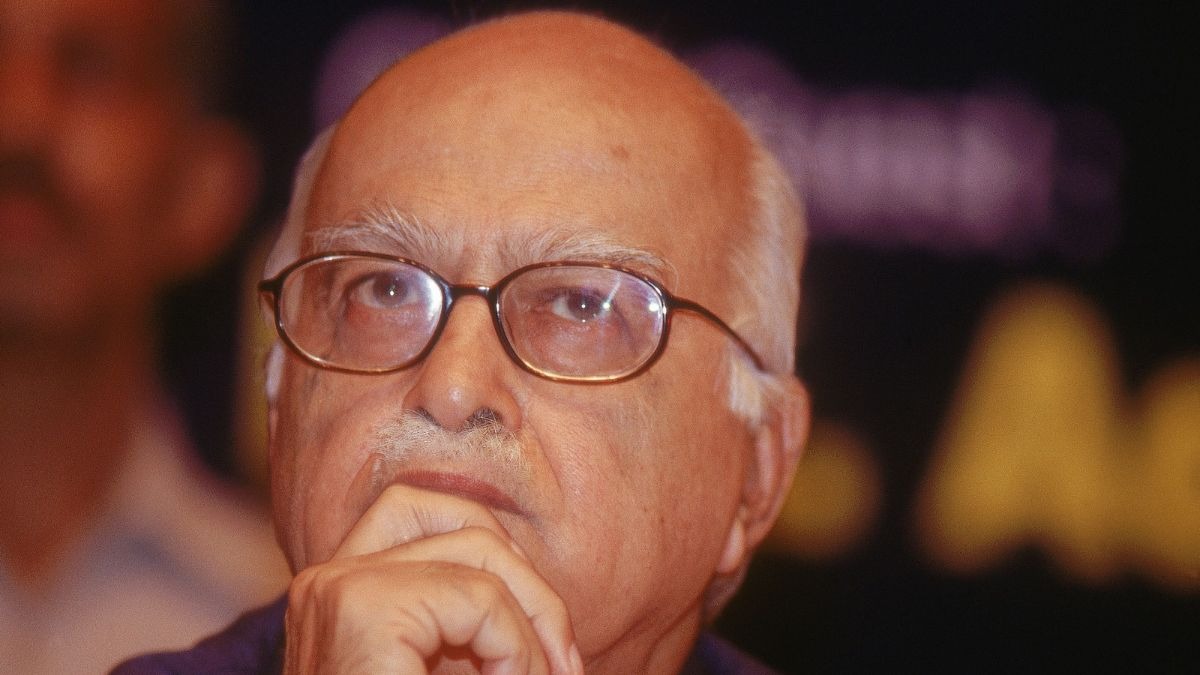
L.K. Advani turns 99 on November 8, reflecting on the 1995 Gujarat crisis that threatened the BJP government. He said, "We may not only survive but because of that ailment, emerge even stronger than before." The party faced internal trouble, but members voted together on October 7 to save it.
L.K. Advani turns 99 on November 8. His exclusive interview to INDIA TODAY on the events that had threatened to topple the BJP government in Gujarat
(NOTE: This article was originally published in the India Today issue dated October 31, 1995)
BJP President L.K. Advani, who had maintained a studied silence in public as rapidly unfolding events threatened to topple the party's government in Gujarat, took time off from the hectic negotiations that are still under way in New Delhi to talk at length about the developments and his own role in the compromise formula to Executive Editor Inderjit Badhwar and Special Correspondent N.K. Singh. Excerpts of the interview:
Q. You prided yourself on being a party with a difference, a party known for its discipline. Haven't the developments in Gujarat shattered all that?
A. It's like a person whose friends and colleagues always regarded him as a healthy person, never a fever, never a cold. And you're suddenly struck by an ailment, and naturally it causes concern. But we may not only survive but because of that ailment, emerge even stronger than before. What happened in Gujarat certainly caused much anguish and concern to crores who saw the BJP as a shining ray of hope in a dismal political scenario. But on the (October) 7th evening when the 120 BJP members of the Assembly voted as one man for the Government, everybody heaved a sigh of relief.
Q. So you are happy with the outcome?
A. It's just relief. But none of us is happy that such a development occurred.
Q. So is the BJP now going the Congress way?
A. This question is in itself a condemnation of the Congress. That the Congress is decadent, that the Congress is degenerate, a party without values. And the question is an expression of concern by our well-wishers, that even a trait of that degeneration should be present in a party of which they have high hopes.
Q. But what about your adversaries?
A. They may be putting this question with a bit of a chuckle. A friend told me the other day that the prime minister was asked about the Gujarat BJP on TV, and my friend told me, for the first time he saw the prime minister laugh. But on the 7th there was again gloom in the Congress party.
Q. Gujarat is the jewel in your crown, and there were early warnings as far back as September. Do you accept any responsibility for not anticipating the magnitude of the crisis?
A. I'm personally responsible. I do not deny that. I've not publicly contradicted any of the statements made in this context. But the fact is that the discontentment conveyed to me directly or to Vajpayeeji or other colleagues at the Centre was prior to the formation of the Government and not in respect of Keshubhai. Just a bit of it was directed against the party's general secretary, Narendra Modi.
Q. But you're criticised for being his backer, and believed in all he did.
A. We had certain discussions and I was thinking that, in the normal course, when organisational elections would take place, whatever changes that were necessary would be made. And it is not correct that the party high command did not take notice of complaints about the Government, or about its leader. As party president and a person who represents Gujarat in the Lok Sabha, I'm responsible.
Q. But how come you did not anticipate the problem ?
A. We do not function as a commercial organisation but as a family. We proceed on trust. Therefore, being caught unawares, as has happened this time, can happen. I'm not trying to justify or rationalise this.
Q. But can't this have a snowballing effect? There's trouble in Uttar Pradesh, Karnataka, Delhi, Maharashtra.
A. That kind of dissidence does occur. But even Gujarat is not going to affect the mood of the people so far as the BJP's prospects for Lok Sabha are concerned. I have experiences of the past. I remember how upset we were with the demonstrations immediately before the assembly elections on the issue of party tickets. It was ugly. It was never witnessed before in the life of the party. But it did not affect the election results a wee bit.
Q. On an emotional level, do you feel that your authority is under question because Vaghela would negotiate not with you but with Vajpayee?
A. No, he never said it. Though, when we chose our team to negotiate with him, we chose Bhairon Singh Shekhawat and Pramod Mahajan because of personal rapport. I, as president, was principally responsible for deciding that in the assembly elections no MP would contest.
Q. But even before the elections Vaghela said you played a partisan role.
A. What he has said I would not pay much heed to that. It would not be proper for me to comment on his expressing his dissent against the party. And being the party president, I can understand that. All through the fortnight that the crisis was there, every decision taken by the party was unanimous.
Q. But it was a major crisis.
A. The crisis may have been major, but the way in which it has been handled redounds to the credit of the party.
Q. But the solution is worse than that.
A. I don't agree with that.
Q. But in this case the person was expelled for indiscipline, and it seems that the party reneged on an extremely important principle laid down by the Sangh Parivar.
A. The Sangh Parivar does not come into this. People have little idea of the way in which the BJP functions, and this makes for good copy - the RSS-Sangh Parivar dichotomy. The hard reality is that, in matters of political concern, the Sangh goes by our judgement rather than we taking their opinion.
Q. You once compared the BJP to the actor A.K. Hangul.
A. I had used that analogy earlier at a time when it was believed that the BJP could become nothing more than a marginal party, that the BJP could never come to centre stage. Now no one can compare the BJP with Hangal of Hindi films, an important actor but never the central player. Today the situation has so rapidly changed that no one can regard the BJP as Hangal. Though some may regard it as khalnayak (villain), we regard it as a nayak (hero)
Q. But this does not detract from the image problem created after Gujarat.
A. You see the kinds of statements being made after Gujarat. The crisis was overcome, the Government remained. And yet it has created more attention than the No. 2 man of the Central Government quitting with the supposed blessing of the widow of a former prime minister, and of the whole dynasty. And yet, that did not cause the kind of stir in Indian politics that this has produced. This only emphasises that the BJP is not just an alternative to the ruling party. Even without being the ruling party, it has become the principal party.
Q. But could the indiscipline be growing because the BJP is opening up its doors to others?
A. The BJP was never a cadre-based party in the sense of the communists, where you have to go through a long process before you get a card. But while the BJP core may be that of cadres, in the organisation, anyone is permitted to become a member of the party and also permitted to stand for elections within days of becoming a party member.
Q. But is this not a reason for indiscipline.
A. I would not like to say this is the principal reason for these problems. But it is true that in the Gujarat crisis, of the 47 members who petitioned against the Government, about 35 are those who had joined the party in the past three or four years.
Q. Your own partymen, including K.L. Sharma, have said that money changed hands and suggest that your party members are susceptible to money power.
A. At this point of time, unless I have any solid basis for malting accusations of this kind, I cannot comment.
Q. But the meeting in Khajuraho , where the dissidents were holed up, showed some basis for the charge.
A. Khajuraho is a solid basis, which only shows that the arrangements for the plane and all that were made. There were no night-landing facilities there and the plane landed at 11.30 p.m. So our charge that the Congress party contributed to this is there. In fact, they tried their hand at a similar exercise three months back in Rajasthan.
Q. What happened then?
A. Shekhawat had gone abroad for medical treatment, and during that period they tried this. But later denied it of course.
Q. Do you believe the Congress is trying to destabilise your governments?
A. This does not disturb people. It is taken for granted. This is the party and the leader-which started as a minority and which broke the Janata Dal twice, besides the Shiv Sena and the Telugu Desam. In fact, AIADMK leaders told me that they tried to break us also. I'm told their eyes are on Delhi, Rajasthan, Maharashtra, Karnataka. Though they have a soft corner for Bihar also.
Q. This is what keeps bringing us back to the same issue. After all, Vaghela is a Jan Sangh man and a swayamsevak, and that he should be the one to succumb.
A. Our office bearers spent two days discussing this. What you have to do is not make any announcements but to apply internal correctives within the party, and we are determined to do that. This experience also makes every state unit slightly wary of people wanting to flock to the party in the hope that they would get a ticket for Lok Sabha.
Q. Can you expand on this?
A. Ever since the last Gujarat and Maharashtra elections, it has become obvious to our supporters and adversaries that in the race to Lok Sabha, the BJP is clearly the front-runner. That we may emerge as the largest single party there is wide spread cynicism. But since we're front-runners, it is not disputed. And so there are people wanting to come to the party. The Gujarat experience should make our state units some-what wary of all this. There are sitting members of Parliament from various parties approaching us.
Q. One criticism is that in Gujarat you actually left out some good candidates belonging to the Vaghela faction.
A. The chief minister has a measure of discretion in choosing his colleagues. We have not told a Bhairon Singh Shekhawat or any other chief minister as to who should be the ministers, although to some extent we are consulted.
Q. What is the reason for your belief that the party may emerge stronger from this crisis?
A. We clearly visualise that in the next elections to Lok Sabha, one of the principal planks of the Congress would be that the Congress alone can give you a stable government that can last a full tenure. If we had not succeeded in managing this crisis in Gujarat, it would have been the principal illustration for the Congress party to project this claim. But now they've been deprived of that.
Q. But there's still no certainty that Gujarat has been entirely solved.
A. We'll deal with the problems as they are, and they're in good hands.
Q. You're absolutely confident about that?
A. Absolutely confident.
Q. But do you think that changing the leader there inspires confidence?
A. Not on the whole. Whenever there's a difficult problem to solve, the options before you are rarely 90 versus 10, but really something like 60 versus 40 or so. And a party has to choose and decide which it thinks is 60. We saw clearly that it was a case of indiscipline, and because of that we had to take a step. But on the 7th we weighed the options. Do we concede this much and save the Government?
Q. But then there was a compromise of principle.
A. Not a compromise of principle. It was crisis management. Even when governments are formed, you have to take into consideration castes, regions and the like, and very often compromises are made. These are overall decisions on how to deal with all aspects of the problem.
Q. One of the fallouts is that a lot of your partymen, even senior people, are speaking on the record and being critical. People like Keshubhai who are very bitter and say the party will never be the same again. They are openly expressing their hurt.
A. Keshubhai ran the Government very well. And even then he volunteered that he would quit. It's a human emotion. I don't blame him at all.
Q. But the party seemed very confused.
A. From Day One, Bhairon Singh, K.L. Sharma and Pramod Mahajan were deputed to go to Ahmedabad and were given clear directions. This is what we cannot accept or this is what we are willing to accept. And one of the solutions given to them was that if neither this nor that then someone else be chosen.
Q. The impression was that you were the hardliner, that no compromise should be made.
A. No, no question, at what stage?
Q. But there was the suspension.
A. For the suspension, I'm responsible. For withdrawal of suspension, I'm responsible. Until the sixth, people said nothing will come out of it. The Government is gone. You can't save it. You can imagine what would be the state of all those backing the exercise. So far as we're concerned, right through the crisis there was no confusion at any stage.
Q. The decision to send Vajpayee was yours?
A. Yes, it was my decision.
Q. Was it because Vaghela and the dissidents refused to talk to you?
A. No. That's not the case. People were coming and going and I was talking to several people. And at that point of time I did not want to talk because things hadn't materialised. When Vajpayeeji went, the solution had virtually been crystallised. And Vajpayeeji was chosen because we needed someone senior. He is senior to me And he is a man in whom there is widespread confidence within the party. There's no doubt about it.
Q. More confidence than in you?
A. Certainly. Because as party president I took the decision that Shankersinh is not to contest.
Q. But hasn't all this affected party programmes on the ground?
A. No. Just in Raipur recently, at our rally there was a massive show of strength.
Q. If you were to handle the Gujarat crisis again, if you were to make a frank admission to your colleagues, look, this is where I went wrong, this is what I could have done better, what would you say?
A. As far as handling the crisis is concerned, I don't think it was all that wrong.
Q. But as you've said, as party president you accept responsibility.
A. In that sense I have to take the blame. That's right.
Q. Your second term as party president is coming to an end in November. Will you go for it again?
A. Well, if my name is proposed. Unless I say, no.
Q. Will you say no?
A. I don't propose to say no. But I did say no when this term was first given to me.