
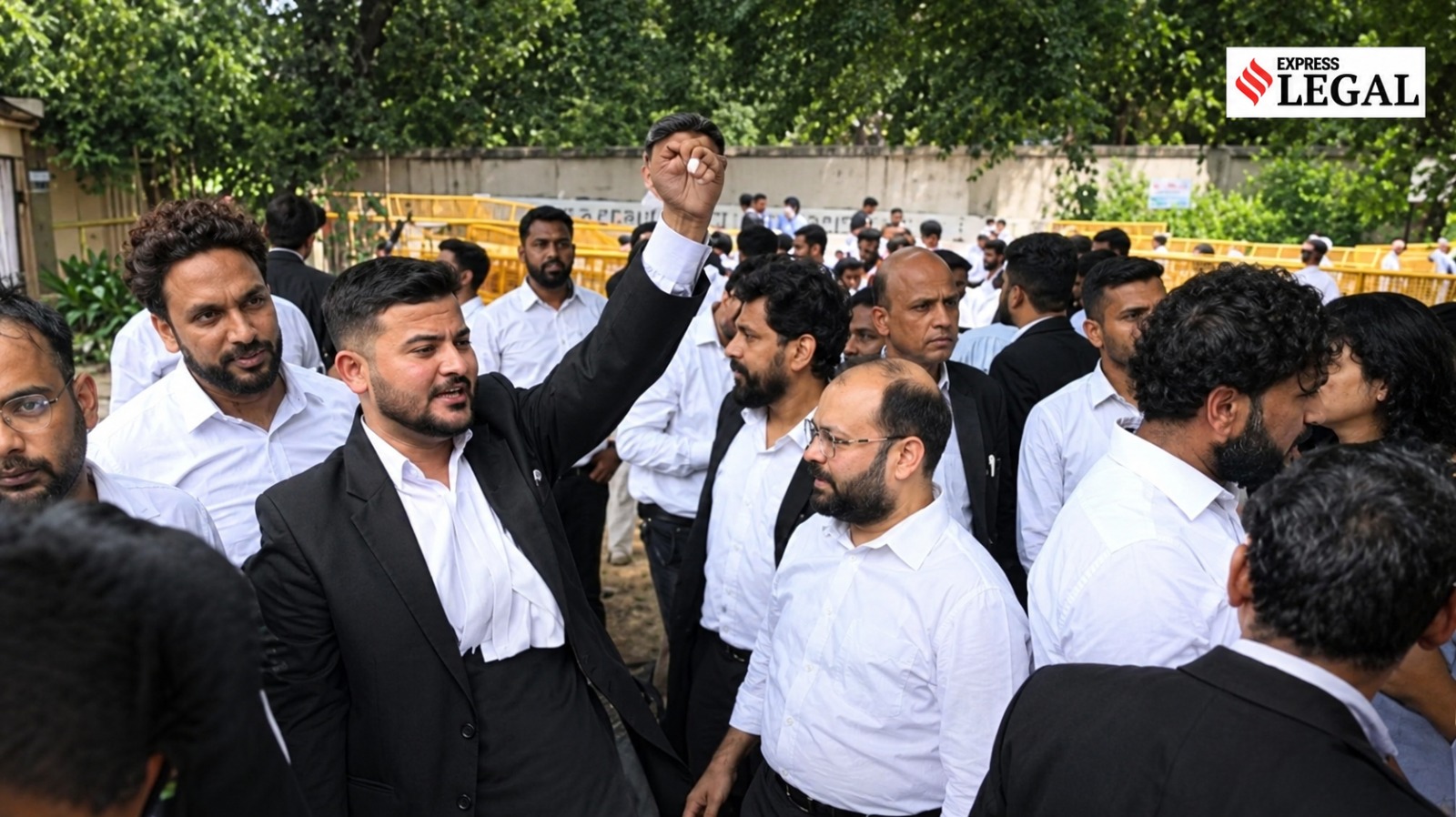
Lawyers across India recently mobilised to protest against various issues affecting the legal fraternity. On October 12, Delhi High Court advocates wore black ribbons to oppose alleged police excesses. Meanwhile, Meghalaya lawyers started a court boycott on October 1 demanding the removal of Advocate General Amit Kumar over past disputes.
Over the past week, members of the legal fraternity across India have stood against alleged police excesses during the recent anti-SIR protests. Demonstrating their support through symbolic action, the Supreme Court Bar Association called on advocates to wear white ribbons in solidarity with their colleagues. Meanwhile, the Delhi High Court Bar Association urged its members to take a similar stand - asking lawyers to wear black ribbons and read the Preamble together.
While regional triggers differ, lawyers in India have repeatedly mobilised and voiced their demands in unison. Here's a look at the five notable occasions when lawyers took to the streets:
1. Delhi HC lawyers protest 'police excesses'
On October 12, the Delhi High Court Bar Association asked its members to wear a black ribbon during court appearances as a mark of protest against alleged police excesses towards fellow advocates who supported the agitation seeking the removal of Chief Election Commissioner Gyanesh Kumar.
2. Boycott demanding Meghalaya AG's removal
The Meghalaya High Court on October 8 issued contempt notices to office-bearers of the High Court Bar Association and Shillong Bar Association over their call to boycott court proceedings from October 1 demanding the removal of Advocate General Amit Kumar. A bench of Chief Justice Revati Mohite Dere and Justice H S Thangkhiew termed the boycott "completely illegal" and directed the Bar Council of Meghalaya and Bar Council of India to take appropriate disciplinary action against lawyers who stayed away from work.
The dispute began on August 3, when Kumar criticised the Bar associations over their alleged failure to protect women lawyers following the alleged molestation of a woman law intern by a senior advocate. The associations subsequently removed Kumar from their membership rolls and sought his removal as Advocate General. On September 30, they announced a statewide boycott until the government removed him, disrupting court proceedings across Meghalaya.
3. NALSAR backlash against Bar Council
Mishra later apologised to the law students over the controversy surrounding the council's actions and announced that the BCI was closing all proceedings against NALSAR's graduating batch of 2026.
4. Stir against virtual police depositions
In August 2025, advocates in Delhi called a three-day strike to oppose a notification issued by Lieutenant Governor V K Saxena on August 13 allowing the police to virtually present evidence in courts from police stations.
Alleging that it would be unfair to the accused who were defending themselves in criminal cases, the advocates unanimously decided to abstain from work as they believed that allowing the police to present evidence virtually would compromise the integrity of the judicial process.
The strikes were eventually called off when the Delhi Police ordered all police officers to physically appear in court for the deposition of evidence.
5. Safeguarding the right to protest
In February 2025, advocates and Bar associations across the country staged protests and abstained from work to protest the 2025 draft Advocates (Amendment) Bill proposed by the Union Law Ministry, which prohibited advocates from boycotting or abstaining from court work.
Calling the bill "unjust, unfair and biased," the protest was primarily focused on opposing Section 35A of the Bill. Following the strikes by lawyers and objections from the BCI, the Union Law and Justice Ministry withdrew the draft Bill.
In 2017, the BCI had issued a notice calling all Bar associations and advocates for a strike in all courts on March 31, 2017, to oppose the "draconian, undemocratic, anti-lawyer Advocates (Amendment) Bill, 2017" proposed by the Law Commission of India to the government.
According to the BCI notice, the Bill defined "misconduct" in a "provocative" manner that "it would be now very difficult and risky to accept the brief of any client for any lawyer." The protest was also called to oppose the prohibition on strikes because, according to the Bill, advocates could be removed from state rolls if they abstained from court work for any reason and could face heavy fines for court boycotts.