
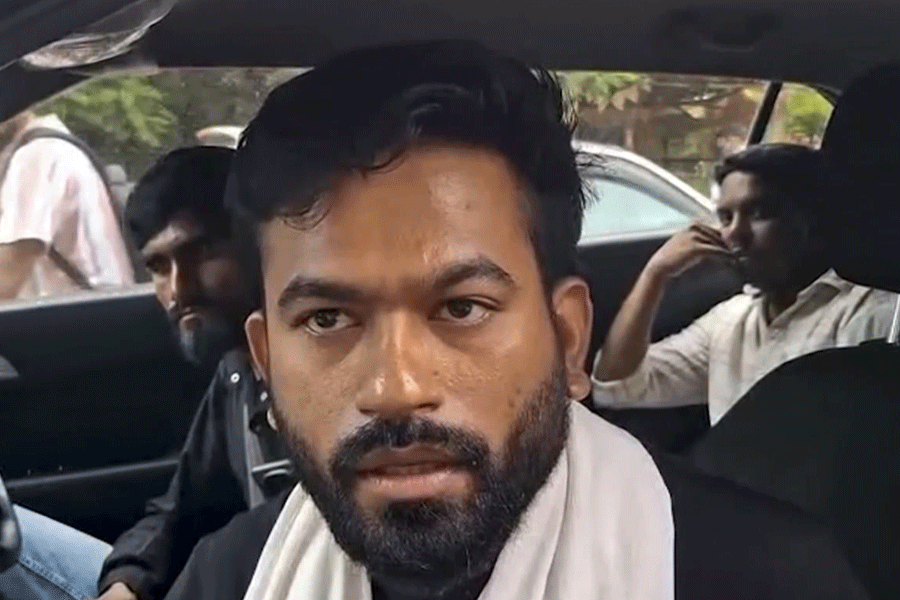
CJP founder Abhijeet Dipke accused PM Modi of ignoring national security to focus on Delhi protests. Dipke questioned why US national Matthew VanDyke got relief in a Myanmar arms training case. He said, "Issues like VanDyke or border safety aren't on the government's priority list," while criticising current border management.
The CJP founder questions the government over relief for Matthew VanDyke in the Myanmar arms training case and the ITBP chief's remarks on countering China
Cockroach Janta Party (CJP) founder Abhijeet Dipke accused the Modi government of prioritising restrictions on protests in Delhi over national security. He cited a Delhi court's decision to extend permission for US national Matthew VanDyke to remain abroad and the ITBP chief's remarks on the need to modernise the force to counter China.
"Matthew VanDyke, who was training terrorists in Myanmar to fight against India, has been allowed by our courts to return to the US and lead his regular life, without any objection", Dipke said in a video posted on X.
VanDyke faces allegations of training armed groups in Myanmar. The NIA's charge sheet did not invoke the UAPA provisions initially cited in the case, although the agency has said its investigation into alleged terror-related aspects is continuing.
"Honestly, why should there be any objection? After all, he was just training terrorists, and not trying to wave our national flag. If he had waved the tiranga, he could have been a big national security threat, but training some terrorists is not a big deal", Dipke added.
The CJP founder also referred to ITBP director general Shatrujeet Singh Kapoor's comments on the challenges of countering China.
"Modi has reassigned our security forces to deploy them in Delhi, so obviously the situation at the border will be tough," he said.
"Issues like VanDyke or border safety aren't on the government's priority list", Dipke added, claiming that the government's priority was to prevent protests in Delhi and suppress public demands for the resignation of chief election commissioner Gyanesh Kumar.
"China is not allowing him to show 'laal aankh' (red eye). Hence, only by beating up students and common citizens for protesting, for participating in a tiranga march, can the government get its 'strong leader' feeling", Dipke concluded.
"Laal aankh" was a political phrase coined by the right-wing ecosystem for a tough, uncompromising security posture toward foreign adversaries. It is linked to PM Modi's 2014 campaign rhetoric, in which he promised to confront adversaries, particularly China and Pakistan, firmly rather than through diplomatic softness.
ITBP chief stresses modernisation
On Thursday, Kapoor told his troops at a force base in Alwar, Rajasthan, that countering China through "traditional" warfare was a thing of the past. He said the ITBP was investing in modernising its weapons, vehicles and border posts.
The DG noted that the recent Ukraine-Russia and Iran-US wars have shown the importance of drone and anti-drone technology, through which a small country can overwhelm a bigger nation during conflict.
The ITBP, raised in 1962, guards the 3,488-km-long Line of Actual Control (LAC) with China.
Meanwhile, the Union home ministry has extended the deployment of 273 Central Armed Police Forces (CAPF) companies in the national capital for a second time until October 31, citing the possibility of "flash protests" by political and other groups, official sources said on Friday.
Of the 273 companies that will continue to remain deployed in Delhi alongside the local police, 125 are from the Central Reserve Police Force (CRPF), including 20 women personnel units; 20 from the Rapid Action Force (RAF); 46 from the Border Security Force (BSF); 39 from the Indo-Tibetan Border Police (ITBP); 31 from the Sashastra Seema Bal (SSB); and 12 from the Central Industrial Security Force (CISF).
Relief for VanDyke extended
A Delhi court on Friday extended till February 24, 2027, the permission granted to VanDyke and six Ukrainian nationals to remain outside India in the Myanmar arms training case being probed by the NIA.
Special Judge Prashant Sharma passed the order after the NIA sought more time to investigate the case. VanDyke, who appeared in person, was allowed to return to the US, while the other six accused appeared via video conference citing health issues.
Questioning the continuation of the case, VanDyke told PTI, "There's no reason for it to continue. If not, I'll stay in India. Until this is over."
The US national, who was allowed to travel to the US for a month in September, also said he had removed his lawyer due to financial difficulties and denied receiving assistance from the US embassy.
The NIA had alleged that VanDyke and the six Ukrainian nationals entered India on tourist visas, travelled to the northeastern region without mandatory permits and subsequently crossed from Mizoram into Myanmar, where they allegedly trained ethnic armed organisations.
The agency had initially invoked provisions of the Unlawful Activities (Prevention) Act, including those relating to conspiracy. It had also alleged that the accused disclosed details about the network and were involved in assembling equipment and targeting a passenger aircraft in Myanmar.
However, in its charge sheet, the NIA did not invoke the UAPA provisions and instead proceeded under Sections 21 and 23 of the Immigration and Foreigners Act, which provide for offences that can be compounded before the Foreigners Regional Registration Office (FRRO).
The agency had earlier said its investigation into the alleged terror-related aspects was ongoing and that it could include further allegations in a supplementary charge sheet.