
Chief secretary Manoj Agarwal inspected flood-hit Malda on Sunday ahead of a Delhi meeting on October 27. He surveyed erosion areas and held talks with officials to find permanent solutions. "If the two rivers merge in future, it will be difficult to prevent floods in Malda," Agarwal said regarding concerns.
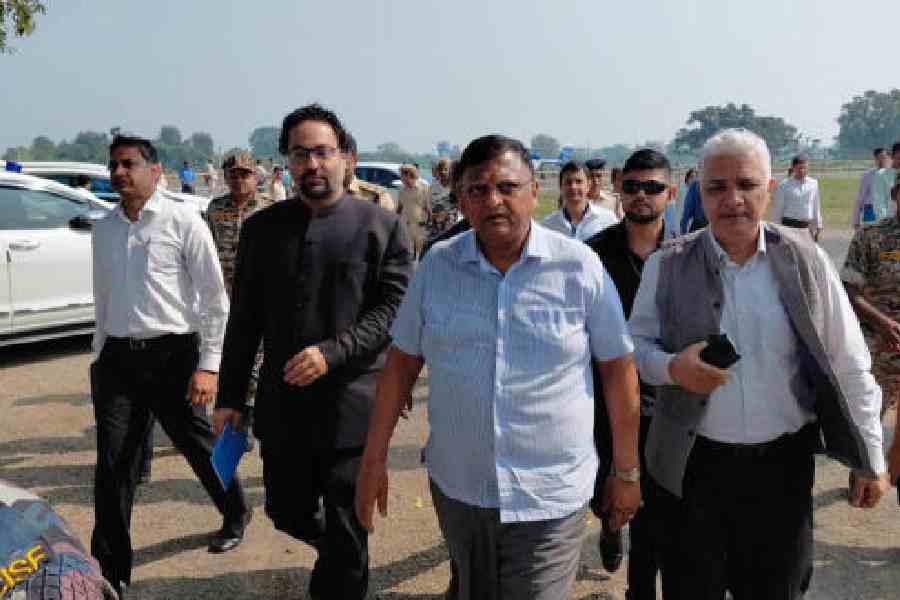
Chief secretary Manoj Agarwal (in a white half-sleeved shirt) is received at Malda Airport by district magistrate Rajanvir Singh Kapur (in black) on Sunday. Pictures by Soumya De Sarkar
Bengal chief secretary Manoj Agarwal inspected flood- and erosion-hit areas of Malda on Sunday ahead of a crucial meeting in Delhi on October 27, where chief minister Suvendu Adhikari is scheduled to discuss a permanent solution to the district's recurring river erosion and flooding with the Union water resources ministry.
Agarwal conducted an aerial survey of Bhutni islet in Manikchak block, Ratua-I block, and the channels of the Ganga, the Fulhar and the Kosi, before holding meetings with district officials and elected representatives.
The proposed Delhi meeting is expected to take up measures requiring coordination with the neighbouring states of Bihar and Jharkhand.
The measures include the dredging of old river channels to divert water and reduce pressure on vulnerable stretches in Malda.
"The Bihar government has given its no-objection certificate for the erosion-prevention work, but clearance from Jharkhand is still awaited. We hope it will come before the chief minister's meeting in Delhi," Agarwal said.
The chief secretary flagged the narrowing gap between the Ganga and Fulhar in the Bhutni and Ratua areas as a serious concern. He warned that convergence of the two rivers could cause extensive flooding, disrupt rail and road links and potentially sever connectivity among north Bengal, the rest of Bengal and neighbouring states.
"The Ganga and Fulhar have come very close to each other. If the two rivers merge in future, it will be difficult to prevent floods in Malda. A permanent solution is needed," Agarwal said.
According to Agarwal, the Ganga near Bhutni has shifted nearly 6km over the past five decades, while erosion along the Fulhar has pushed it nearly 2km in the opposite direction, bringing the rivers closer.
He said timely intervention earlier could have prevented the situation from reaching this stage.
Agarwal arrived from Calcutta by helicopter around 9.30am with senior state officials.
Following the survey, he chaired a meeting at the Malda collectorate attended by district magistrate Rajanvir Singh Kapoor, superintendent of police Anupam Singh and officials of the departments concerned.
A second meeting included minister of state for irrigation Joyel Murmu, Manikchak BJP MLA Gour Chandra Mandal and other legislators.
Outlining the proposed measures, Agarwal said erosion-prevention work would begin near the interstate river boundary adjoining Bihar and Jharkhand, about 16km from Manikchak.
The plan includes dredging old channels through which the Ganga previously flowed in the neighbouring states. An estimated ₹50 crore would be required for the first phase.
Agarwal said the government was also examining a proposal for a dam and sluice gates on the Kosi in Bihar to help moderate flooding in Malda. River experts were involved in preparing a pilot project, while construction of concrete embankments was proposed from January.
The visit also triggered a political exchange over responsibility for the district's recurring floods.
Manikchak MLA Mandal accused the previous Trinamool government of corruption in the construction of embankments, alleging that public money had been squandered while residents continued to suffer.
District Trinamool leader Biswajit Ghosh rejected Mandal's allegations and blamed inadequate support from the Centre for aggravating Malda's difficulties.
"The Trinamool government continued erosion-prevention work through the irrigation department despite the Centre's lack of support. We, too, want a permanent solution to floods and erosion in Malda," Ghosh said.