
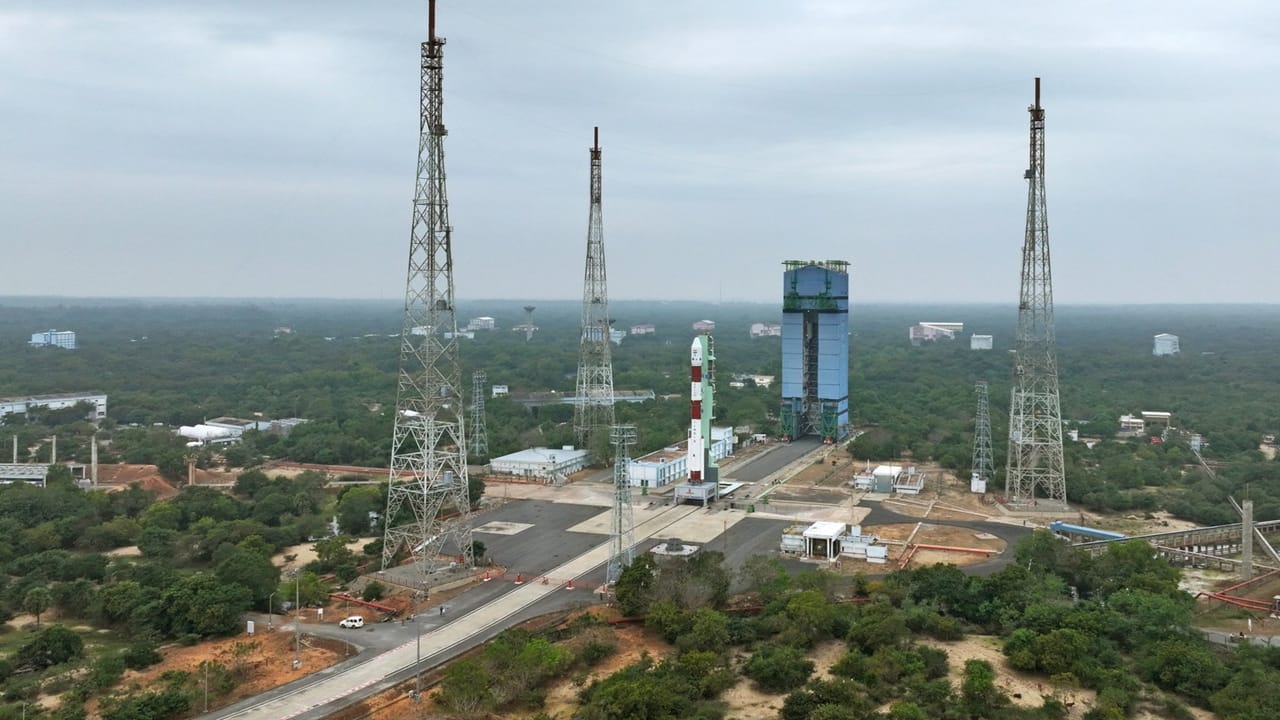
The first industry-built PSLV will be ready for its maiden launch in the first quarter of 2027, ISRO chairman Dr V Narayanan said on November 24. A consortium of HAL and L&T is building five rockets. Narayanan said, "We need to develop a lot of space assets for communication."
Market Mastery
Webinar by Vishal Malkan
Find the weak links
in your portfolio by Vishal Malkan
The first industry-built Polar Satellite Launch Vehicle (PSLV) will be ready for its maiden launch within the first quarter of 2027, Indian Space Research Organisation (ISRO) chairman Dr V Narayanan said on November 24.
The PSLV is being built by the Hindustan Aeronautics Ltd (HAL) - Larsen and Toubro (L&T) consortium.
"Earlier it was built only by ISRO through the support of the industry but now the L&T and HAL consortium has been given 5 PSLVs and the rocket is getting ready. The first launch is expected next year in the first quarter," Narayanan told reporters on the sidelines of the India International Space Conclave in New Delhi.
Following the Rs 860 crore contract awarded by NewSpace India Limited (NSIL) (the commercial arm of ISRO, the consortium is producing five PSLV rockets.
The PSLV, monikered the "workhorse of ISRO" is an expendable-medium lift launch vehicle weighing 320 tonnes. It first flew in 1993, and it can take up to 1,750 kg of payload to sun-synchronous polar orbits of 600 km altitude.
It has also been used to launch various satellites into geosynchronous and geostationary orbits -- both at 35,786 km from Earth.
Narayanan, also provided an update on the Gaganyaan (human space flight mission), stating ISRO is currently working on the orbital model. "It's a technology-intensive activity," he said adding that the drive to get it ready is in the "final phase".
On November 23, ISRO astronaut Prasanth B Nair said that a lot of protocols and procedures for the Gaganyaan-1 mission, where an AI-enabled half-humanoid robot is scheduled to fly, is being built from scratch.
To launch a human being and bring them back safely, we need an entire ecosystem of procedures and protocols. None of that exists currently, so we have to build it. We are doing all of that now," Nair said.
Narayanan who is also the secretary in the Department of Space, also called for further participation of the private industry in this ecosystem. "We need to develop a lot of space assets for communication, earth observation. Right now we have only 56 space assets. This cannot be done only by government sector," he said.