
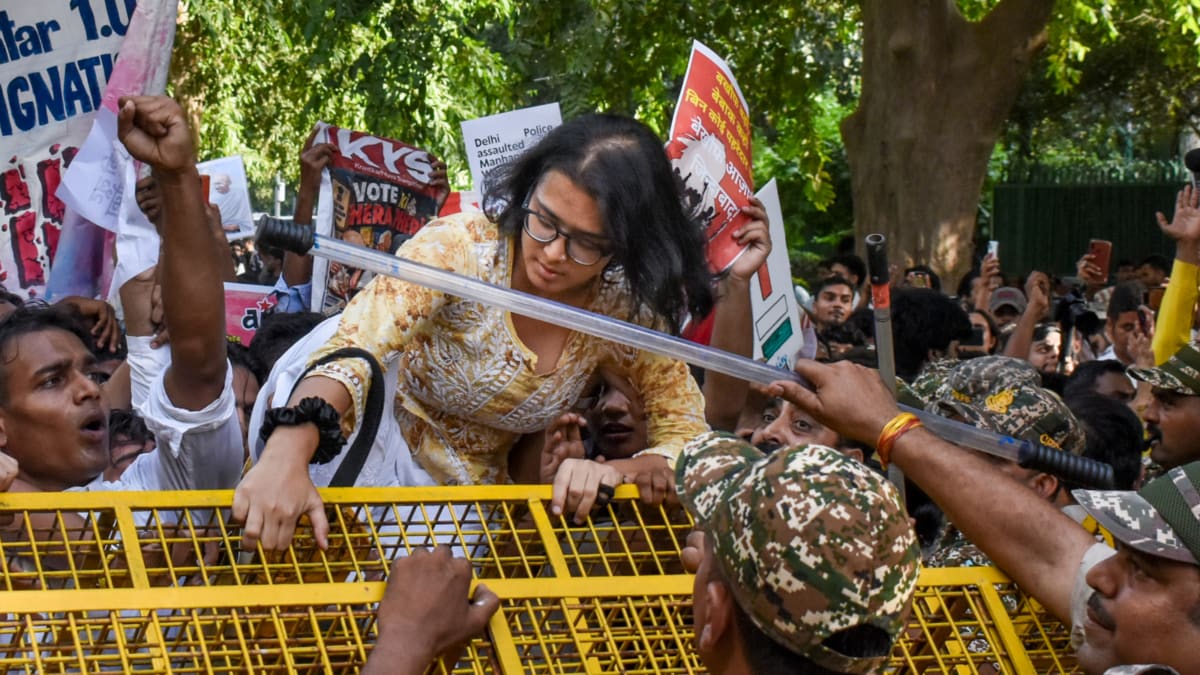
The Supreme Court heard petitions on Thursday regarding police action and alleged assaults during October 10 protests in Delhi. Solicitor General Tushar Mehta said, “In the present era of digital world, everyone with a mic is becoming an independent journalist.” The court also discussed allegations of harassment against women protesters.
Meanwhile, BJP leader Gaurav Bhatia alleged that women police officers had been “touched and manhandled inappropriately” during protests.
The Supreme Court on Thursday heard a batch of petitions concerning police action, alleged assaults on journalists and protesters, and restrictions imposed on public transport during the October 10 protests in Delhi against Chief Election Commissioner Gyanesh Kumar and the Special Intensive Revision (SIR) of electoral rolls.
During the hearing, Solicitor General Tushar Mehta raised concerns about the changing nature of journalism in the digital era, while the court addressed allegations of sexual harassment and the treatment of women during the protests. “In the present era of digital world, everyone with a mic is becoming an independent journalist, most of them are reel makers," Mehta told the court. He, however, acknowledged the need to protect women, stating, “But, we know that no woman should be sexually harassed."
The hearing also saw BJP spokesperson Gaurav Bhatia raise allegations of inappropriate conduct against women during protests. Referring to an alleged incident involving a woman journalist, Bhatia told the Supreme Court that “there was a lady journalist who was pregnant and was pushed by LoP Rahul Gandhi."
He also alleged that women police officers had been “touched and manhandled inappropriately", bringing the conduct of protesters and the treatment of women into focus during the proceedings.
The court was also informed about the allegation of sexual assault levelled by a journalist against ACP Bhagat. During the hearing, the issue of police action against the journalist came up, with the submission that there should be “no coercive action against the journalist who alleged sexual assault".
Mehta also argued that public-interest concerns should extend beyond the political class and those participating in demonstrations. “No one of these public spirited persons have thought about traders, rickshaw pullers," he said, highlighting the disruption caused to ordinary citizens and businesses by the restrictions imposed in the national capital.