
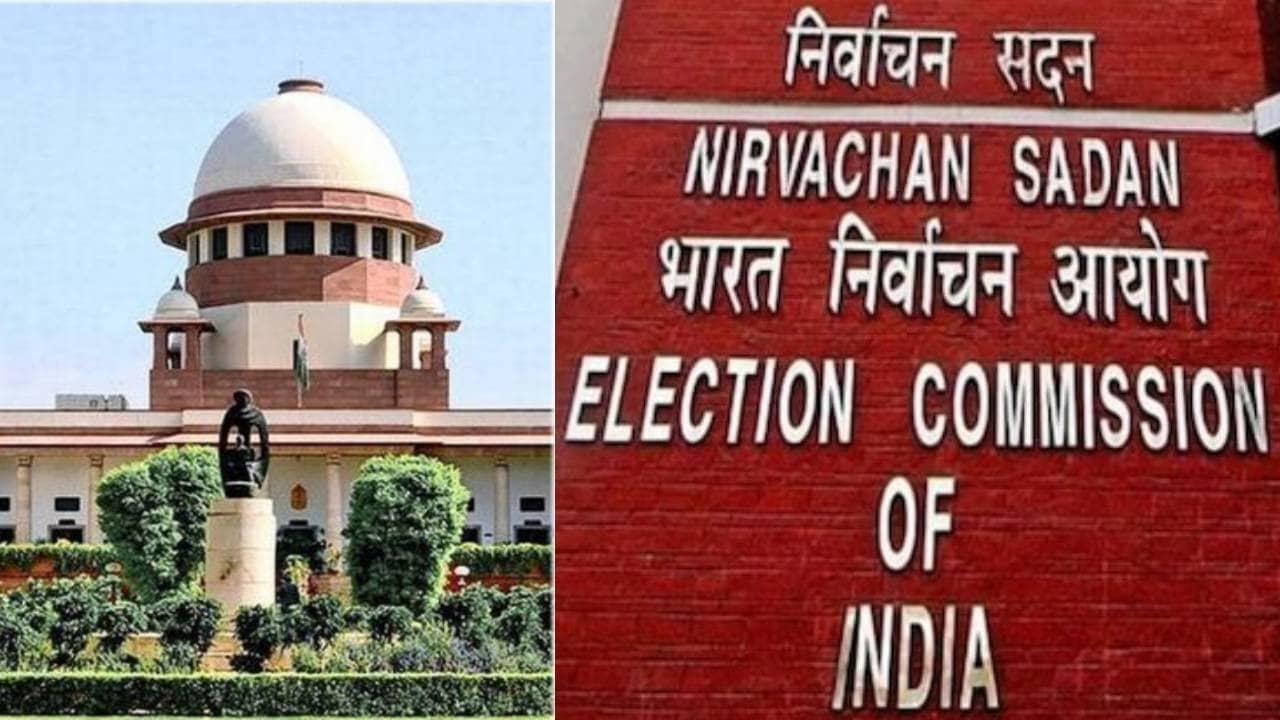
The Election Commission of India filed a 15-point counter-affidavit in the Supreme Court regarding electoral roll revisions. The poll body said Form 6 was not amended and no deletion happens without an ERO order. It showed that all three SIR orders were unanimous decisions made by the full Commission members.
ECI filed 15-point counter-affidavit in Supreme Court stating affidavit approved unanimously, all 3 SIR orders unanimous, Form 6 not amended, no addition or deletion in ECINet without ERO order.
New Delhi: The Election Commission of India (ECI), in a comprehensive counter-affidavit filed before the Supreme Court, has set out a detailed 15-point rebuttal to petitions challenging the functioning of Chief Election Commissioner (CEC) Gyanesh Kumar and the Special Intensive Revision (SIR) of electoral rolls.
The Commission has asserted that the affidavit was approved unanimously by all 3 members, comprising the CEC and both Election Commissioners, thereby rejecting insinuations of internal discord. It has further stressed that all 3 SIR orders, issued in June 2025, October 2025 and May 2026, were unanimous decisions of the full Commission and not unilateral actions.
The poll body also clarified the internal procedure, noting that notes, queries or suggestions made by the CEC or Election Commissioners while a file is under circulation do not constitute decisions of the Commission. It explained that files move first to one Election Commissioner, then to the other, and finally to the CEC, and in urgent matters approval is obtained electronically and recorded on the file later.
Form 6 Row, ECINet Safeguards And Goa Numbers Clarified
On the controversy surrounding voter registration, the Commission submitted that Form 6 has not been amended and that only the Centre has the power to amend it, while the SIR declaration is a separate document. However, it admitted that the online display could be interpreted as an amendment and stated that from October 21, the online application will be split into Form 6 and the declaration, in line with the physical form.
The Commission further stated that unmapped voters need not attend hearings, as Booth Level Officers (BLOs) will collect documents from their homes, with hearings being held only in exceptional cases and preferably through online mode.
The Commission, with regard to apprehensions over ECINet, submitted that no name is added or deleted except by order of the Electoral Registration Officer (ERO) and that a committee comprising experts from IIT and IISc has been constituted to check compliance with safeguards.
On the issue of Goa, where 97 voters were claimed to have been left out, the ECI clarified that 88 had already been enrolled, 6 were residing abroad and three held Portuguese passports.
Work Allocation Order, Bengal Appeals And Plea Against CEC
The counter-affidavit also addressed the July 28 work allocation order, stating that the order was issued by an Additional Secretary on deputation, that both Election Commissioners wrote to the Cabinet Secretary the very next day and that the order was never implemented after the joint direction issued by the two ECs on July 30.
On appeals in West Bengal against inclusion of voters, the Commission stated that the appeals were filed by officers of the Chief Electoral Officer (CEO) of West Bengal, under orders of the Supreme Court and that these matters were not brought to the Commission. It also warned that any officer issuing orders beyond delegated powers will face action.
Crucially, the Commission submitted that the plea to restrain the CEC is not maintainable, as the CEC can be removed only in the manner applicable to a Supreme Court judge. It added that the Commission never released or authorised the release of any internal note or file to the media and pointed out that repeated challenges to EVMs have already been rejected by the Supreme Court.
The filing comes after weeks of protests by Opposition parties, including the Congress, which had alleged unilateral decision-making by the CEC and irregularities in the revision exercise, allegations that the Commission has now branded as being based on a single media report.
Here's what the Election Commission said in the 15-point rebuttal in the Supreme Court:
Affidavit approved unanimously by all three members - the CEC and both Election Commissioners.
All three SIR orders - June 2025, October 2025, May 2026 - were unanimous decisions of the Commission.
Notes, queries, or suggestions made by the CEC or ECs while a file moves are not decisions of the Commission.
Files go to one EC, then the other EC, then the CEC. In urgent cases, approval is taken electronically and recorded on file later.
Any officer issuing orders beyond delegated powers will face action.
July 28 work allocation order was issued by an Additional Secretary on deputation. Both ECs wrote to the Cabinet Secretary the next day. The order was never implemented after the ECs' joint direction of July 30.
Form 6 has not been amended. Only the Centre can amend it. The SIR declaration is a separate document.
Unmapped voters need not attend hearings. BLOs will collect documents from their homes. Hearings are only in exceptional cases, preferably online.
ECINet - no name is added or deleted except by order of the ERO. A committee with experts from IIT and IISc has been set up to check compliance.
Goa - of 97 "left out" voters, 88 had already been enrolled, 6 were abroad and 3 held Portuguese passports.
West Bengal appeals against inclusion of voters were filed by officers of the CEO, West Bengal, under Supreme Court orders. "These matters were not brought to the Commission".
Plea to restrain the CEC is not maintainable. CEC can be removed only like a Supreme Court judge.
Commission never released or authorised the release of any internal note or file to the media.
Repeated challenges to EVMs already rejected by the Supreme Court.
Get Current Updates on India News, Entertainment News, Cricket Newsalong withLatest Newsand Web Storiesfrom India andaround the world.