
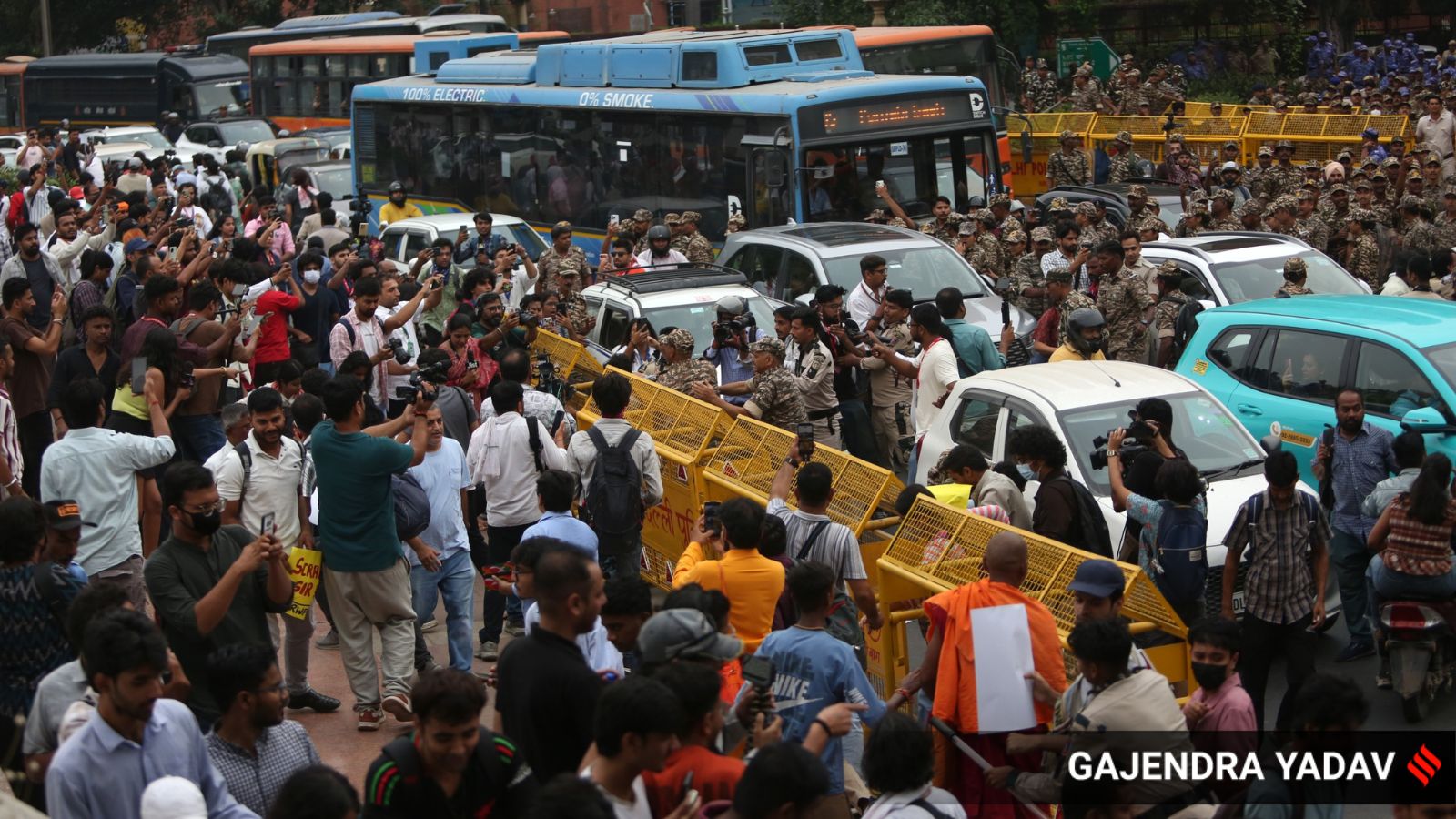
The Centre told the Supreme Court on Thursday that it is difficult to distinguish between a reel maker and an independent journalist. Solicitor General Tushar Mehta said, "We do not know who is a reel maker, and who is an independent journalist." The court is hearing petitions regarding police excesses.
The Centre on Thursday told the Supreme Court that it is difficult to distinguish between a "reel maker" and an "independent journalist". The apex court is hearing a batch of petitions related to the alleged police excesses, SIR and protests against the Election Commissioner Gyanesh Kumar.
A bench of Chief Justice of India Surya Kant and Joymalya Bagchi was hearing about 32 petitions relating to alleged police excesses, SIR and the powers of the Chief Election Commissioner and the Election Commissioners.
Appearing for the central government, Solicitor General Tushar Mehta was responding to the allegations of sexual harassment faced by women journalists at the hands of male police officers during the anti-SIR protests.
He said, "What has happened, and our experience is that there are several people who say we are freelance journalists. They have a mic, and they record things, and they upload on the.. What is going on is reel-making; that happens even at the protest site. So, we do not know who is a reel maker, and who is an independent journalist."
Mehta, however, said, "But no lady should be inappropriately dealt with, including female police personnel."
'Blanket direction'
He also expressed his reservation against a "blanket direction," which he said Jaising, including formation of a committee.
"Your lordships may examine what is done by the police. If your lordships, after that, come to the conclusion that there is nothing, they have not done enough, then your lordships have the power to do that, though I am objecting. Second, as far as no FIR against any lady journalist, that would be too wide a thing to do," he said.
On the point of the woman journalist seeking an FIR, Mehta said there will be a response filed within a short period of time. "Within a week, and we will file our response on affidavit," he said.
The CJI said it was a very serious issue and Mehta agreed. "Law must follow whatever consequences are involved."
While Mehta agreed, he requested the court not to "put the cart before the horse".
Jaising, however, questioned how the journalist could have been booked in a counter FIR under the SCST Act by "preempting" her case. "How do I protect myself?... The police are misusing the SCST Act.
A woman journalist who had accused a Delhi Police officer of alleged sexual harassment and manhandling during a protest on October 3 was booked on charges of caste-based discrimination against the same officer. Two other journalists, who also accused the officer, have been booked.
According to police, the case was lodged against the journalists based on Assistant Commissioner of Police (ACP) Vivek Bhagat's complaint.
According to the FIR, Bhagat was deployed at Buta Singh roundabout on October 3 during a protest called by AISA's Neha, demanding the removal of CEC Gyanesh Kumar.
Bhagat, in his complaint, alleged that at about 2.30 pm, a journalist, while pointing to his nameplate, identified his caste, and made caste-based derogatory remarks against him and his appointment as ACP. Bhagat claimed he belongs to the SC community.