
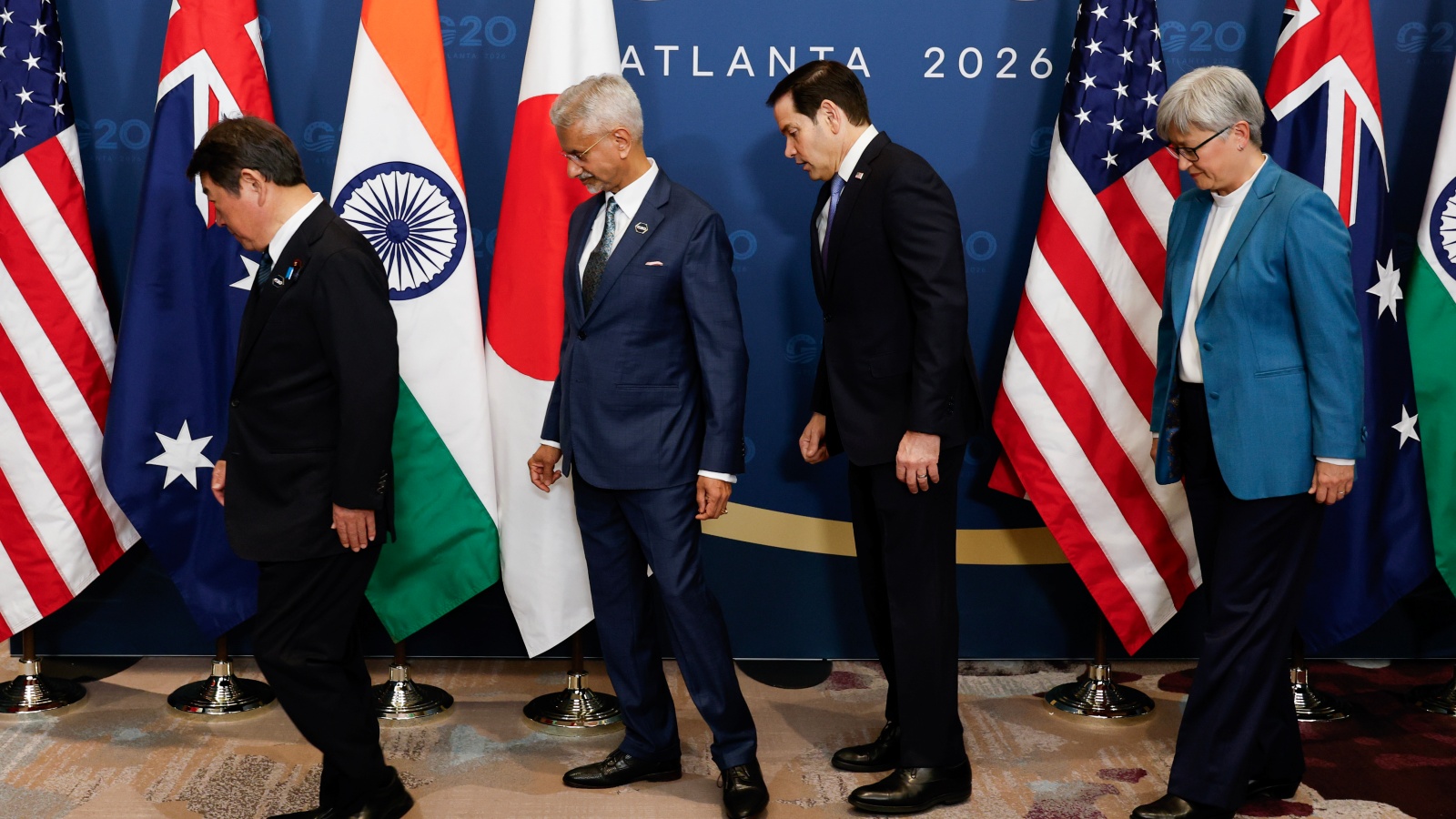
Foreign ministers at the Quad gathering in Atlanta expressed grave concern over global supply chain disruptions and economic coercion. Analysts now question if India’s deep investment in the Quad truly serves its national interests. Many wonder why India supports US-led initiatives while facing limited material help against Chinese pressure.
For a foreign policy professional covering security issues in the Indo-Pacific, the glaring differences in how the same bilateral relationship is viewed in the US and India offer plenty of room for reflection.
In the US, those who think and write about India at think tanks tend to view New Delhi with skepticism -- questioning its ability to contribute meaningfully to a conflict in Asia, its commitment to democratic norms and minority rights, and even the sustainability of its economic growth trajectory. In New Delhi, meanwhile, government officials and think tanks often seem to be the flag bearers for Washington and its initiatives.
Analysts in the Western world frequently bemoan India as the weakest link in the Quad. There has not been more ardent support for a US-led initiative in New Delhi among diplomats and think tanks alike, sometimes even at the expense of what one might consider India's own strategic and national security interests.
At the Quad gathering in Atlanta, foreign ministers expressed grave concern over global supply chain disruptions and economic coercion. Which states are causing these disruptions and engaging in acts of economic coercion? China is one. Who are the others?
Over the last few years, India has been stuck between a rock and a hard place, between Beijing and Washington. Both have used different tools of economic statecraft -- export controls and tariffs -- impacting India's security.
The apparent bromance between Donald Trump and Xi Jinping, alongside the reemergence of what increasingly resembles a G2-like world order, should at least prompt analysts in Delhi to question the strategic merits of India's investment in the Quad.
India and the US do not have common "enemies". The prospect of an expansionist China was the underlying logic for much of the US-India cooperation within the Quad. Yet while India continues to face Chinese pressure on multiple fronts from the Himalaya to gray-zone activities such as information operations targeting the Indian diaspora, where, exactly, has the US materially lent India a hand?
The Quad has developed initiatives spanning critical technologies, infrastructure, connectivity and port development, pulling India into engagements across the Indo-Pacific from the western Indian Ocean to the Pacific Islands. But for a country that struggles to meet its defense-production targets, remains heavily dependent on foreign imports for much of its military equipment, and is already stretched across its immediate maritime neighborhood, what exactly compels India to spread its limited resources across the Indo-Pacific?
New Delhi has strong bilateral relationships with both Australia and Japan, two other members of the Quad. While Japan is largely viewed positively across Asia, the same cannot necessarily be said of Australia, particularly in the Pacific. India's decision to partner with Australia in the Pacific risks looking less like an extension of India's own regional engagement and more like New Delhi leveraging the goodwill and political capital it has accumulated with Pacific Island nations for Western partners such as Australia to capitalise upon. The same dilemma extends beyond the Pacific. Whether it is Australia in the Pacific, France in West Africa, or the US in the Middle East, India's growing association with Western powers creates a difficult contradiction for New Delhi. It cannot indefinitely straddle both worlds without risking some of the credibility it has built in the Global South.
The hope or perhaps the wish that the Quad will one day evolve into an Asian NATO may or may not materialise. But India's increasingly deep cooperation with Western powers across the Global South through the Quad could come at the cost of the goodwill that New Delhi has spent decades cultivating.
you may like
This is particularly consequential because India has built a considerable reservoir of goodwill in the Global South by positioning itself as a first responder and an advocate for developing countries. New Delhi delivered vaccines when many Western countries shut their doors. It sent doctors to earthquake-affected regions. It provided relief supplies to neighboring countries, often before others could respond. And it has consistently sought to articulate the concerns of the Global South in international fora.
That diplomatic capital is not limitless. Why then would New Delhi risk spending it on a multilateral grouping whose tangible benefits to India and to Indians remain difficult to articulate? The Quad may serve important strategic objectives for Washington, Tokyo, and Canberra. But that does not necessarily mean that those objectives are identical to India's. Perhaps the more fundamental question for New Delhi is not whether the Quad is good or bad, but whether India's participation in it is advancing Indian interests or increasingly serving the strategic priorities of others.