
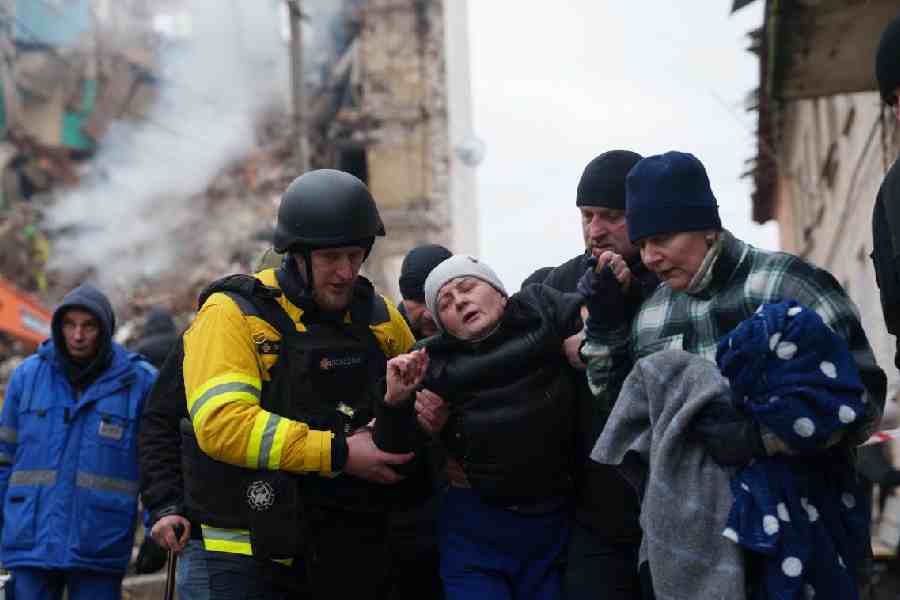
India drew a parallel between the Ukraine war and the 1943 Bengal famine at the UN Security Council. Parvathaneni said, "The costs of conflict are not shared equally." He warned that global supply chain disruptions hit developing nations hardest, causing severe food and fuel shortages that threaten millions of lives.
India tells Security Council that disruptions to Black Sea grain shipments, energy supplies and commercial shipping are placing the Global South at disproportionate risk
India has drawn a parallel between the ongoing Ukraine war and the 1943 Bengal famine at the United Nations Security Council (UNSC), warning that the fallout of armed conflicts falls disproportionately on developing nations and can have devastating consequences for food security.
"The costs of conflict are not shared equally," Parvathaneni said, stressing that developing countries were bearing the heaviest burden of the resulting shortages.
He cited the Bengal famine of 1943, which claimed more than three million lives, as a grim example of how wartime decisions and priorities can produce catastrophic humanitarian consequences far beyond the battlefield.
The ambassador was speaking at a briefing titled 'Protecting critical energy infrastructure and Black Sea lifelines of global food supply'. He warned that the effects of the Ukraine conflict, now in its fifth year, had spread well beyond the countries directly involved, with interconnected global supply chains transmitting its impact worldwide.
"Global South countries are the most adversely affected by the food, fuel, and fertiliser crisis caused by today's global conflicts," he added.
Parvathaneni also reiterated New Delhi's support for a peaceful settlement, invoking Prime Minister Narendra Modi's call for the world to move away from prolonged conflict and towards lasting peace.
Reaffirming India's willingness to support diplomatic efforts to end the war, he said Modi had consistently underscored that "this is not an era of war" and had stood firmly with the concerns of the Global South.
India noted with concern that conflicts exacerbate food insecurity by disrupting agriculture, displacing communities, damaging infrastructure and hindering humanitarian access.
Their consequences extend globally through disruptions to energy, fertiliser supplies, transport and agricultural trade, disproportionately affecting the Global South.
"For the Global South, peace is not in the abstract. It is achieved when hungry mouths are fed, when a ship reaches a port, and when a seafarer returns home safe," Parvathaneni said.
India called on the Security Council to prioritise humanitarian access, protection of civilian infrastructure and freedom of navigation, ensuring that humanitarian supplies and legitimate trade remain unaffected.
"For India, this is why dialogue and diplomacy, safe commercial shipping and uninterrupted grain and energy flows are practical necessities," he said.
"This current situation is not different from the time of the Second World War, when peoples not responsible for the start of the conflict became their unintended collateral damage," he added.
"The pain and suffering caused by the devastating Bengal famine of 1943 in India that killed over 3 million people in India, is a stark reminder of the terrible human cost of a distant conflict caused by unchecked wartime priorities and calculations," Parvathaneni said.
"It is precisely because of these harsh consequences that India attaches such importance to preventing food insecurity," he said.
Parvathaneni said India's commitment to protecting Black Sea lifelines and global food supplies was rooted in the recognition that the region, like India, was one of the world's major food baskets.
He noted that the Black Sea region and India together account for nearly a fifth of global cereal production, while Russia and Ukraine account for almost a quarter of global exports of wheat, maize and barley.
"Their importance to global food security underscores how disruptions to agricultural production, maritime connectivity, and international trade can have consequences far beyond the immediate regions affected," he said.
He highlighted India's humanitarian assistance, including wheat supplies to Afghanistan, rice to Sudan and aid to Palestine, as an example of its commitment to global food supply chains.
India also expressed concern over merchant vessels and their crews increasingly coming under attack in global conflicts, citing incidents in which Indian seafarers had lost their lives.
"We call for an end to the targeting of commercial shipping and seafarers, and for safe navigation through international waterways to be restored at the earliest," Parvathaneni said.
He recalled that India and Liberia had launched the Group of Friends on Safety and Security of Shipping and Seafarers during the UN high-level week in September.
UN Under-Secretary-General for Political and Peacebuilding Affairs Rosemary DiCarlo warned that attacks on energy infrastructure were more extensive than during the corresponding period last year, disrupting heating, electricity and water supplies.
She also expressed concern over continued drone attacks in the Black Sea, threatening civilian navigation and disrupting food exports.
World Food Programme (WFP) Executive Director Luke Lindberg, briefing via video conference, warned that Black Sea food shipments had fallen sharply despite grain remaining available.
He said around 10 million tonnes of Russian and Ukrainian wheat, enough to feed 44 million people, may not reach global markets this year.
Lindberg urged member states to rally around three "red lines": no more famines, no more weaponisation of food and no more attacks on humanitarians.
UN Development Programme (UNDP) Administrator Alexander De Croo said the agency was working with national and local authorities in Ukraine to restore power and essential services ahead of winter, while laying the foundations for longer-term recovery.